nystatin oral
e069d495-7f1a-4970-8f4d-aa93d124b3fc
34391-3
HUMAN PRESCRIPTION DRUG LABEL
Drug Facts
Composition & Product
Identifiers & Packaging
Indications and Usage
Nystatin Oral Suspension is indicated for the treatment of candidiasis in the oral cavity.
Dosage and Administration
INFANTS: 2 mL (200,000 units) four times daily (in infants and young children, use dropper to place one-half of dose in each side of mouth and avoid feeding for 5 to 10 minutes). NOTE: Limited clinical studies in premature and low birth weight infants indicate that 1 mL four times daily is effective. CHILDREN AND ADULTS: 4–6 mL (400,000 to 600,000 units) four times daily (one-half of dose in each side of mouth). The preparation should be retained in the mouth as long as possible before swallowing. Continue treatment for at least 48 hours after perioral symptoms have disappeared and cultures demonstrate eradication of Candida albicans.
Contraindications
The preparation is contraindicated in patients with a history of hypersensitivity to any of its components.
Adverse Reactions
Nystatin is well tolerated even with prolonged therapy. Oral irritation and sensitization have been reported. (See PRECAUTIONS: General ). Gastrointestinal: Diarrhea (including one case of bloody diarrhea), nausea, vomiting, gastrointestinal upset/disturbances. Dermatologic: Rash, including urticaria has been reported rarely. Stevens-Johnson syndrome has been reported very rarely. Other: Tachycardia, bronchospasm, facial swelling, and non-specific myalgia have also been rarely reported.
How Supplied
Product: 50090-1740 NDC: 50090-1740-0 60 mL in a BOTTLE, GLASS
Description
(100,000 units per mL) Rx only
Medication Information
Indications and Usage
Nystatin Oral Suspension is indicated for the treatment of candidiasis in the oral cavity.
Dosage and Administration
INFANTS: 2 mL (200,000 units) four times daily (in infants and young children, use dropper to place one-half of dose in each side of mouth and avoid feeding for 5 to 10 minutes).
NOTE: Limited clinical studies in premature and low birth weight infants indicate that 1 mL four times daily is effective.
CHILDREN AND ADULTS: 4–6 mL (400,000 to 600,000 units) four times daily (one-half of dose in each side of mouth). The preparation should be retained in the mouth as long as possible before swallowing.
Continue treatment for at least 48 hours after perioral symptoms have disappeared and cultures demonstrate eradication of Candida albicans.
Contraindications
The preparation is contraindicated in patients with a history of hypersensitivity to any of its components.
Adverse Reactions
Nystatin is well tolerated even with prolonged therapy. Oral irritation and sensitization have been reported. (See PRECAUTIONS: General ).
Gastrointestinal: Diarrhea (including one case of bloody diarrhea), nausea, vomiting, gastrointestinal upset/disturbances.
Dermatologic: Rash, including urticaria has been reported rarely. Stevens-Johnson syndrome has been reported very rarely.
Other: Tachycardia, bronchospasm, facial swelling, and non-specific myalgia have also been rarely reported.
How Supplied
Product: 50090-1740
NDC: 50090-1740-0 60 mL in a BOTTLE, GLASS
Description
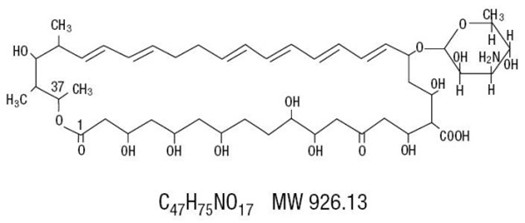
Nystatin is an antimycotic polyene antibiotic obtained from Streptomyces noursei. Structural formula:
Nystatin Oral Suspension, for oral administration, contains 100,000 USP Nystatin Units per mL. Inactive ingredients: alcohol (≤ 1% v/v), artificial wild cherry flavor, banana flavor, D&C yellow #10, FD&C red #40, glycerin, USP, magnesium aluminum silicate, methylparaben, NF, potassium phosphate dibasic, USP, propylene glycol, USP, propylparaben, NF, purified water, USP and sucrose 33.5%. May also contain citric acid, USP for pH adjustment.
Section 42229-5
(100,000 units per mL)
Rx only
General
This medication is not to be used for the treatment of systemic mycoses. Discontinue treatment if sensitization or irritation is reported during use.
Nystatin
Overdosage
Oral doses of nystatin in excess of five million units daily have caused nausea and gastrointestinal upset. There have been no reports of serious toxic effects of superinfections (see CLINICAL PHARMACOLOGY, Pharmacokinetics ).
Microbiology
Nystatin is both fungistatic and fungicidal in vitro against a wide variety of yeasts and yeast-like fungi. Candida albicans demonstrates no significant resistance to nystatin in vitro on repeated subculture in increasing levels of nystatin; other Candida species become quite resistant. Generally, resistance does not develop in vivo. Nystatin acts by binding to sterols in the cell membrane of susceptible Candida species with a resultant change in membrane permeability allowing leakage of intracellular components. Nystatin exhibits no appreciable activity against bacteria, protozoa, or viruses.
Pediatric Use
Nursing Mothers
It is not known whether nystatin is excreted in human milk. Because many drugs are excreted in human milk, caution should be exercised when nystatin is administered to a nursing woman.
Pharmacokinetics
Gastrointestinal absorption of nystatin is insignificant. Most orally administered nystatin is passed unchanged in the stool. In patients with renal insufficiency receiving oral therapy with conventional dosage forms, significant plasma concentrations of nystatin may occasionally occur.
Teratogenic Effects Category C
Animal reproduction studies have not been conducted with nystatin oral suspension. It is also not known whether nystatin oral suspension can cause fetal harm when administered to a pregnant woman or can affect reproduction capacity. Nystatin oral suspension should be given to a pregnant woman only if clearly needed.
Carcinogenesis, Mutagenesis, Impairment of Fertility
No long-term animal studies have been performed to evaluate carcinogenic potential. There also have been no studies to determine mutagenicity or whether this medication affects fertility in males or females.
Structured Label Content
Indications and Usage (INDICATIONS AND USAGE)
Nystatin Oral Suspension is indicated for the treatment of candidiasis in the oral cavity.
Dosage and Administration (DOSAGE AND ADMINISTRATION)
INFANTS: 2 mL (200,000 units) four times daily (in infants and young children, use dropper to place one-half of dose in each side of mouth and avoid feeding for 5 to 10 minutes).
NOTE: Limited clinical studies in premature and low birth weight infants indicate that 1 mL four times daily is effective.
CHILDREN AND ADULTS: 4–6 mL (400,000 to 600,000 units) four times daily (one-half of dose in each side of mouth). The preparation should be retained in the mouth as long as possible before swallowing.
Continue treatment for at least 48 hours after perioral symptoms have disappeared and cultures demonstrate eradication of Candida albicans.
Contraindications (CONTRAINDICATIONS)
The preparation is contraindicated in patients with a history of hypersensitivity to any of its components.
Adverse Reactions (ADVERSE REACTIONS)
Nystatin is well tolerated even with prolonged therapy. Oral irritation and sensitization have been reported. (See PRECAUTIONS: General ).
Gastrointestinal: Diarrhea (including one case of bloody diarrhea), nausea, vomiting, gastrointestinal upset/disturbances.
Dermatologic: Rash, including urticaria has been reported rarely. Stevens-Johnson syndrome has been reported very rarely.
Other: Tachycardia, bronchospasm, facial swelling, and non-specific myalgia have also been rarely reported.
How Supplied (HOW SUPPLIED)
Product: 50090-1740
NDC: 50090-1740-0 60 mL in a BOTTLE, GLASS
Description (DESCRIPTION)
Nystatin is an antimycotic polyene antibiotic obtained from Streptomyces noursei. Structural formula:
Nystatin Oral Suspension, for oral administration, contains 100,000 USP Nystatin Units per mL. Inactive ingredients: alcohol (≤ 1% v/v), artificial wild cherry flavor, banana flavor, D&C yellow #10, FD&C red #40, glycerin, USP, magnesium aluminum silicate, methylparaben, NF, potassium phosphate dibasic, USP, propylene glycol, USP, propylparaben, NF, purified water, USP and sucrose 33.5%. May also contain citric acid, USP for pH adjustment.
Section 42229-5 (42229-5)
(100,000 units per mL)
Rx only
General
This medication is not to be used for the treatment of systemic mycoses. Discontinue treatment if sensitization or irritation is reported during use.
Nystatin
Overdosage (OVERDOSAGE)
Oral doses of nystatin in excess of five million units daily have caused nausea and gastrointestinal upset. There have been no reports of serious toxic effects of superinfections (see CLINICAL PHARMACOLOGY, Pharmacokinetics ).
Microbiology
Nystatin is both fungistatic and fungicidal in vitro against a wide variety of yeasts and yeast-like fungi. Candida albicans demonstrates no significant resistance to nystatin in vitro on repeated subculture in increasing levels of nystatin; other Candida species become quite resistant. Generally, resistance does not develop in vivo. Nystatin acts by binding to sterols in the cell membrane of susceptible Candida species with a resultant change in membrane permeability allowing leakage of intracellular components. Nystatin exhibits no appreciable activity against bacteria, protozoa, or viruses.
Pediatric Use
Nursing Mothers
It is not known whether nystatin is excreted in human milk. Because many drugs are excreted in human milk, caution should be exercised when nystatin is administered to a nursing woman.
Pharmacokinetics
Gastrointestinal absorption of nystatin is insignificant. Most orally administered nystatin is passed unchanged in the stool. In patients with renal insufficiency receiving oral therapy with conventional dosage forms, significant plasma concentrations of nystatin may occasionally occur.
Teratogenic Effects Category C
Animal reproduction studies have not been conducted with nystatin oral suspension. It is also not known whether nystatin oral suspension can cause fetal harm when administered to a pregnant woman or can affect reproduction capacity. Nystatin oral suspension should be given to a pregnant woman only if clearly needed.
Carcinogenesis, Mutagenesis, Impairment of Fertility
No long-term animal studies have been performed to evaluate carcinogenic potential. There also have been no studies to determine mutagenicity or whether this medication affects fertility in males or females.
Advanced Ingredient Data
Raw Label Data
All Sections (JSON)
Additional Information
Back to search View SPL set listing Open on DailyMed ↗
Source: dailymed · Ingested: 2026-02-15T11:37:51.950768 · Updated: 2026-03-14T21:52:14.420915