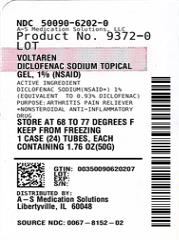
voltaren arthritis pain
de6519b6-1165-4ee3-aad0-97439a3768bb
34390-5
HUMAN OTC DRUG LABEL
Drug Facts
Composition & Product
Identifiers & Packaging
Purpose
Arthritis pain reliever
How Supplied
Product: 50090-6202 NDC: 50090-6202-0 50 g in a TUBE / 24 in a CASE
Description
Diclofenac sodium (NSAID*) 1% (equivalent to 0.93% diclofenac) *nonsteroidal anti-inflammatory drug
Medication Information
Warnings
For external use only
Allergy alert:Diclofenac may cause a severe allergic reaction, especially in people allergic to aspirin.
Symptoms may include:
- hives
- asthma (wheezing)
- skin reddening
- blisters
- facial swelling
- shock
- rash
If an allergic reaction occurs, stop use and seek medical help right away.
Liver warning:This product contains diclofenac. Liver damage may occur if you apply
- more or for a longer time than directed
- when using other drugs containing diclofenac
Stomach bleeding warning:This product contains an NSAID, which may cause severe stomach bleeding. The chance is small but higher if you
- are age 60 or older
- have had stomach ulcers or bleeding problems
- take a blood thinning (anticoagulant) or steroid drug
- take other drugs containing prescription or nonprescription NSAIDs (aspirin, ibuprofen, naproxen, or others)
- have 3 or more alcoholic drinks every day while using this product
- apply more or for longer than directed
Heart attack and stroke warning:NSAIDs, except aspirin, increase the risk of heart attack, heart failure, and stroke. These can be fatal. The risk is higher if you use more than directed or for longer than directed.
Uses
- for the temporary relief of arthritis pain
ONLY inthe following areas:
- hand, wrist, elbow (upper body areas)
- foot, ankle, knee (lower body areas)
- this product may take up to 7 days to work for arthritis pain; it is not for immediate relief. If no pain relief in 7 days, stop use.
Purpose
Arthritis pain reliever
Directions
Use up to 21 days unless directed by your doctor
Not for strains, sprains, bruises, or sports injuries. This product has not been shown to work for these types of injuries.
|
Daily |
Per Dose |
|
For your arthritis pain:
|
Use ENCLOSED DOSING CARD to measure a dose
|
Other Information
- store at 20-25°C (68-77°F). Keep from freezing.
- read all product information before using. Keep the dosing card, this carton and accompanying User Guide for important information.
Inactive Ingredients
carbomer homopolymer Type C, cocoyl caprylocaprate, fragrance, isopropyl alcohol, mineral oil, polyoxyl 20 cetostearyl ether, propylene glycol, purified water, strong ammonia solution
How Supplied
Product: 50090-6202
NDC: 50090-6202-0 50 g in a TUBE / 24 in a CASE
Description
Diclofenac sodium (NSAID*) 1% (equivalent to 0.93% diclofenac) *nonsteroidal anti-inflammatory drug
Section 42229-5
Additional Information
ORIGINAL PRESCRIPTION STRENGTH
Medicated Gel Clinically Proven to Relieve Arthritis Pain
TREATMENT AREAS
- Hand Wrist Elbow Foot Ankle Knee
- Not for use on any other body area (such as back, hip, or shoulder)
TREATMENT AREAS
Use Enclosed Dosing Card to Measure a Dose
Voltaren ARTHRITIS PAIN
diclofenac sodium topical gel, 1% (NSAID) – arthritis pain reliever
Dosing Card (NOT ACTUAL SIZE)
Read product User Guide before use
Not for immediate pain relief
Upper body dose2.25 inches long (2 grams)
Lower body dose4.5 inches long (4 grams)
How to Use
- For arthritis pain only
- Use 4 times a day
- May take up to 7 days to work for your arthritis pain
- For use on no more than 2 body areas
- Use up to 21 days unless directed by your doctor
- Tamper evident statement: Do not use if safety seal on tube nozzle is broken or missing.
Do Not Use
- if you have ever had an allergic reaction to any other pain reliever or to a fever reducer
- for strains, sprains, bruises or sports injuries. This product has not been shown to work for these types of injuries.
- right before or after heart surgery
- on more than 2 body areas at the same time
- in the eyes, nose or mouth
Medication Guide
Medication Guide for Nonsteroidal Anti-Inflammatory Drugs (NSAIDs)
What is the most important information I should know about medicines called Nonsteroidal Anti-Inflammatory Drugs (NSAIDs)?
NSAIDs can cause serious side effects, including:
-
•Increased risk of a heart attack or stroke that can lead to death. This risk may happen early in treatment and may increase:
-
owith increasing doses of NSAIDs
-
owith longer use of NSAIDs
-
Do not take NSAIDs right before or after a heart surgery called a “coronary artery bypass graft (CABG).”
Avoid taking NSAIDs after a recent heart attack, unless your healthcare provider tells you to. You may have an increased risk of another heart attack if you take NSAIDs after a recent heart attack.
-
•Increased risk of bleeding, ulcers, and tears (perforation) of the esophagus (tube leading from the mouth to the stomach), stomach and intestines:
-
oanytime during use
-
owithout warning symptoms
-
othat may cause death
-
The risk of getting an ulcer or bleeding increases with:
-
-
opast history of stomach ulcers, or stomach or intestinal bleeding with use of NSAIDs
-
otaking medicines called “corticosteroids”, “anticoagulants”, “SSRIs”, or “SNRIs
-
oincreasing doses of NSAIDs
-
oolder age
-
olonger use of NSAID
-
opoor health
-
osmoking
-
oadvanced liver problems
-
odrinking alcohol
-
obleeding problems
-
NSAIDs should only be used:
-
-
oexactly as prescribed
-
oat the lowest dose possible for your treatment
-
ofor the shortest time needed
-
What are NSAIDs?
NSAIDs are used to treat pain and redness, swelling, and heat (inflammation) from medical conditions such as different types of arthritis, menstrual cramps, and other types of short-term pain
Who should not take NSAIDs?
Do not take NSAIDs :
-
•if you had an asthma attack, hives, or other allergic reaction with aspirin or any other NSAIDs
-
•right before or after heart bypass surgery
Before taking NSAIDs, tell your healthcare provider about all of your medical conditions, including if you:
-
•have liver or kidney problems
-
•have high blood pressure
-
•have asthma
-
•are pregnant or plan to become pregnant. Talk to your healthcare provider if you are considering taking NSAIDs during pregnancy. You should not take NSAIDs after 29 weeks of pregnancy.
-
•Are breastfeeding or plan to breast feed
Tell your healthcare provider all of the medicines you take, including prescription or over-the-counter medicines, vitamins or herbal supplements. NSAIDs and some other medicines can interact with each other and cause serious side effects. Do not start taking any new medicine without talking to your healthcare provider first.
What are the possible side effects of NSAIDs?
NSAIDs can cause serious side effects, including:
See “What is the most important information I should know about medicines called Nonsteroidal Anti-inflammatory Drugs (NSAIDs)?”
-
•new or worse high blood pressure
-
•heart failure
-
•liver problems including liver failure
-
•kidney problems including kidney failure
-
•low red blood cells (anemia)
-
•life-threatening skin reactions
-
•life-threatening allergic reactions
-
•Other side effects of NSAIDs include: stomach pain, constipation, diarrhea, gas, heartburn, nausea, vomiting, and dizziness.
Get emergency help right away if you have any of the following symptoms:
-
•shortness of breath or trouble breathing
-
•slurred speech
-
•chest pain
-
•swelling of the face or throat
-
•weakness in one part or side of your body
Stop taking your NSAID and call your healthcare provider right away if you get any of the following symptoms:
-
•nausea
-
•vomit blood
-
•more tired or weaker than usual
-
•there is blood in your bowel movement or it is black and sticky like tar
-
•diarrhea
-
•itching
-
•unusual weight gain
-
•your skin or eyes look yellow
-
•skin rash or blisters with fever
-
•indigestion or stomach pain
-
•swelling of the arms, legs, hands and feet
-
•flu-like symptoms
If you take too much of your NSAID, call your healthcare provider or get medical help right away.
These are not all the possible side effects of NSAIDs. For more information, ask your healthcare provider or pharmacist about NSAIDs.
Call your doctor for medical advice about side effects. You may report side effects to FDA at 1-800-FDA-1088.
Other information about NSAIDs
-
•Aspirin is an NSAID but it does not increase the chance of a heart attack. Aspirin can cause bleeding in the brain, stomach, and intestines. Aspirin can also cause ulcers in the stomach and intestines.
-
•Some NSAIDs are sold in lower doses without a prescription (over-the-counter). Talk to your healthcare provider before using over-the-counter NSAIDs for more than 10 days.
General Information about the safe and effective use of NSAIDs
Medicines are sometimes prescribed for purposes other than those listed in a Medication Guide. Do not use NSAIDs for a condition for which it was not prescribed. Do not give NSAIDs to other people, even if they have the same symptoms that you have. It may harm them.
If you would like more information about NSAIDs, talk with your healthcare provider. You can ask your pharmacist or healthcare provider for information about NSAIDs that is written for health professionals.
This Medication Guide has been approved by the U.S. Food and Drug Administration.
Marketed by:
-
Endo Pharmaceuticals Inc., Malvern, PA 19355
Manufactured by:
Novartis Pharma Produktions GmbH,
Wehr, Germany for
Sandoz Inc., Princeton, NJ 08540
Revised: April 2016
Active Ingredient
Diclofenac sodium (NSAID*) 1% (equivalent to 0.93% diclofenac)
*nonsteroidal anti-inflammatory drug
Diclofenac Sodium
Questions Or Comments?
1-855-297-3031 www.voltarengel.com
When Using This Product
- avoid contact with eyes, nose, or mouth
- if eye contact occurs, rinse thoroughly with water
Ask A Doctor Before Use If
- you have problems or serious side effects from taking pain relievers or fever reducers
- stomach bleeding warning applies to you
- you have a history of stomach problems, such as heartburn
- you have high blood pressure, heart disease, liver cirrhosis, kidney disease, asthma, or had a stroke
- you are taking a diuretic
- you are under age 18 years. It is not known if this drug works or is safe in children under age 18 years.
Read the Enclosed User Guide
- use only as directed
- do not use more than directed or for longer than directed
- apply only to clean, dry skin that does not have any cuts, open wounds, infections or rashes
- do not apply in same area as any other product
- do not apply with external heat such as heating pad
- do not apply a bandage over the treated area
- store ENCLOSED DOSING CARD with your Voltaren Arthritis Pain. The dosing card is
re-usable.
Stop Use and Ask A Doctor If
- pain gets worse or lasts more than 21 days
- redness or swelling is present in the painful area
- fever occurs
- skin irritation occurs
- any new symptoms appear. These could be signs of a serious condition.
- you experience any of the following signs of stomach bleeding:
- feel faint
- have bloody or black stools
- vomit blood
- have stomach pain that does not get better
- you have symptoms of heart problems or stroke:
- chest pain
- trouble breathing
- leg swelling
- weakness in one part or side of body
- slurred speech
If Pregnant Or Breast Feeding,
ask a health professional before use. It is especially important not to use diclofenac at 20 weeks or later in pregnancy unless definitely directed to do so by a doctor because it may cause problems in the unborn child or complications during delivery.
Ask A Doctor Or Pharmacist Before Use If You Are
- under a doctor’s care for any serious condition
- taking any other drug
Structured Label Content
Warnings
For external use only
Allergy alert:Diclofenac may cause a severe allergic reaction, especially in people allergic to aspirin.
Symptoms may include:
- hives
- asthma (wheezing)
- skin reddening
- blisters
- facial swelling
- shock
- rash
If an allergic reaction occurs, stop use and seek medical help right away.
Liver warning:This product contains diclofenac. Liver damage may occur if you apply
- more or for a longer time than directed
- when using other drugs containing diclofenac
Stomach bleeding warning:This product contains an NSAID, which may cause severe stomach bleeding. The chance is small but higher if you
- are age 60 or older
- have had stomach ulcers or bleeding problems
- take a blood thinning (anticoagulant) or steroid drug
- take other drugs containing prescription or nonprescription NSAIDs (aspirin, ibuprofen, naproxen, or others)
- have 3 or more alcoholic drinks every day while using this product
- apply more or for longer than directed
Heart attack and stroke warning:NSAIDs, except aspirin, increase the risk of heart attack, heart failure, and stroke. These can be fatal. The risk is higher if you use more than directed or for longer than directed.
Uses
- for the temporary relief of arthritis pain
ONLY inthe following areas:
- hand, wrist, elbow (upper body areas)
- foot, ankle, knee (lower body areas)
- this product may take up to 7 days to work for arthritis pain; it is not for immediate relief. If no pain relief in 7 days, stop use.
Purpose
Arthritis pain reliever
Directions
Use up to 21 days unless directed by your doctor
Not for strains, sprains, bruises, or sports injuries. This product has not been shown to work for these types of injuries.
|
Daily |
Per Dose |
|
For your arthritis pain:
|
Use ENCLOSED DOSING CARD to measure a dose
|
Other Information (Other information)
- store at 20-25°C (68-77°F). Keep from freezing.
- read all product information before using. Keep the dosing card, this carton and accompanying User Guide for important information.
Inactive Ingredients (Inactive ingredients)
carbomer homopolymer Type C, cocoyl caprylocaprate, fragrance, isopropyl alcohol, mineral oil, polyoxyl 20 cetostearyl ether, propylene glycol, purified water, strong ammonia solution
How Supplied (HOW SUPPLIED)
Product: 50090-6202
NDC: 50090-6202-0 50 g in a TUBE / 24 in a CASE
Section 42229-5 (42229-5)
Additional Information
ORIGINAL PRESCRIPTION STRENGTH
Medicated Gel Clinically Proven to Relieve Arthritis Pain
TREATMENT AREAS
- Hand Wrist Elbow Foot Ankle Knee
- Not for use on any other body area (such as back, hip, or shoulder)
TREATMENT AREAS
Use Enclosed Dosing Card to Measure a Dose
Voltaren ARTHRITIS PAIN
diclofenac sodium topical gel, 1% (NSAID) – arthritis pain reliever
Dosing Card (NOT ACTUAL SIZE)
Read product User Guide before use
Not for immediate pain relief
Upper body dose2.25 inches long (2 grams)
Lower body dose4.5 inches long (4 grams)
How to Use
- For arthritis pain only
- Use 4 times a day
- May take up to 7 days to work for your arthritis pain
- For use on no more than 2 body areas
- Use up to 21 days unless directed by your doctor
- Tamper evident statement: Do not use if safety seal on tube nozzle is broken or missing.
Do Not Use (Do not use)
- if you have ever had an allergic reaction to any other pain reliever or to a fever reducer
- for strains, sprains, bruises or sports injuries. This product has not been shown to work for these types of injuries.
- right before or after heart surgery
- on more than 2 body areas at the same time
- in the eyes, nose or mouth
Medication Guide
Medication Guide for Nonsteroidal Anti-Inflammatory Drugs (NSAIDs)
What is the most important information I should know about medicines called Nonsteroidal Anti-Inflammatory Drugs (NSAIDs)?
NSAIDs can cause serious side effects, including:
-
•Increased risk of a heart attack or stroke that can lead to death. This risk may happen early in treatment and may increase:
-
owith increasing doses of NSAIDs
-
owith longer use of NSAIDs
-
Do not take NSAIDs right before or after a heart surgery called a “coronary artery bypass graft (CABG).”
Avoid taking NSAIDs after a recent heart attack, unless your healthcare provider tells you to. You may have an increased risk of another heart attack if you take NSAIDs after a recent heart attack.
-
•Increased risk of bleeding, ulcers, and tears (perforation) of the esophagus (tube leading from the mouth to the stomach), stomach and intestines:
-
oanytime during use
-
owithout warning symptoms
-
othat may cause death
-
The risk of getting an ulcer or bleeding increases with:
-
-
opast history of stomach ulcers, or stomach or intestinal bleeding with use of NSAIDs
-
otaking medicines called “corticosteroids”, “anticoagulants”, “SSRIs”, or “SNRIs
-
oincreasing doses of NSAIDs
-
oolder age
-
olonger use of NSAID
-
opoor health
-
osmoking
-
oadvanced liver problems
-
odrinking alcohol
-
obleeding problems
-
NSAIDs should only be used:
-
-
oexactly as prescribed
-
oat the lowest dose possible for your treatment
-
ofor the shortest time needed
-
What are NSAIDs?
NSAIDs are used to treat pain and redness, swelling, and heat (inflammation) from medical conditions such as different types of arthritis, menstrual cramps, and other types of short-term pain
Who should not take NSAIDs?
Do not take NSAIDs :
-
•if you had an asthma attack, hives, or other allergic reaction with aspirin or any other NSAIDs
-
•right before or after heart bypass surgery
Before taking NSAIDs, tell your healthcare provider about all of your medical conditions, including if you:
-
•have liver or kidney problems
-
•have high blood pressure
-
•have asthma
-
•are pregnant or plan to become pregnant. Talk to your healthcare provider if you are considering taking NSAIDs during pregnancy. You should not take NSAIDs after 29 weeks of pregnancy.
-
•Are breastfeeding or plan to breast feed
Tell your healthcare provider all of the medicines you take, including prescription or over-the-counter medicines, vitamins or herbal supplements. NSAIDs and some other medicines can interact with each other and cause serious side effects. Do not start taking any new medicine without talking to your healthcare provider first.
What are the possible side effects of NSAIDs?
NSAIDs can cause serious side effects, including:
See “What is the most important information I should know about medicines called Nonsteroidal Anti-inflammatory Drugs (NSAIDs)?”
-
•new or worse high blood pressure
-
•heart failure
-
•liver problems including liver failure
-
•kidney problems including kidney failure
-
•low red blood cells (anemia)
-
•life-threatening skin reactions
-
•life-threatening allergic reactions
-
•Other side effects of NSAIDs include: stomach pain, constipation, diarrhea, gas, heartburn, nausea, vomiting, and dizziness.
Get emergency help right away if you have any of the following symptoms:
-
•shortness of breath or trouble breathing
-
•slurred speech
-
•chest pain
-
•swelling of the face or throat
-
•weakness in one part or side of your body
Stop taking your NSAID and call your healthcare provider right away if you get any of the following symptoms:
-
•nausea
-
•vomit blood
-
•more tired or weaker than usual
-
•there is blood in your bowel movement or it is black and sticky like tar
-
•diarrhea
-
•itching
-
•unusual weight gain
-
•your skin or eyes look yellow
-
•skin rash or blisters with fever
-
•indigestion or stomach pain
-
•swelling of the arms, legs, hands and feet
-
•flu-like symptoms
If you take too much of your NSAID, call your healthcare provider or get medical help right away.
These are not all the possible side effects of NSAIDs. For more information, ask your healthcare provider or pharmacist about NSAIDs.
Call your doctor for medical advice about side effects. You may report side effects to FDA at 1-800-FDA-1088.
Other information about NSAIDs
-
•Aspirin is an NSAID but it does not increase the chance of a heart attack. Aspirin can cause bleeding in the brain, stomach, and intestines. Aspirin can also cause ulcers in the stomach and intestines.
-
•Some NSAIDs are sold in lower doses without a prescription (over-the-counter). Talk to your healthcare provider before using over-the-counter NSAIDs for more than 10 days.
General Information about the safe and effective use of NSAIDs
Medicines are sometimes prescribed for purposes other than those listed in a Medication Guide. Do not use NSAIDs for a condition for which it was not prescribed. Do not give NSAIDs to other people, even if they have the same symptoms that you have. It may harm them.
If you would like more information about NSAIDs, talk with your healthcare provider. You can ask your pharmacist or healthcare provider for information about NSAIDs that is written for health professionals.
This Medication Guide has been approved by the U.S. Food and Drug Administration.
Marketed by:
-
Endo Pharmaceuticals Inc., Malvern, PA 19355
Manufactured by:
Novartis Pharma Produktions GmbH,
Wehr, Germany for
Sandoz Inc., Princeton, NJ 08540
Revised: April 2016
Active Ingredient (Active ingredient)
Diclofenac sodium (NSAID*) 1% (equivalent to 0.93% diclofenac)
*nonsteroidal anti-inflammatory drug
Diclofenac Sodium (diclofenac sodium)
Questions Or Comments? (Questions or comments?)
1-855-297-3031 www.voltarengel.com
When Using This Product (When using this product)
- avoid contact with eyes, nose, or mouth
- if eye contact occurs, rinse thoroughly with water
Ask A Doctor Before Use If (Ask a doctor before use if)
- you have problems or serious side effects from taking pain relievers or fever reducers
- stomach bleeding warning applies to you
- you have a history of stomach problems, such as heartburn
- you have high blood pressure, heart disease, liver cirrhosis, kidney disease, asthma, or had a stroke
- you are taking a diuretic
- you are under age 18 years. It is not known if this drug works or is safe in children under age 18 years.
Read the Enclosed User Guide (Read the enclosed User Guide)
- use only as directed
- do not use more than directed or for longer than directed
- apply only to clean, dry skin that does not have any cuts, open wounds, infections or rashes
- do not apply in same area as any other product
- do not apply with external heat such as heating pad
- do not apply a bandage over the treated area
- store ENCLOSED DOSING CARD with your Voltaren Arthritis Pain. The dosing card is
re-usable.
Stop Use and Ask A Doctor If (Stop use and ask a doctor if)
- pain gets worse or lasts more than 21 days
- redness or swelling is present in the painful area
- fever occurs
- skin irritation occurs
- any new symptoms appear. These could be signs of a serious condition.
- you experience any of the following signs of stomach bleeding:
- feel faint
- have bloody or black stools
- vomit blood
- have stomach pain that does not get better
- you have symptoms of heart problems or stroke:
- chest pain
- trouble breathing
- leg swelling
- weakness in one part or side of body
- slurred speech
If Pregnant Or Breast Feeding, (If pregnant or breast-feeding,)
ask a health professional before use. It is especially important not to use diclofenac at 20 weeks or later in pregnancy unless definitely directed to do so by a doctor because it may cause problems in the unborn child or complications during delivery.
Ask A Doctor Or Pharmacist Before Use If You Are (Ask a doctor or pharmacist before use if you are)
- under a doctor’s care for any serious condition
- taking any other drug
Advanced Ingredient Data
Raw Label Data
All Sections (JSON)
Additional Information
Back to search View SPL set listing Open on DailyMed ↗
Source: dailymed · Ingested: 2026-02-15T12:03:07.765767 · Updated: 2026-03-14T23:03:01.087200