Ciclopirox Shampoo
b44b190b-8e2a-4937-a6c5-92f37911e7f8
34391-3
HUMAN PRESCRIPTION DRUG LABEL
Drug Facts
Composition & Product
Identifiers & Packaging
Dosage and Administration
Ciclopirox Shampoo 1% is not for ophthalmic, oral, or intravaginal use. Wet hair and apply approximately 1 teaspoon (5 mL) of Ciclopirox Shampoo 1% to the scalp. Up to 2 teaspoons (10 mL) may be used for long hair. Lather and leave on hair and scalp for 3 minutes. A timer may be used. Avoid contact with eyes. Rinse off. Treatment should be repeated twice per week for 4 weeks, with a minimum of 3 days between applications. If a patient with seborrheic dermatitis shows no clinical improvement after 4 weeks of treatment with Ciclopirox Shampoo 1%, the diagnosis should be reviewed.
Contraindications
None.
Warnings and Precautions
If signs of irritation occur, discontinue use. ( 5.1 ) Avoid contact with eyes. ( 5.1 ) Hair discoloration has been reported with Ciclopirox use. ( 5.1 )
Adverse Reactions
The most frequently reported adverse reactions are pruritus, burning, and erythema. ( 6.1 ) To report SUSPECTED ADVERSE REACTIONS, contact Taro at 1-866-923-4914 or FDA at 1-800-FDA-1088 or http://www.fda.gov/medwatch.
How Supplied
Ciclopirox Shampoo, 1% is colorless and translucent, and is supplied in 120 mL plastic bottles (NDC 51672-1351-8). Discard unused product after initial treatment duration.
Storage and Handling
Ciclopirox Shampoo, 1% is colorless and translucent, and is supplied in 120 mL plastic bottles (NDC 51672-1351-8). Discard unused product after initial treatment duration.
Description
Ciclopirox Shampoo 1% is indicated for the topical treatment of seborrheic dermatitis of the scalp in adults.
Medication Information
Warnings and Precautions
If signs of irritation occur, discontinue use. ( 5.1 ) Avoid contact with eyes. ( 5.1 ) Hair discoloration has been reported with Ciclopirox use. ( 5.1 )
Dosage and Administration
Ciclopirox Shampoo 1% is not for ophthalmic, oral, or intravaginal use. Wet hair and apply approximately 1 teaspoon (5 mL) of Ciclopirox Shampoo 1% to the scalp. Up to 2 teaspoons (10 mL) may be used for long hair. Lather and leave on hair and scalp for 3 minutes. A timer may be used. Avoid contact with eyes. Rinse off. Treatment should be repeated twice per week for 4 weeks, with a minimum of 3 days between applications. If a patient with seborrheic dermatitis shows no clinical improvement after 4 weeks of treatment with Ciclopirox Shampoo 1%, the diagnosis should be reviewed.
Contraindications
None.
Adverse Reactions
The most frequently reported adverse reactions are pruritus, burning, and erythema. ( 6.1 ) To report SUSPECTED ADVERSE REACTIONS, contact Taro at 1-866-923-4914 or FDA at 1-800-FDA-1088 or http://www.fda.gov/medwatch.
Storage and Handling
Ciclopirox Shampoo, 1% is colorless and translucent, and is supplied in 120 mL plastic bottles (NDC 51672-1351-8). Discard unused product after initial treatment duration.
How Supplied
Ciclopirox Shampoo, 1% is colorless and translucent, and is supplied in 120 mL plastic bottles (NDC 51672-1351-8). Discard unused product after initial treatment duration.
Description
Ciclopirox Shampoo 1% is indicated for the topical treatment of seborrheic dermatitis of the scalp in adults.
Section 34077-8
Teratogenic Effects: Pregnancy Category B
There are no adequate or well-controlled studies in pregnant women. Therefore, Ciclopirox Shampoo 1% should be used during pregnancy only if the potential benefit justifies the potential risk to the fetus.
Oral embryofetal developmental studies were conducted in mice, rats, rabbits and monkeys. Ciclopirox or ciclopirox olamine was orally administered during the period of organogenesis. No maternal toxicity, embryotoxicity or teratogenicity were noted at the highest doses of 77, 125, 80 and 38.5 mg/kg/day ciclopirox in mice, rats, rabbits and monkeys, respectively (approximately 13, 42, 54 and 26 times the maximum recommended human dose based on body surface area comparisons, respectively).
Dermal embryofetal developmental studies were conducted in rats and rabbits with ciclopirox olamine dissolved in PEG 400. Ciclopirox olamine was topically administered during the period of organogenesis. No maternal toxicity, embryotoxicity or teratogenicity were noted at the highest doses of 92 mg/kg/day and 77 mg/kg/day ciclopirox in rats and rabbits, respectively (approximately 31 and 54 times the maximum recommended human dose based on body surface area comparisons, respectively).
Section 42229-5
Mfd. by: Taro Pharmaceuticals Inc., Brampton, Ontario, Canada L6T 1C1
Dist. by: Taro Pharmaceuticals U.S.A., Inc., Hawthorne, NY 10532
Revised: November, 2015 PPK-6006-2 41
Section 42230-3
Patient Information
Ciclopirox Shampoo 1%
| Important:For use on the scalp only. Do not get Ciclopirox Shampoo 1% in your eyes, mouth, or vagina. |
Section 44425-7
Store at 20° - 25°C (68° - 77°F)[see USP Controlled Room Temperature].
Keep out of reach of children.
Section 51945-4
PRINCIPAL DISPLAY PANEL - 120 mL Bottle Carton
120 mL
NDC 51672-1351-8
Ciclopirox
Shampoo
1%
FOR TOPICAL USE ONLY
NOT FOR OPHTHALMIC,
ORAL OR INTRAVAGINAL
USE
Keep this and all
medication out of the
reach of children
This package is not
child resistant
Rx only
TARO
11 Description
Ciclopirox Shampoo 1% contains the synthetic antifungal agent, ciclopirox for topical use.
Each gram (equivalent to 0.96 mL) of Ciclopirox Shampoo 1% contains 10 mg ciclopirox in a shampoo base consisting of disodium laureth sulfosuccinate, laureth-2, purified water USP, sodium chloride USP, and sodium laureth sulfate.
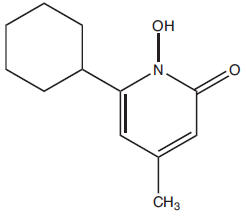
Ciclopirox Shampoo is a colorless, translucent solution. The chemical name for ciclopirox is 6-cyclohexyl-1-hydroxy-4-methyl-2(1 H)-pyridone, with the empirical formula C 12H 17NO 2and a molecular weight of 207.27. The CAS Registry Number is [29342-05-0]. The chemical structure is:
12.4 Microbiology
Ciclopirox is fungicidal in vitroagainst Malassezia furfur (Pityrosporum spp.), P. ovale,and P. orbiculare.
The clinical significance of antifungal activity in the treatment of seborrheic dermatitis is not known.
5.1 Local Effects
If a reaction suggesting sensitivity or irritation occurs with the use of Ciclopirox Shampoo 1%, treatment should be discontinued and appropriate therapy instituted.
Contact of Ciclopirox Shampoo 1% with the eyes should be avoided. If contact occurs, rinse thoroughly with water.
In patients with lighter hair color, hair discoloration has been reported.
8.4 Pediatric Use
No clinical trials have been conducted in subjects younger than 16 years.
8.5 Geriatric Use
In clinical trials, the safety and tolerability of Ciclopirox Shampoo 1% in the population 65 years and older was comparable to that of younger subjects. Results of the efficacy analysis in those subjects 65 years and older showed effectiveness in 25 of 85 (29%) subjects treated with Ciclopirox Shampoo 1%, and in 15 of 61 (25%) subjects treated with the vehicle; due to the small sample size, a statistically significant difference was not demonstrated. Other reported clinical experience has not identified differences in responses between the elderly and younger subjects, but greater sensitivity to adverse effects in some older individuals cannot be ruled out.
14 Clinical Studies
In two randomized, double-blind clinical trials, subjects 16 years and older with seborrheic dermatitis of the scalp applied Ciclopirox Shampoo or its vehicle twice weekly for 4 weeks. Subjects who were immunocompromised, those with psoriasis or atopic dermatitis, women of childbearing potential not using adequate contraception, and pregnant or lactating women were excluded from the clinical trials. An evaluation of the overall status of the seborrheic dermatitis, the presence and severity of erythema or inflammation, and scaling, was made at week 4, using a scale of 0 = none, 1 = slight, 2 = mild, 3 = moderate, 4 = pronounced, and 5 = severe. Effective treatment was defined as achieving a score of 0 (or a score of 1 if the baseline score was ≥ 3) simultaneously for status of the seborrheic dermatitis, erythema or inflammation, and scaling at Week 4. Ciclopirox shampoo was shown to be statistically significantly more effective than vehicle in both trials. Efficacy results for the two trials are presented in Table 1 below.
| Ciclopirox Shampoo 1% | Vehicle | |
|---|---|---|
| Study 1 | 220/380 (58%) | 60/192 (31%) |
| Study 2 | 65/250 (26%) | 32/249 (13%) |
Efficacy for African American subjects was not demonstrated, although only 53 African American subjects were enrolled in the two pivotal trials.
4 Contraindications
None.
6 Adverse Reactions
- The most frequently reported adverse reactions are pruritus, burning, and erythema. ( 6.1)
To report SUSPECTED ADVERSE REACTIONS, contact Taro at 1-866-923-4914 or FDA at 1-800-FDA-1088 or http://www.fda.gov/medwatch.
8.3 Nursing Mothers
It is not known whether this drug is excreted in human milk. Because many drugs are excreted in human milk, caution should be exercised when Ciclopirox Shampoo 1% is administered to a nursing woman.
12.2 Pharmacodynamics
The pharmacodynamics of Ciclopirox Shampoo 1% are unknown.
12.3 Pharmacokinetics
In a study in patients with seborrheic dermatitis of the scalp, application of 5 mL ciclopirox shampoo 1% twice weekly for 4 weeks, with an exposure time of 3 minutes per application, resulted in detectable serum concentrations of ciclopirox in 6 out of 18 patients. The serum concentrations measured throughout the dosing interval on Days 1 and 29 ranged from 10.3 ng/mL to 13.2 ng/mL. Total urinary excretion of ciclopirox was less than 0.5% of the administered dose.
1 Indication and Usage
Ciclopirox Shampoo 1% is indicated for the topical treatment of seborrheic dermatitis of the scalp in adults.
12.1 Mechanism of Action
Ciclopirox is a hydroxypyridone antifungal agent although the relevance of this property for the indication of seborrheic dermatitis is not known. Ciclopirox acts by chelation of polyvalent cations (Fe 3+ or Al 3+), resulting in the inhibition of the metal-dependent enzymes that are responsible for the degradation of peroxides within the fungal cell.
5 Warnings and Precautions
2 Dosage and Administration
Ciclopirox Shampoo 1% is not for ophthalmic, oral, or intravaginal use.
Wet hair and apply approximately 1 teaspoon (5 mL) of Ciclopirox Shampoo 1% to the scalp. Up to 2 teaspoons (10 mL) may be used for long hair. Lather and leave on hair and scalp for 3 minutes. A timer may be used. Avoid contact with eyes. Rinse off. Treatment should be repeated twice per week for 4 weeks, with a minimum of 3 days between applications.
If a patient with seborrheic dermatitis shows no clinical improvement after 4 weeks of treatment with Ciclopirox Shampoo 1%, the diagnosis should be reviewed.
3 Dosage Forms and Strengths
Ciclopirox Shampoo 1% is a shampoo containing 1% ciclopirox.
Each gram (equivalent to 0.96 mL) of Ciclopirox Shampoo contains 10 mg ciclopirox in a colorless and translucent shampoo base.
6.2 Post Marketing Experience
The following adverse reactions have been identified during post approval use of Ciclopirox Shampoo 1%: hair discoloration and abnormal hair texture, alopecia, irritation and rash. Because these events are reported voluntarily from a population of uncertain size, it is not possible to reliably estimate their frequency or establish a causal relationship to drug exposure.
6.1 Clinical Trials Experience
Because clinical trials are conducted under widely varying conditions, adverse reaction rates observed in the clinical trials of a drug cannot be directly compared to rates in the clinical trials of another drug and may not reflect the rates observed in clinical practice.
In 626 subjects treated with Ciclopirox Shampoo 1% twice weekly in the two pivotal clinical trials, the most frequent adverse events were increased itching in 1% of subjects, and application site reactions, such as burning, erythema, and itching, also in 1% of subjects.
17 Patient Counseling Information
See FDA-approved patient labeling (Patient Information)
The patient should be instructed to:
- Use Ciclopirox Shampoo 1% as directed by the physician. Avoid contact with the eyes. If contact occurs, rinse thoroughly with water. Ciclopirox Shampoo 1% is for external use on the scalp only. Do not swallow.
- Use Ciclopirox Shampoo 1% for seborrheic dermatitis for the full treatment time even though symptoms may have improved. Notify the physician if there is no improvement after 4 weeks.
- Inform the physician if the area of application shows signs of increased irritation (redness, itching, burning, blistering, swelling, or oozing).
16 How Supplied/storage and Handling
Ciclopirox Shampoo, 1% is colorless and translucent, and is supplied in 120 mL plastic bottles (NDC 51672-1351-8). Discard unused product after initial treatment duration.
13.1 Carcinogenesis, Mutagenesis, and Impairment of Fertility
A 104-week dermal carcinogenicity study in mice was conducted with ciclopirox cream applied at doses up to 1.93% (100 mg/kg/day or 300 mg/m 2/day).
No increase in drug related neoplasms was noted when compared to control.
The following in vitrogenotoxicity tests have been conducted with ciclopirox: evaluation of gene mutation in the Ames Salmonellaand E. coliassays (negative); chromosome aberration assays in V79 Chinese hamster lung fibroblast cells, with and without metabolic activation (positive); chromosome aberration assays in V79 Chinese hamster lung fibroblast cells in the presence of supplemental Fe3+, with and without metabolic activation (negative); gene mutation assays in the HGPRT-test with V79 Chinese hamster lung fibroblast cells (negative); and a primary DNA damage assay (i.e., unscheduled DNA synthesis assay in A549 human cells) (negative). An in vitrocell transformation assay in BALB/c 3T3 cells was negative for cell transformation. In an in vivoChinese hamster bone marrow cytogenetic assay, ciclopirox was negative for chromosome aberrations at a dosage of 5000 mg/kg body weight.
A combined oral fertility and embryofetal developmental study was conducted in rats with ciclopirox olamine. No effect on fertility or reproductive performance was noted at the highest dose tested of 3.85 mg/kg/day ciclopirox (approximately 1.3 times the maximum recommended human dose based on body surface area comparisons).
Structured Label Content
Section 34077-8 (34077-8)
Teratogenic Effects: Pregnancy Category B
There are no adequate or well-controlled studies in pregnant women. Therefore, Ciclopirox Shampoo 1% should be used during pregnancy only if the potential benefit justifies the potential risk to the fetus.
Oral embryofetal developmental studies were conducted in mice, rats, rabbits and monkeys. Ciclopirox or ciclopirox olamine was orally administered during the period of organogenesis. No maternal toxicity, embryotoxicity or teratogenicity were noted at the highest doses of 77, 125, 80 and 38.5 mg/kg/day ciclopirox in mice, rats, rabbits and monkeys, respectively (approximately 13, 42, 54 and 26 times the maximum recommended human dose based on body surface area comparisons, respectively).
Dermal embryofetal developmental studies were conducted in rats and rabbits with ciclopirox olamine dissolved in PEG 400. Ciclopirox olamine was topically administered during the period of organogenesis. No maternal toxicity, embryotoxicity or teratogenicity were noted at the highest doses of 92 mg/kg/day and 77 mg/kg/day ciclopirox in rats and rabbits, respectively (approximately 31 and 54 times the maximum recommended human dose based on body surface area comparisons, respectively).
Section 42229-5 (42229-5)
Mfd. by: Taro Pharmaceuticals Inc., Brampton, Ontario, Canada L6T 1C1
Dist. by: Taro Pharmaceuticals U.S.A., Inc., Hawthorne, NY 10532
Revised: November, 2015 PPK-6006-2 41
Section 42230-3 (42230-3)
Patient Information
Ciclopirox Shampoo 1%
| Important:For use on the scalp only. Do not get Ciclopirox Shampoo 1% in your eyes, mouth, or vagina. |
Section 44425-7 (44425-7)
Store at 20° - 25°C (68° - 77°F)[see USP Controlled Room Temperature].
Keep out of reach of children.
Section 51945-4 (51945-4)
PRINCIPAL DISPLAY PANEL - 120 mL Bottle Carton
120 mL
NDC 51672-1351-8
Ciclopirox
Shampoo
1%
FOR TOPICAL USE ONLY
NOT FOR OPHTHALMIC,
ORAL OR INTRAVAGINAL
USE
Keep this and all
medication out of the
reach of children
This package is not
child resistant
Rx only
TARO
11 Description (11 DESCRIPTION)
Ciclopirox Shampoo 1% contains the synthetic antifungal agent, ciclopirox for topical use.
Each gram (equivalent to 0.96 mL) of Ciclopirox Shampoo 1% contains 10 mg ciclopirox in a shampoo base consisting of disodium laureth sulfosuccinate, laureth-2, purified water USP, sodium chloride USP, and sodium laureth sulfate.
Ciclopirox Shampoo is a colorless, translucent solution. The chemical name for ciclopirox is 6-cyclohexyl-1-hydroxy-4-methyl-2(1 H)-pyridone, with the empirical formula C 12H 17NO 2and a molecular weight of 207.27. The CAS Registry Number is [29342-05-0]. The chemical structure is:
12.4 Microbiology
Ciclopirox is fungicidal in vitroagainst Malassezia furfur (Pityrosporum spp.), P. ovale,and P. orbiculare.
The clinical significance of antifungal activity in the treatment of seborrheic dermatitis is not known.
5.1 Local Effects
If a reaction suggesting sensitivity or irritation occurs with the use of Ciclopirox Shampoo 1%, treatment should be discontinued and appropriate therapy instituted.
Contact of Ciclopirox Shampoo 1% with the eyes should be avoided. If contact occurs, rinse thoroughly with water.
In patients with lighter hair color, hair discoloration has been reported.
8.4 Pediatric Use
No clinical trials have been conducted in subjects younger than 16 years.
8.5 Geriatric Use
In clinical trials, the safety and tolerability of Ciclopirox Shampoo 1% in the population 65 years and older was comparable to that of younger subjects. Results of the efficacy analysis in those subjects 65 years and older showed effectiveness in 25 of 85 (29%) subjects treated with Ciclopirox Shampoo 1%, and in 15 of 61 (25%) subjects treated with the vehicle; due to the small sample size, a statistically significant difference was not demonstrated. Other reported clinical experience has not identified differences in responses between the elderly and younger subjects, but greater sensitivity to adverse effects in some older individuals cannot be ruled out.
14 Clinical Studies (14 CLINICAL STUDIES)
In two randomized, double-blind clinical trials, subjects 16 years and older with seborrheic dermatitis of the scalp applied Ciclopirox Shampoo or its vehicle twice weekly for 4 weeks. Subjects who were immunocompromised, those with psoriasis or atopic dermatitis, women of childbearing potential not using adequate contraception, and pregnant or lactating women were excluded from the clinical trials. An evaluation of the overall status of the seborrheic dermatitis, the presence and severity of erythema or inflammation, and scaling, was made at week 4, using a scale of 0 = none, 1 = slight, 2 = mild, 3 = moderate, 4 = pronounced, and 5 = severe. Effective treatment was defined as achieving a score of 0 (or a score of 1 if the baseline score was ≥ 3) simultaneously for status of the seborrheic dermatitis, erythema or inflammation, and scaling at Week 4. Ciclopirox shampoo was shown to be statistically significantly more effective than vehicle in both trials. Efficacy results for the two trials are presented in Table 1 below.
| Ciclopirox Shampoo 1% | Vehicle | |
|---|---|---|
| Study 1 | 220/380 (58%) | 60/192 (31%) |
| Study 2 | 65/250 (26%) | 32/249 (13%) |
Efficacy for African American subjects was not demonstrated, although only 53 African American subjects were enrolled in the two pivotal trials.
4 Contraindications (4 CONTRAINDICATIONS)
None.
6 Adverse Reactions (6 ADVERSE REACTIONS)
- The most frequently reported adverse reactions are pruritus, burning, and erythema. ( 6.1)
To report SUSPECTED ADVERSE REACTIONS, contact Taro at 1-866-923-4914 or FDA at 1-800-FDA-1088 or http://www.fda.gov/medwatch.
8.3 Nursing Mothers
It is not known whether this drug is excreted in human milk. Because many drugs are excreted in human milk, caution should be exercised when Ciclopirox Shampoo 1% is administered to a nursing woman.
12.2 Pharmacodynamics
The pharmacodynamics of Ciclopirox Shampoo 1% are unknown.
12.3 Pharmacokinetics
In a study in patients with seborrheic dermatitis of the scalp, application of 5 mL ciclopirox shampoo 1% twice weekly for 4 weeks, with an exposure time of 3 minutes per application, resulted in detectable serum concentrations of ciclopirox in 6 out of 18 patients. The serum concentrations measured throughout the dosing interval on Days 1 and 29 ranged from 10.3 ng/mL to 13.2 ng/mL. Total urinary excretion of ciclopirox was less than 0.5% of the administered dose.
1 Indication and Usage (1 INDICATION AND USAGE)
Ciclopirox Shampoo 1% is indicated for the topical treatment of seborrheic dermatitis of the scalp in adults.
12.1 Mechanism of Action
Ciclopirox is a hydroxypyridone antifungal agent although the relevance of this property for the indication of seborrheic dermatitis is not known. Ciclopirox acts by chelation of polyvalent cations (Fe 3+ or Al 3+), resulting in the inhibition of the metal-dependent enzymes that are responsible for the degradation of peroxides within the fungal cell.
5 Warnings and Precautions (5 WARNINGS AND PRECAUTIONS)
2 Dosage and Administration (2 DOSAGE AND ADMINISTRATION)
Ciclopirox Shampoo 1% is not for ophthalmic, oral, or intravaginal use.
Wet hair and apply approximately 1 teaspoon (5 mL) of Ciclopirox Shampoo 1% to the scalp. Up to 2 teaspoons (10 mL) may be used for long hair. Lather and leave on hair and scalp for 3 minutes. A timer may be used. Avoid contact with eyes. Rinse off. Treatment should be repeated twice per week for 4 weeks, with a minimum of 3 days between applications.
If a patient with seborrheic dermatitis shows no clinical improvement after 4 weeks of treatment with Ciclopirox Shampoo 1%, the diagnosis should be reviewed.
3 Dosage Forms and Strengths (3 DOSAGE FORMS AND STRENGTHS)
Ciclopirox Shampoo 1% is a shampoo containing 1% ciclopirox.
Each gram (equivalent to 0.96 mL) of Ciclopirox Shampoo contains 10 mg ciclopirox in a colorless and translucent shampoo base.
6.2 Post Marketing Experience
The following adverse reactions have been identified during post approval use of Ciclopirox Shampoo 1%: hair discoloration and abnormal hair texture, alopecia, irritation and rash. Because these events are reported voluntarily from a population of uncertain size, it is not possible to reliably estimate their frequency or establish a causal relationship to drug exposure.
6.1 Clinical Trials Experience
Because clinical trials are conducted under widely varying conditions, adverse reaction rates observed in the clinical trials of a drug cannot be directly compared to rates in the clinical trials of another drug and may not reflect the rates observed in clinical practice.
In 626 subjects treated with Ciclopirox Shampoo 1% twice weekly in the two pivotal clinical trials, the most frequent adverse events were increased itching in 1% of subjects, and application site reactions, such as burning, erythema, and itching, also in 1% of subjects.
17 Patient Counseling Information (17 PATIENT COUNSELING INFORMATION)
See FDA-approved patient labeling (Patient Information)
The patient should be instructed to:
- Use Ciclopirox Shampoo 1% as directed by the physician. Avoid contact with the eyes. If contact occurs, rinse thoroughly with water. Ciclopirox Shampoo 1% is for external use on the scalp only. Do not swallow.
- Use Ciclopirox Shampoo 1% for seborrheic dermatitis for the full treatment time even though symptoms may have improved. Notify the physician if there is no improvement after 4 weeks.
- Inform the physician if the area of application shows signs of increased irritation (redness, itching, burning, blistering, swelling, or oozing).
16 How Supplied/storage and Handling (16 HOW SUPPLIED/STORAGE AND HANDLING)
Ciclopirox Shampoo, 1% is colorless and translucent, and is supplied in 120 mL plastic bottles (NDC 51672-1351-8). Discard unused product after initial treatment duration.
13.1 Carcinogenesis, Mutagenesis, and Impairment of Fertility
A 104-week dermal carcinogenicity study in mice was conducted with ciclopirox cream applied at doses up to 1.93% (100 mg/kg/day or 300 mg/m 2/day).
No increase in drug related neoplasms was noted when compared to control.
The following in vitrogenotoxicity tests have been conducted with ciclopirox: evaluation of gene mutation in the Ames Salmonellaand E. coliassays (negative); chromosome aberration assays in V79 Chinese hamster lung fibroblast cells, with and without metabolic activation (positive); chromosome aberration assays in V79 Chinese hamster lung fibroblast cells in the presence of supplemental Fe3+, with and without metabolic activation (negative); gene mutation assays in the HGPRT-test with V79 Chinese hamster lung fibroblast cells (negative); and a primary DNA damage assay (i.e., unscheduled DNA synthesis assay in A549 human cells) (negative). An in vitrocell transformation assay in BALB/c 3T3 cells was negative for cell transformation. In an in vivoChinese hamster bone marrow cytogenetic assay, ciclopirox was negative for chromosome aberrations at a dosage of 5000 mg/kg body weight.
A combined oral fertility and embryofetal developmental study was conducted in rats with ciclopirox olamine. No effect on fertility or reproductive performance was noted at the highest dose tested of 3.85 mg/kg/day ciclopirox (approximately 1.3 times the maximum recommended human dose based on body surface area comparisons).
Advanced Ingredient Data
Raw Label Data
All Sections (JSON)
Additional Information
Back to search View SPL set listing Open on DailyMed ↗
Source: dailymed · Ingested: 2026-02-15T11:48:05.995329 · Updated: 2026-03-14T22:29:01.799450