flavoxate hydrochloride tablets 100 mg, film-coated
b4260d7e-2ab3-49f6-aa57-bae19a23d82a
34391-3
HUMAN PRESCRIPTION DRUG LABEL
Drug Facts
Composition & Product
Identifiers & Packaging
Indications and Usage
Flavoxate hydrochloride tablets are indicated for symptomatic relief of dysuria, urgency, nocturia, suprapubic pain, frequency and incontinence as may occur in cystitis, prostatitis, urethritis, urethrocystitis/urethrotrigonitis. Flavoxate hydrochloride tablets are not indicated for definitive treatment, but are compatible with drugs used for the treatment of urinary tract infections.
Contraindications
Flavoxate hydrochloride is contraindicated in patients who have any of the following obstructive conditions: pyloric or duodenal obstruction, obstructive intestinal lesions or ileus, achalasia, gastrointestinal hemorrhage and obstructive uropathies of the lower urinary tract.
Adverse Reactions
The following adverse reactions have been observed, but there are not enough data to support an estimate of their frequency. Gastrointestinal: Nausea, vomiting, dry mouth. CNS: Vertigo, headache, mental confusion, especially in the elderly, drowsiness, nervousness. Hematologic: Leukopenia (one case which was reversible upon discontinuation of the drug). Cardiovascular: Tachycardia and palpitation. Allergic : Urticaria and other dermatoses, eosinophilia and hyperpyrexia. Ophthalmic: Increased ocular tension, blurred vision, disturbance in eye accommodation. Renal: Dysuria.
How Supplied
Flavoxate hydrochloride 100 mg tablets are available as white, round biconvex, film-coated tablets, debossed “ Є58 ” on one side and plain on the other side, and are available as follows: NDC 42806-058-01 Bottles of 100 NDC 42806-058-10 Bottles of 1000 Store at 20° - 25°C (68° - 77°F) [see USP Controlled Room Temperature]. Dispense contents in a tight, light-resistant container. Distributed by Epic Pharma, LLC Laurelton, NY 11413 Rev. 07-2023-00 MF058REV07/23 OE1140
Description
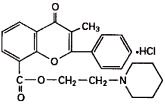
Flavoxate hydrochloride tablets contain flavoxate hydrochloride, a synthetic urinary tract spasmolytic. Chemically, flavoxate hydrochloride is 2-piperidinoethyl 3-methyl-4-oxo-2-phenyl-4 H -1-benzopyran-8-carboxylate hydrochloride. The empirical formula of flavoxate hydrochloride is C 24 H 25 NO 4 •HCl. The molecular weight is 427.94. The structural formula appears below. Each tablet for oral administration contains 100 mg flavoxate hydrochloride. In addition, each tablet contains the following inactive ingredients: colloidal silicon dioxide, corn starch, dibasic calcium phosphate dihydrate, magnesium stearate, hypromellose, polydextrose, polyethylene glycol, titanium dioxide and triacetin.
Medication Information
Warnings
Flavoxate hydrochloride should be given cautiously in patients with suspected glaucoma.
Indications and Usage
Flavoxate hydrochloride tablets are indicated for symptomatic relief of dysuria, urgency, nocturia, suprapubic pain, frequency and incontinence as may occur in cystitis, prostatitis, urethritis, urethrocystitis/urethrotrigonitis. Flavoxate hydrochloride tablets are not indicated for definitive treatment, but are compatible with drugs used for the treatment of urinary tract infections.
Contraindications
Flavoxate hydrochloride is contraindicated in patients who have any of the following obstructive conditions: pyloric or duodenal obstruction, obstructive intestinal lesions or ileus, achalasia, gastrointestinal hemorrhage and obstructive uropathies of the lower urinary tract.
Adverse Reactions
The following adverse reactions have been observed, but there are not enough data to support an estimate of their frequency.
Gastrointestinal: Nausea, vomiting, dry mouth.
CNS: Vertigo, headache, mental confusion, especially in the elderly, drowsiness, nervousness.
Hematologic: Leukopenia (one case which was reversible upon discontinuation of the drug).
Cardiovascular: Tachycardia and palpitation.
Allergic: Urticaria and other dermatoses, eosinophilia and hyperpyrexia.
Ophthalmic: Increased ocular tension, blurred vision, disturbance in eye accommodation.
Renal: Dysuria.
How Supplied
Flavoxate hydrochloride 100 mg tablets are available as white, round biconvex, film-coated tablets, debossed “ Є58” on one side and plain on the other side, and are available as follows:
NDC 42806-058-01 Bottles of 100
NDC 42806-058-10 Bottles of 1000
Store at 20° - 25°C (68° - 77°F) [see USP Controlled Room Temperature]. Dispense contents in a tight, light-resistant container.
Distributed by
Epic Pharma, LLC
Laurelton, NY 11413
Rev. 07-2023-00
MF058REV07/23
OE1140
Description
Flavoxate hydrochloride tablets contain flavoxate hydrochloride, a synthetic urinary tract spasmolytic.
Chemically, flavoxate hydrochloride is 2-piperidinoethyl 3-methyl-4-oxo-2-phenyl-4 H-1-benzopyran-8-carboxylate hydrochloride. The empirical formula of flavoxate hydrochloride is C 24H 25NO 4•HCl. The molecular weight is 427.94. The structural formula appears below.
Each tablet for oral administration contains 100 mg flavoxate hydrochloride. In addition, each tablet contains the following inactive ingredients: colloidal silicon dioxide, corn starch, dibasic calcium phosphate dihydrate, magnesium stearate, hypromellose, polydextrose, polyethylene glycol, titanium dioxide and triacetin.
Overdosage
The oral LD50 for flavoxate hydrochloride in rats is 4273 mg/kg. The oral LD 50 for flavoxate hydrochloride in mice is 1837 mg/kg.
It is not known whether flavoxate hydrochloride is dialyzable.
Pediatric Use
Safety and effectiveness in children below the age of 12 years have not been established.
Nursing Mothers
It is not known whether this drug is excreted in human milk. Because many drugs are excreted in human milk, caution should be exercised when flavoxate hydrochloride is administered to a nursing woman.
Clinical Pharmacology
Flavoxate hydrochloride counteracts smooth muscle spasm of the urinary tract and exerts its effect directly on the muscle.
In a single study of 11 normal male subjects, the time to onset of action was 55 minutes. The peak effect was observed at 112 minutes. 57% of the flavoxate hydrochloride was excreted in the urine within 24 hours.
Information for Patients
Patients should be informed that if drowsiness and blurred vision occur, they should not operate a motor vehicle or machinery or participate in activities where alertness is required.
Adults and Children Over 12 Years of Age
One or two 100 mg tablets 3 or 4 times a day. With improvement of symptoms, the dose may be reduced. This drug cannot be recommended for infants and children under 12 years of age because safety and efficacy have not been demonstrated in this age group.
Teratogenic Effects Pregnancy Category B
Reproduction studies have been performed in rats and rabbits at doses up to 34 times the human dose and revealed no evidence of impaired fertility or harm to the fetus due to flavoxate hydrochloride. There are, however, no well-controlled studies in pregnant women. Because animal reproduction studies are not always predictive of human response, this drug should be used during pregnancy only if clearly needed.
Carcinogenesis, Mutagenesis, Impairment of Fertility
Mutagenicity studies and long-term studies in animals to determine the carcinogenic potential of flavoxate hydrochloride have not been performed.
Package/label Principal Display Panel – 100 Mg 100ct
Flavoxate Hydrochloride Tablets, 100 mg 100ct
Structured Label Content
Warnings (WARNINGS)
Flavoxate hydrochloride should be given cautiously in patients with suspected glaucoma.
Indications and Usage (INDICATIONS AND USAGE)
Flavoxate hydrochloride tablets are indicated for symptomatic relief of dysuria, urgency, nocturia, suprapubic pain, frequency and incontinence as may occur in cystitis, prostatitis, urethritis, urethrocystitis/urethrotrigonitis. Flavoxate hydrochloride tablets are not indicated for definitive treatment, but are compatible with drugs used for the treatment of urinary tract infections.
Contraindications (CONTRAINDICATIONS)
Flavoxate hydrochloride is contraindicated in patients who have any of the following obstructive conditions: pyloric or duodenal obstruction, obstructive intestinal lesions or ileus, achalasia, gastrointestinal hemorrhage and obstructive uropathies of the lower urinary tract.
Adverse Reactions (ADVERSE REACTIONS)
The following adverse reactions have been observed, but there are not enough data to support an estimate of their frequency.
Gastrointestinal: Nausea, vomiting, dry mouth.
CNS: Vertigo, headache, mental confusion, especially in the elderly, drowsiness, nervousness.
Hematologic: Leukopenia (one case which was reversible upon discontinuation of the drug).
Cardiovascular: Tachycardia and palpitation.
Allergic: Urticaria and other dermatoses, eosinophilia and hyperpyrexia.
Ophthalmic: Increased ocular tension, blurred vision, disturbance in eye accommodation.
Renal: Dysuria.
How Supplied (HOW SUPPLIED)
Flavoxate hydrochloride 100 mg tablets are available as white, round biconvex, film-coated tablets, debossed “ Є58” on one side and plain on the other side, and are available as follows:
NDC 42806-058-01 Bottles of 100
NDC 42806-058-10 Bottles of 1000
Store at 20° - 25°C (68° - 77°F) [see USP Controlled Room Temperature]. Dispense contents in a tight, light-resistant container.
Distributed by
Epic Pharma, LLC
Laurelton, NY 11413
Rev. 07-2023-00
MF058REV07/23
OE1140
Description (DESCRIPTION)
Flavoxate hydrochloride tablets contain flavoxate hydrochloride, a synthetic urinary tract spasmolytic.
Chemically, flavoxate hydrochloride is 2-piperidinoethyl 3-methyl-4-oxo-2-phenyl-4 H-1-benzopyran-8-carboxylate hydrochloride. The empirical formula of flavoxate hydrochloride is C 24H 25NO 4•HCl. The molecular weight is 427.94. The structural formula appears below.
Each tablet for oral administration contains 100 mg flavoxate hydrochloride. In addition, each tablet contains the following inactive ingredients: colloidal silicon dioxide, corn starch, dibasic calcium phosphate dihydrate, magnesium stearate, hypromellose, polydextrose, polyethylene glycol, titanium dioxide and triacetin.
Overdosage (OVERDOSAGE)
The oral LD50 for flavoxate hydrochloride in rats is 4273 mg/kg. The oral LD 50 for flavoxate hydrochloride in mice is 1837 mg/kg.
It is not known whether flavoxate hydrochloride is dialyzable.
Pediatric Use
Safety and effectiveness in children below the age of 12 years have not been established.
Nursing Mothers
It is not known whether this drug is excreted in human milk. Because many drugs are excreted in human milk, caution should be exercised when flavoxate hydrochloride is administered to a nursing woman.
Clinical Pharmacology (CLINICAL PHARMACOLOGY)
Flavoxate hydrochloride counteracts smooth muscle spasm of the urinary tract and exerts its effect directly on the muscle.
In a single study of 11 normal male subjects, the time to onset of action was 55 minutes. The peak effect was observed at 112 minutes. 57% of the flavoxate hydrochloride was excreted in the urine within 24 hours.
Information for Patients
Patients should be informed that if drowsiness and blurred vision occur, they should not operate a motor vehicle or machinery or participate in activities where alertness is required.
Adults and Children Over 12 Years of Age (Adults and children over 12 years of age)
One or two 100 mg tablets 3 or 4 times a day. With improvement of symptoms, the dose may be reduced. This drug cannot be recommended for infants and children under 12 years of age because safety and efficacy have not been demonstrated in this age group.
Teratogenic Effects Pregnancy Category B (Teratogenic Effects-Pregnancy Category B)
Reproduction studies have been performed in rats and rabbits at doses up to 34 times the human dose and revealed no evidence of impaired fertility or harm to the fetus due to flavoxate hydrochloride. There are, however, no well-controlled studies in pregnant women. Because animal reproduction studies are not always predictive of human response, this drug should be used during pregnancy only if clearly needed.
Carcinogenesis, Mutagenesis, Impairment of Fertility
Mutagenicity studies and long-term studies in animals to determine the carcinogenic potential of flavoxate hydrochloride have not been performed.
Package/label Principal Display Panel – 100 Mg 100ct (PACKAGE/LABEL PRINCIPAL DISPLAY PANEL – 100 mg 100ct)
Flavoxate Hydrochloride Tablets, 100 mg 100ct
Advanced Ingredient Data
Raw Label Data
All Sections (JSON)
Additional Information
Back to search View SPL set listing Open on DailyMed ↗
Source: dailymed · Ingested: 2026-02-15T11:39:40.199056 · Updated: 2026-03-14T21:58:55.917732