Potassium Chloride
aeb2e14e-cd7c-49d0-a15f-fbbe89a03c6b
34391-3
HUMAN PRESCRIPTION DRUG LABEL
Drug Facts
Composition & Product
Identifiers & Packaging
Indications and Usage
Potassium chloride oral solution is indicated for the treatment and prophylaxis of hypokalemia with or without metabolic alkalosis, in patients for whom dietary management with potassium-rich foods or diuretic dose reduction are insufficient.
Dosage and Administration
Dilute prior to administration. ( 2.1 , 5.1 ) Monitor serum potassium and adjust dosage accordingly ( 2.2 , 2.3 ) Treatment of hypokalemia: Adults: Initial doses range from 40 to 100 mEq/day in 2 to 5 divided doses: limit doses to 40 mEq per dose. Total daily dose should not exceed 200 mEq ( 2.2 ) Pediatric patients aged birth to 16 years old: 2 to 4 mEq/kg/day in divided doses; not to exceed 1 mEq/kg as a single dose or 40 mEq whichever is lower; if deficits are severe or ongoing losses are great, consider intravenous therapy. Total daily dose should not exceed 100 mEq ( 2.3 ) Maintenance or Prophylaxis of hypokalemia: Adults: Typical dose is 20 mEq per day ( 2.2 ) Pediatric patients aged birth to 16 years old: typical dose is 1 mEq/kg/day. Do not exceed 3 mEq/kg/day ( 2.3 )
Contraindications
Potassium chloride is contraindicated in patients on potassium sparing diuretics.
Warnings and Precautions
Gastrointestinal Irritation : Dilute before use, take with meals ( 5.1 )
Adverse Reactions
The most common adverse reactions to oral potassium salts are nausea, vomiting, flatulence, abdominal pain/discomfort, and diarrhea.
Drug Interactions
Potassium Sparing Diuretics: Avoid concomitant use ( 7.1 ) Renin- Angiotensin-Aldosterone System Inhibitors: Monitor for hyperkalemia ( 7.2 ) Nonsteroidal Anti-Inflammatory drugs: Monitor for hyperkalemia ( 7.3 )
How Supplied
Potassium Chloride Oral Solution USP, is a clear, orange solution available in two strengths as follows: 10%: 20 mEq/15 mL oral solution NDC# 54288-160-47 Bottle of 473 mL 20%: 40 mEq/15 mL oral solution NDC# 54288-161-47 Bottle of 473 mL
Storage and Handling
Potassium Chloride Oral Solution USP, is a clear, orange solution available in two strengths as follows: 10%: 20 mEq/15 mL oral solution NDC# 54288-160-47 Bottle of 473 mL 20%: 40 mEq/15 mL oral solution NDC# 54288-161-47 Bottle of 473 mL
Description
Potassium chloride oral solution is indicated for the treatment and prophylaxis of hypokalemia with or without metabolic alkalosis, in patients for whom dietary management with potassium-rich foods or diuretic dose reduction are insufficient.
Medication Information
Warnings and Precautions
Gastrointestinal Irritation : Dilute before use, take with meals ( 5.1 )
Indications and Usage
Potassium chloride oral solution is indicated for the treatment and prophylaxis of hypokalemia with or without metabolic alkalosis, in patients for whom dietary management with potassium-rich foods or diuretic dose reduction are insufficient.
Dosage and Administration
Dilute prior to administration. ( 2.1 , 5.1 ) Monitor serum potassium and adjust dosage accordingly ( 2.2 , 2.3 ) Treatment of hypokalemia: Adults: Initial doses range from 40 to 100 mEq/day in 2 to 5 divided doses: limit doses to 40 mEq per dose. Total daily dose should not exceed 200 mEq ( 2.2 ) Pediatric patients aged birth to 16 years old: 2 to 4 mEq/kg/day in divided doses; not to exceed 1 mEq/kg as a single dose or 40 mEq whichever is lower; if deficits are severe or ongoing losses are great, consider intravenous therapy. Total daily dose should not exceed 100 mEq ( 2.3 ) Maintenance or Prophylaxis of hypokalemia: Adults: Typical dose is 20 mEq per day ( 2.2 ) Pediatric patients aged birth to 16 years old: typical dose is 1 mEq/kg/day. Do not exceed 3 mEq/kg/day ( 2.3 )
Contraindications
Potassium chloride is contraindicated in patients on potassium sparing diuretics.
Adverse Reactions
The most common adverse reactions to oral potassium salts are nausea, vomiting, flatulence, abdominal pain/discomfort, and diarrhea.
Drug Interactions
Potassium Sparing Diuretics: Avoid concomitant use ( 7.1 ) Renin- Angiotensin-Aldosterone System Inhibitors: Monitor for hyperkalemia ( 7.2 ) Nonsteroidal Anti-Inflammatory drugs: Monitor for hyperkalemia ( 7.3 )
Storage and Handling
Potassium Chloride Oral Solution USP, is a clear, orange solution available in two strengths as follows: 10%: 20 mEq/15 mL oral solution NDC# 54288-160-47 Bottle of 473 mL 20%: 40 mEq/15 mL oral solution NDC# 54288-161-47 Bottle of 473 mL
How Supplied
Potassium Chloride Oral Solution USP, is a clear, orange solution available in two strengths as follows: 10%: 20 mEq/15 mL oral solution NDC# 54288-160-47 Bottle of 473 mL 20%: 40 mEq/15 mL oral solution NDC# 54288-161-47 Bottle of 473 mL
Description
Potassium chloride oral solution is indicated for the treatment and prophylaxis of hypokalemia with or without metabolic alkalosis, in patients for whom dietary management with potassium-rich foods or diuretic dose reduction are insufficient.
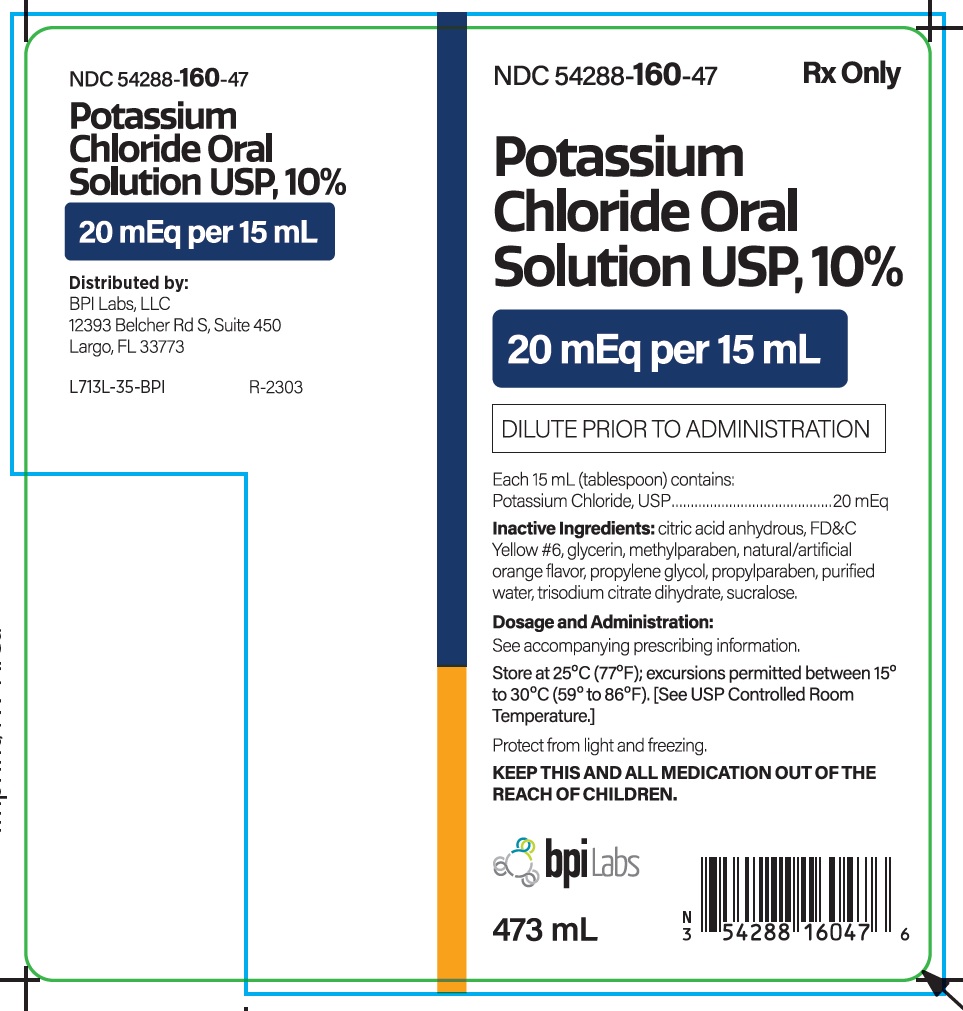
Principal Display Panel
NDC 54288-160-47
Each 15 mL (tablespoon) contains: Potassium Chloride, USP 20 mEq
Section 42229-5
Monitoring
Monitor serum potassium and adjust dosages accordingly. For treatment of hypokalemia, monitor potassium levels daily or more often depending on the severity of hypokalemia until they return to normal. Monitor potassium levels monthly to biannually for maintenance or prophylaxis.
The treatment of potassium depletion, particularly in the presence of cardiac disease, renal disease, or acidosis requires careful attention to acid-base balance, volume status, electrolytes, including magnesium, sodium, chloride, phosphate, and calcium, electrocardiograms and the clinical status of the patient. Correct volume status, acid-base balance and electrolyte deficits as appropriate.
Section 44425-7
Storage
Store at 25ºC (77ºF); excursions permitted between 15º to 30ºC (59º to 86ºF). [See USP Controlled Room Temperature.].
Dispense in a tight, light-resistant container as defined in the USP.
PROTECT from LIGHT and FREEZING.
10.1 Symptoms
The administration of oral potassium salts to persons with normal excretory mechanisms for potassium rarely causes serious hyperkalemia. However, if excretory mechanisms are impaired or if potassium is administered too rapidly potentially fatal hyperkalemia can result.
Hyperkalemia is usually asymptomatic and may be manifested only by an increased serum potassium concentration (6.5–8.0 mEq/L) and characteristic electrocardiographic changes (peaking of T-waves, loss of P-waves, depression of S-T segment, and prolongation of the QT-interval). Late manifestations include muscle paralysis and cardiovascular collapse from cardiac arrest (9–12 mEq/L).
8.1 Pregnancy
There are no human data related to use of Potassium Chloride during pregnancy, and animal studies have not been conducted. Potassium supplementation that does not lead to hyperkalemia is not expected to cause fetal harm.
The background risk for major birth defects and miscarriage in the indicated population is unknown. All pregnancies have a background risk of birth defect, loss, or other adverse outcomes. In the U.S. general population, the estimated background risk of major birth defects and miscarriage in clinically recognized pregnancies is 2-4% and 15-20%, respectively.
8.6 Cirrhosis
Patients with cirrhosis should usually be started at the low end of the dosing range, and the serum potassium level should be monitored frequently. [see Clinical Pharmacology (12.3)] .
10.2 Treatment
Treatment measures for hyperkalemia include the following:
1.Monitor closely for arrhythmias and electrolyte changes.2.Eliminate foods and medications containing potassium and of any agents with potassium-sparing properties such as potassium-sparing diuretics, ARBs, ACE inhibitors, NSAIDs, certain nutritional supplements and many others.3.Administer intravenous calcium gluconate if the patient is at no risk or low risk of developing digitalis toxicity.4.Administer intravenously 300 to 500 mL/hr of 10% dextrose solution containing 10 to 20 units of crystalline insulin per 1000 mL.5.Correct acidosis, if present, with intravenous sodium bicarbonate.6.Use exchange resins, hemodialysis, or peritoneal dialysis.
In patients who have been stabilized on digitalis, too rapid a lowering of the serum potassium concentration can produce digitalis toxicity.
11 Description
Potassium Chloride is a white crystalline or colorless solid. It is soluble in water and slightly soluble in alcohol. Chemically, Potassium Chloride is K-Cl with a molecular mass of 74.55.
8.4 Pediatric Use
The safety and effectiveness of potassium chloride have been demonstrated in children with diarrhea and malnutrition from birth to 16 years.
8.5 Geriatric Use
Clinical studies of Potassium Chloride did not include sufficient numbers of subjects aged 65 and over to determine whether they respond differently from younger subjects. Other reported clinical experience has not identified differences in responses between the elderly and younger patients. In general, dose selection for an elderly patient should be cautious, usually starting at the low end of the dosing range, reflecting the greater frequency of decreased hepatic, renal, or cardiac function, and of concomitant disease or other drug therapy.
This drug is known to be substantially excreted by the kidney, and the risk of toxic reactions to this drug may be greater in patients with impaired renal function. Because elderly patients are more likely to have decreased renal function, care should be taken in dose selection, and it may be useful to monitor renal function.
4 Contraindications
Potassium chloride is contraindicated in patients on potassium sparing diuretics.
6 Adverse Reactions
The most common adverse reactions to oral potassium salts are nausea, vomiting, flatulence, abdominal pain/discomfort, and diarrhea.
7 Drug Interactions
8.7 Renal Impairment
Patients with renal impairment have reduced urinary excretion of potassium and are at substantially increased risk of hyperkalemia. Patients with impaired renal function, particularly if the patient is on ACE inhibitors, ARBs, or nonsteroidal anti-inflammatory drugs should usually be started at the low end of the dosing range because of the potential for development of hyperkalemia. The serum potassium level should be monitored frequently. Renal function should be assessed periodically.
12.3 Pharmacokinetics
Based on published literature, the rate of absorption and urinary excretion of potassium from KCl oral solution were higher during the first few hours after dosing relative to modified release KCl products. The bioavailability of potassium, as measured by the cumulative urinary excretion of K+ over a 24-hour post dose period, is similar for KCl solution and modified release products.
1 Indications and Usage
Potassium chloride oral solution is indicated for the treatment and prophylaxis of hypokalemia with or without metabolic alkalosis, in patients for whom dietary management with potassium-rich foods or diuretic dose reduction are insufficient.
12.1 Mechanism of Action
The potassium ion (K+) is the principal intracellular cation of most body tissues. Potassium ions participate in a number of essential physiological processes including the maintenance of intracellular tonicity; the transmission of nerve impulses; the contraction of cardiac, skeletal, and smooth muscle; and the maintenance of normal renal function.
The intracellular concentration of potassium is approximately 150 to 160 mEq per liter. The normal adult plasma concentration is 3.5 to 5 mEq per liter. An active ion transport system maintains this gradient across the plasma membrane.
Potassium is a normal dietary constituent, and under steady-state conditions the amount of potassium absorbed from the gastrointestinal tract is equal to the amount excreted in the urine. The usual dietary intake of potassium is 50 to 100 mEq per day.
5 Warnings and Precautions
- Gastrointestinal Irritation: Dilute before use, take with meals ( 5.1)
2 Dosage and Administration
Dilute prior to administration. ( 2.1, 5.1)
Monitor serum potassium and adjust dosage accordingly ( 2.2, 2.3)
Treatment of hypokalemia:
- Adults: Initial doses range from 40 to 100 mEq/day in 2 to 5 divided doses: limit doses to 40 mEq per dose. Total daily dose should not exceed 200 mEq ( 2.2)
- Pediatric patients aged birth to 16 years old: 2 to 4 mEq/kg/day in divided doses; not to exceed 1 mEq/kg as a single dose or 40 mEq whichever is lower; if deficits are severe or ongoing losses are great, consider intravenous therapy. Total daily dose should not exceed 100 mEq ( 2.3)
Maintenance or Prophylaxis of hypokalemia:
3 Dosage Forms and Strengths
Oral Solution 10%: 1.3 mEq potassium per mL.
Oral Solution 20%: 2.6 mEq potassium per mL.
8 Use in Specific Populations
5.1 Gastrointestinal Irritation
May cause gastrointestinal irritation if administered undiluted. Increased dilution of the solution and taking with meals may reduce gastrointestinal irritation [see Dosage and Administration (2.1)] .
7.1 Potassium Sparing Diuretics
Use with potassium-sparing diuretics can produce severe hyperkalemia. Avoid concomitant use.
16 How Supplied/storage and Handling
Potassium Chloride Oral Solution USP, is a clear, orange solution available in two strengths as follows:
10%: 20 mEq/15 mL oral solution NDC# 54288-160-47 Bottle of 473 mL
20%: 40 mEq/15 mL oral solution NDC# 54288-161-47 Bottle of 473 mL
7.3 Nonsteroidal Anti Inflammatory Drugs (nsaids)
NSAIDs may produce potassium retention by reducing renal synthesis of prostaglandin E and impairing the renin-angiotensin system. Closely monitor potassium in patients on concomitant NSAIDs.
7.2 Renin Angiotensin Aldosterone System Inhibitors
Drugs that inhibit the renin-angiotensin-aldosterone system (RAAS) including angiotensin converting enzyme (ACE) inhibitors, angiotensin receptor blockers (ARBs), spironolactone, eplerenone, or aliskiren produce potassium retention by inhibiting aldosterone production. Closely monitor potassium in patients receiving concomitant RAAS therapy.
Structured Label Content
Principal Display Panel (PRINCIPAL DISPLAY PANEL)
NDC 54288-160-47
Each 15 mL (tablespoon) contains: Potassium Chloride, USP 20 mEq
Section 42229-5 (42229-5)
Monitoring
Monitor serum potassium and adjust dosages accordingly. For treatment of hypokalemia, monitor potassium levels daily or more often depending on the severity of hypokalemia until they return to normal. Monitor potassium levels monthly to biannually for maintenance or prophylaxis.
The treatment of potassium depletion, particularly in the presence of cardiac disease, renal disease, or acidosis requires careful attention to acid-base balance, volume status, electrolytes, including magnesium, sodium, chloride, phosphate, and calcium, electrocardiograms and the clinical status of the patient. Correct volume status, acid-base balance and electrolyte deficits as appropriate.
Section 44425-7 (44425-7)
Storage
Store at 25ºC (77ºF); excursions permitted between 15º to 30ºC (59º to 86ºF). [See USP Controlled Room Temperature.].
Dispense in a tight, light-resistant container as defined in the USP.
PROTECT from LIGHT and FREEZING.
10.1 Symptoms
The administration of oral potassium salts to persons with normal excretory mechanisms for potassium rarely causes serious hyperkalemia. However, if excretory mechanisms are impaired or if potassium is administered too rapidly potentially fatal hyperkalemia can result.
Hyperkalemia is usually asymptomatic and may be manifested only by an increased serum potassium concentration (6.5–8.0 mEq/L) and characteristic electrocardiographic changes (peaking of T-waves, loss of P-waves, depression of S-T segment, and prolongation of the QT-interval). Late manifestations include muscle paralysis and cardiovascular collapse from cardiac arrest (9–12 mEq/L).
8.1 Pregnancy
There are no human data related to use of Potassium Chloride during pregnancy, and animal studies have not been conducted. Potassium supplementation that does not lead to hyperkalemia is not expected to cause fetal harm.
The background risk for major birth defects and miscarriage in the indicated population is unknown. All pregnancies have a background risk of birth defect, loss, or other adverse outcomes. In the U.S. general population, the estimated background risk of major birth defects and miscarriage in clinically recognized pregnancies is 2-4% and 15-20%, respectively.
8.6 Cirrhosis
Patients with cirrhosis should usually be started at the low end of the dosing range, and the serum potassium level should be monitored frequently. [see Clinical Pharmacology (12.3)] .
10.2 Treatment
Treatment measures for hyperkalemia include the following:
1.Monitor closely for arrhythmias and electrolyte changes.2.Eliminate foods and medications containing potassium and of any agents with potassium-sparing properties such as potassium-sparing diuretics, ARBs, ACE inhibitors, NSAIDs, certain nutritional supplements and many others.3.Administer intravenous calcium gluconate if the patient is at no risk or low risk of developing digitalis toxicity.4.Administer intravenously 300 to 500 mL/hr of 10% dextrose solution containing 10 to 20 units of crystalline insulin per 1000 mL.5.Correct acidosis, if present, with intravenous sodium bicarbonate.6.Use exchange resins, hemodialysis, or peritoneal dialysis.
In patients who have been stabilized on digitalis, too rapid a lowering of the serum potassium concentration can produce digitalis toxicity.
11 Description (11 DESCRIPTION)
Potassium Chloride is a white crystalline or colorless solid. It is soluble in water and slightly soluble in alcohol. Chemically, Potassium Chloride is K-Cl with a molecular mass of 74.55.
8.4 Pediatric Use
The safety and effectiveness of potassium chloride have been demonstrated in children with diarrhea and malnutrition from birth to 16 years.
8.5 Geriatric Use
Clinical studies of Potassium Chloride did not include sufficient numbers of subjects aged 65 and over to determine whether they respond differently from younger subjects. Other reported clinical experience has not identified differences in responses between the elderly and younger patients. In general, dose selection for an elderly patient should be cautious, usually starting at the low end of the dosing range, reflecting the greater frequency of decreased hepatic, renal, or cardiac function, and of concomitant disease or other drug therapy.
This drug is known to be substantially excreted by the kidney, and the risk of toxic reactions to this drug may be greater in patients with impaired renal function. Because elderly patients are more likely to have decreased renal function, care should be taken in dose selection, and it may be useful to monitor renal function.
4 Contraindications (4 CONTRAINDICATIONS)
Potassium chloride is contraindicated in patients on potassium sparing diuretics.
6 Adverse Reactions (6 ADVERSE REACTIONS)
The most common adverse reactions to oral potassium salts are nausea, vomiting, flatulence, abdominal pain/discomfort, and diarrhea.
7 Drug Interactions (7 DRUG INTERACTIONS)
8.7 Renal Impairment
Patients with renal impairment have reduced urinary excretion of potassium and are at substantially increased risk of hyperkalemia. Patients with impaired renal function, particularly if the patient is on ACE inhibitors, ARBs, or nonsteroidal anti-inflammatory drugs should usually be started at the low end of the dosing range because of the potential for development of hyperkalemia. The serum potassium level should be monitored frequently. Renal function should be assessed periodically.
12.3 Pharmacokinetics
Based on published literature, the rate of absorption and urinary excretion of potassium from KCl oral solution were higher during the first few hours after dosing relative to modified release KCl products. The bioavailability of potassium, as measured by the cumulative urinary excretion of K+ over a 24-hour post dose period, is similar for KCl solution and modified release products.
1 Indications and Usage (1 INDICATIONS AND USAGE)
Potassium chloride oral solution is indicated for the treatment and prophylaxis of hypokalemia with or without metabolic alkalosis, in patients for whom dietary management with potassium-rich foods or diuretic dose reduction are insufficient.
12.1 Mechanism of Action
The potassium ion (K+) is the principal intracellular cation of most body tissues. Potassium ions participate in a number of essential physiological processes including the maintenance of intracellular tonicity; the transmission of nerve impulses; the contraction of cardiac, skeletal, and smooth muscle; and the maintenance of normal renal function.
The intracellular concentration of potassium is approximately 150 to 160 mEq per liter. The normal adult plasma concentration is 3.5 to 5 mEq per liter. An active ion transport system maintains this gradient across the plasma membrane.
Potassium is a normal dietary constituent, and under steady-state conditions the amount of potassium absorbed from the gastrointestinal tract is equal to the amount excreted in the urine. The usual dietary intake of potassium is 50 to 100 mEq per day.
5 Warnings and Precautions (5 WARNINGS AND PRECAUTIONS)
- Gastrointestinal Irritation: Dilute before use, take with meals ( 5.1)
2 Dosage and Administration (2 DOSAGE AND ADMINISTRATION)
Dilute prior to administration. ( 2.1, 5.1)
Monitor serum potassium and adjust dosage accordingly ( 2.2, 2.3)
Treatment of hypokalemia:
- Adults: Initial doses range from 40 to 100 mEq/day in 2 to 5 divided doses: limit doses to 40 mEq per dose. Total daily dose should not exceed 200 mEq ( 2.2)
- Pediatric patients aged birth to 16 years old: 2 to 4 mEq/kg/day in divided doses; not to exceed 1 mEq/kg as a single dose or 40 mEq whichever is lower; if deficits are severe or ongoing losses are great, consider intravenous therapy. Total daily dose should not exceed 100 mEq ( 2.3)
Maintenance or Prophylaxis of hypokalemia:
3 Dosage Forms and Strengths (3 DOSAGE FORMS AND STRENGTHS)
Oral Solution 10%: 1.3 mEq potassium per mL.
Oral Solution 20%: 2.6 mEq potassium per mL.
8 Use in Specific Populations (8 USE IN SPECIFIC POPULATIONS)
5.1 Gastrointestinal Irritation
May cause gastrointestinal irritation if administered undiluted. Increased dilution of the solution and taking with meals may reduce gastrointestinal irritation [see Dosage and Administration (2.1)] .
7.1 Potassium Sparing Diuretics (7.1 Potassium-Sparing Diuretics)
Use with potassium-sparing diuretics can produce severe hyperkalemia. Avoid concomitant use.
16 How Supplied/storage and Handling (16 HOW SUPPLIED/STORAGE AND HANDLING)
Potassium Chloride Oral Solution USP, is a clear, orange solution available in two strengths as follows:
10%: 20 mEq/15 mL oral solution NDC# 54288-160-47 Bottle of 473 mL
20%: 40 mEq/15 mL oral solution NDC# 54288-161-47 Bottle of 473 mL
7.3 Nonsteroidal Anti Inflammatory Drugs (nsaids) (7.3 Nonsteroidal Anti-Inflammatory Drugs (NSAIDs))
NSAIDs may produce potassium retention by reducing renal synthesis of prostaglandin E and impairing the renin-angiotensin system. Closely monitor potassium in patients on concomitant NSAIDs.
7.2 Renin Angiotensin Aldosterone System Inhibitors (7.2 Renin-Angiotensin-Aldosterone System Inhibitors)
Drugs that inhibit the renin-angiotensin-aldosterone system (RAAS) including angiotensin converting enzyme (ACE) inhibitors, angiotensin receptor blockers (ARBs), spironolactone, eplerenone, or aliskiren produce potassium retention by inhibiting aldosterone production. Closely monitor potassium in patients receiving concomitant RAAS therapy.
Advanced Ingredient Data
Raw Label Data
All Sections (JSON)
Additional Information
Back to search View SPL set listing Open on DailyMed ↗
Source: dailymed · Ingested: 2026-02-15T11:51:40.237220 · Updated: 2026-03-14T22:41:13.455924