sodium sulfacetamide 10% sulfur 2% cream
a57b734d-5d6d-4cd7-8003-9174cc785e41
34391-3
HUMAN PRESCRIPTION DRUG LABEL
Drug Facts
Composition & Product
Identifiers & Packaging
Dosage and Administration
Cleanse skin thoroughly before application. Apply a thin layer to affected areas 1-3 times daily or as directed by a physician. To minimize potential dryness, start with one application daily, then gradually increase to 2-3 times daily as needed or as directed by a physician.
Contraindications
Sodium Sulfacetamide 10% Sulfur 2% Cream is contraindicated for use by patients having known hypersensitivity to sulfonamides, sulfur or any other component of this preparation. Sodium Sulfacetamide 10% Sulfur 2% Cream is not to be used by patients with kidney disease.
Adverse Reactions
Although rare, sodium sulfacetamide may cause local irritation.
How Supplied
Sodium Sulfacetamide 10% Sulfur 2% Cream is available in 2 oz (57 g) bottles, NDC 42192-150-02.
Description
Rx Only
Medication Information
Dosage and Administration
Cleanse skin thoroughly before application. Apply a thin layer to affected areas 1-3 times daily or as directed by a physician. To minimize potential dryness, start with one application daily, then gradually increase to 2-3 times daily as needed or as directed by a physician.
Contraindications
Sodium Sulfacetamide 10% Sulfur 2% Cream is contraindicated for use by patients having known hypersensitivity to sulfonamides, sulfur or any other component of this preparation. Sodium Sulfacetamide 10% Sulfur 2% Cream is not to be used by patients with kidney disease.
Adverse Reactions
Although rare, sodium sulfacetamide may cause local irritation.
How Supplied
Sodium Sulfacetamide 10% Sulfur 2% Cream is available in 2 oz (57 g) bottles, NDC 42192-150-02.
Description
Rx Only
Section 34072-9
FOR EXTERNAL USE ONLY. Keep away from eyes. Keep out of reach of children. Keep container tightly closed.
PRECAUTIONS: General - If irritation develops, use of the product should be discontinued and appropriate therapy instituted. Patients should be carefully observed for possible local irritation or sensitization during long-term therapy. The object of this therapy is to achieve desquamation without irritation, but sodium sulfacetamide and sulfur can cause reddening and scaling of the epidermis. These side effects are not unusual in the treatment of acne vulgaris, but patients should be cautioned about the possibility.
Section 34076-0
Information for patients - Avoid contact with eyes, eyelids, lips and mucous membranes. If accidental contact occurs, rinse with water. If excessive irritation develops, discontinue use and consult your physician.
Section 34080-2
NURSING MOTHERS: It is not known whether sodium sulfacetamide is excreted in the human milk following topical use of Sodium Sulfacetamide 10% Sulfur 2% Cream. However, small amounts of orally administered sulfonamides have been reported to be eliminated in human milk. In view of this and because many drugs are excreted in human milk, caution should be exercised when Sodium Sulfacetamide 10% Sulfur 2% Cream is administered to a nursing woman.
Section 34081-0
PEDIATRIC USE: Safety and effectiveness in children under the age of 12 have not been established.
Section 34083-6
Carcinogenesis, Mutagenesis and Impairment of Fertility - Long-term studies in animals have not been performed to evaluate carcinogenic potential.
Section 42228-7
Pregnancy: Category C. Animal reproduction studies have not been conducted with Sodium Sulfacetamide 10% Sulfur 2% Cream. It is not known whether Sodium Sulfacetamide 10% Sulfur 2% Cream can cause fetal harm when administered to a pregnant woman or can affect reproduction capacity. Sodium Sulfacetamide 10% Sulfur 2% Cream should be given to a pregnant woman only if clearly needed.
Section 42229-5
Rx Only
Section 44425-7
Store at 20° - 25°C (68° - 77°F); excursions permitted to 15° - 30°C (59° - 86°F) [see USP Controlled Room Temperature]
Warnings:
Although rare, sensitivity to sodium sulfacetamide may occur. Therefore, caution and careful supervision should be observed when prescribing this drug for patients who may be prone to hypersensitivity to topical sulfonamides. Systemic toxic reactions such as agranulocytosis, acute hemolytic anemia, purpura hemorrhagica, drug fever, jaundice and contact dermatitis indicate hypersensitivity to sulfonamides. Particular caution should be employed if areas of denuded or abraded skin are involved.
Description:
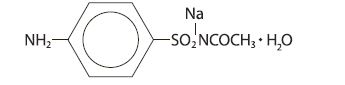
Sodium sulfacetamide is a sulfonamide with antibacterial activity while sulfur acts as a keratolytic agent. Chemically sodium sulfacetamide is N-[(4-aminophenyl) sulfonyl]-acetamide, monosodium salt, monohydrate. The structural formula is:
Each gram of Sodium Sulfacetamide 10% Sulfur 2% Cream contains 100 mg of Sodium Sulfacetamide and 20 mg of Sulfur in a base containing BHT, Ceteareth-20, Cetearyl Alcohol, Cetyl Alcohol,Disodium EDTA, Ethylhexyl Palmitate, Ethylparaben, Fragrance, Glyceryl Monostearate SE, Methylparaben, Phenoxyethanol, Propylene Glycol, Propylparaben, Purified Water, Sodium Thiosulfate and Xanthan Gum.
Indications:
Sodium Sulfacetamide 10% Sulfur 2% Cream is indicated in the topical control of acne vulgaris, acne rosacea and seborrheic dermatitis.
How Supplied:
Sodium Sulfacetamide 10% Sulfur 2% Cream is available in 2 oz (57 g) bottles, NDC 42192-150-02.
Adverse Reactions:
Although rare, sodium sulfacetamide may cause local irritation.
Contraindications:
Sodium Sulfacetamide 10% Sulfur 2% Cream is contraindicated for use by patients having known hypersensitivity to sulfonamides, sulfur or any other component of this preparation. Sodium Sulfacetamide 10% Sulfur 2% Cream is not to be used by patients with kidney disease.
Clinical Pharmacology:
Sodium Sulfacetamide exhibits antibacterial activity. It is believed to block bacterial growth by acting as a competitive antagonist of para-aminobenzoic acid (PABA). While absorption through intact skin has not been determined for sodium sulfacetamide, it is estimated that 1% of topically applied sulfur is absorbed. Although the exact mode of the keralytic activity of sulfur is unknown, it is reported to result from the interaction of sulfur with the cysteine content of keratinocytes. In combination with sulfacetamide, sulfur has been reported to inhibit P. acnes, thereby reducing the associated inflammation.
Dosage and Administration:
Cleanse skin thoroughly before application. Apply a thin layer to affected areas 1-3 times daily or as directed by a physician. To minimize potential dryness, start with one application daily, then gradually increase to 2-3 times daily as needed or as directed by a physician.
Principal Display Panel 57 G Bottle Label
NDC 42192-150-02
Rx Only
Sulfacetamide Sodium 10%
Sulfur 2% Cream
Net wt. 2 oz (57 g)
Acella
PHARMACEUTICALS, LLC
Structured Label Content
Section 34072-9 (34072-9)
FOR EXTERNAL USE ONLY. Keep away from eyes. Keep out of reach of children. Keep container tightly closed.
PRECAUTIONS: General - If irritation develops, use of the product should be discontinued and appropriate therapy instituted. Patients should be carefully observed for possible local irritation or sensitization during long-term therapy. The object of this therapy is to achieve desquamation without irritation, but sodium sulfacetamide and sulfur can cause reddening and scaling of the epidermis. These side effects are not unusual in the treatment of acne vulgaris, but patients should be cautioned about the possibility.
Section 34076-0 (34076-0)
Information for patients - Avoid contact with eyes, eyelids, lips and mucous membranes. If accidental contact occurs, rinse with water. If excessive irritation develops, discontinue use and consult your physician.
Section 34080-2 (34080-2)
NURSING MOTHERS: It is not known whether sodium sulfacetamide is excreted in the human milk following topical use of Sodium Sulfacetamide 10% Sulfur 2% Cream. However, small amounts of orally administered sulfonamides have been reported to be eliminated in human milk. In view of this and because many drugs are excreted in human milk, caution should be exercised when Sodium Sulfacetamide 10% Sulfur 2% Cream is administered to a nursing woman.
Section 34081-0 (34081-0)
PEDIATRIC USE: Safety and effectiveness in children under the age of 12 have not been established.
Section 34083-6 (34083-6)
Carcinogenesis, Mutagenesis and Impairment of Fertility - Long-term studies in animals have not been performed to evaluate carcinogenic potential.
Section 42228-7 (42228-7)
Pregnancy: Category C. Animal reproduction studies have not been conducted with Sodium Sulfacetamide 10% Sulfur 2% Cream. It is not known whether Sodium Sulfacetamide 10% Sulfur 2% Cream can cause fetal harm when administered to a pregnant woman or can affect reproduction capacity. Sodium Sulfacetamide 10% Sulfur 2% Cream should be given to a pregnant woman only if clearly needed.
Section 42229-5 (42229-5)
Rx Only
Section 44425-7 (44425-7)
Store at 20° - 25°C (68° - 77°F); excursions permitted to 15° - 30°C (59° - 86°F) [see USP Controlled Room Temperature]
Warnings: (WARNINGS:)
Although rare, sensitivity to sodium sulfacetamide may occur. Therefore, caution and careful supervision should be observed when prescribing this drug for patients who may be prone to hypersensitivity to topical sulfonamides. Systemic toxic reactions such as agranulocytosis, acute hemolytic anemia, purpura hemorrhagica, drug fever, jaundice and contact dermatitis indicate hypersensitivity to sulfonamides. Particular caution should be employed if areas of denuded or abraded skin are involved.
Description: (DESCRIPTION:)
Sodium sulfacetamide is a sulfonamide with antibacterial activity while sulfur acts as a keratolytic agent. Chemically sodium sulfacetamide is N-[(4-aminophenyl) sulfonyl]-acetamide, monosodium salt, monohydrate. The structural formula is:
Each gram of Sodium Sulfacetamide 10% Sulfur 2% Cream contains 100 mg of Sodium Sulfacetamide and 20 mg of Sulfur in a base containing BHT, Ceteareth-20, Cetearyl Alcohol, Cetyl Alcohol,Disodium EDTA, Ethylhexyl Palmitate, Ethylparaben, Fragrance, Glyceryl Monostearate SE, Methylparaben, Phenoxyethanol, Propylene Glycol, Propylparaben, Purified Water, Sodium Thiosulfate and Xanthan Gum.
Indications: (INDICATIONS:)
Sodium Sulfacetamide 10% Sulfur 2% Cream is indicated in the topical control of acne vulgaris, acne rosacea and seborrheic dermatitis.
How Supplied: (HOW SUPPLIED:)
Sodium Sulfacetamide 10% Sulfur 2% Cream is available in 2 oz (57 g) bottles, NDC 42192-150-02.
Adverse Reactions: (ADVERSE REACTIONS:)
Although rare, sodium sulfacetamide may cause local irritation.
Contraindications: (CONTRAINDICATIONS:)
Sodium Sulfacetamide 10% Sulfur 2% Cream is contraindicated for use by patients having known hypersensitivity to sulfonamides, sulfur or any other component of this preparation. Sodium Sulfacetamide 10% Sulfur 2% Cream is not to be used by patients with kidney disease.
Clinical Pharmacology: (CLINICAL PHARMACOLOGY:)
Sodium Sulfacetamide exhibits antibacterial activity. It is believed to block bacterial growth by acting as a competitive antagonist of para-aminobenzoic acid (PABA). While absorption through intact skin has not been determined for sodium sulfacetamide, it is estimated that 1% of topically applied sulfur is absorbed. Although the exact mode of the keralytic activity of sulfur is unknown, it is reported to result from the interaction of sulfur with the cysteine content of keratinocytes. In combination with sulfacetamide, sulfur has been reported to inhibit P. acnes, thereby reducing the associated inflammation.
Dosage and Administration: (DOSAGE AND ADMINISTRATION:)
Cleanse skin thoroughly before application. Apply a thin layer to affected areas 1-3 times daily or as directed by a physician. To minimize potential dryness, start with one application daily, then gradually increase to 2-3 times daily as needed or as directed by a physician.
Principal Display Panel 57 G Bottle Label (PRINCIPAL DISPLAY PANEL - 57 g Bottle Label)
NDC 42192-150-02
Rx Only
Sulfacetamide Sodium 10%
Sulfur 2% Cream
Net wt. 2 oz (57 g)
Acella
PHARMACEUTICALS, LLC
Advanced Ingredient Data
Raw Label Data
All Sections (JSON)
Additional Information
Back to search View SPL set listing Open on DailyMed ↗
Source: dailymed · Ingested: 2026-02-15T11:47:08.179327 · Updated: 2026-03-14T22:26:24.564180