procort (hydrocortisone acetate and pramoxine hydrochloride) cream
9e899b72-a16e-4b55-93b5-ab5baec37d50
34391-3
HUMAN PRESCRIPTION DRUG LABEL
Drug Facts
Composition & Product
Identifiers & Packaging
Description
PROCORT ®
Medication Information
Indications and Usage
Topical corticosteroids are indicated for the relief of
the inflammatory and pruritic manifestations of corticosteroid-responsive dermatoses.
Dosage and Administration
topical corticosteroids are generally applied to the affected area as a thin film 3 to 4 times daily, depending on the severity of the condition. Occlusive dressing may be used for the management of psoriasis or recalcitrant conditions. If an infection develops, the use of occlusive dressings should be discontinued and appropriate antimicrobial therapy instituted.
Directions for rectal administration:
1. To open, remove foil, tab or puncture foil seal with cap.
2. Remove the applicator’s wrapping and attach the applicator to the tube.
3. Squeeze the tube to fill the applicator and lubricate the tip with cream.
4. Gently insert the applicator into rectum and squeeze tube begin to force the required amount of cream into rectum.
5. Wipe applicator tip clean remove and discard.
6. Securely apply screw cap on tube.
Dosage Forms and Strengths
hydrocortisone acetate 1.85%, Pramoxine HCL 1.15% is a topical cream and supplied in the following:
60 gram tube kit (NDC# 50967–357–60), each containing a 60 g tube and/15 single use app applicators.
2 gram Sample Kit (NDC# 50967–357–02), each containing a 2g tube and/1 single use applicator
Contraindications
Topical corticosteroids are contraindicated in those patients
with a history of hypersensitivity to any of the components of the preparation.
Description
PROCORT ®
Section 34084-4
The following local adverse reactions are reported in frequently with topical corticosteroids, but may occur more frequently with the use of occlusive dressings. These reactions are listed in an approximate decreasing order of occurrence; itching, burning, skin irritation.
Section 34088-5
topically applied corticosteroids can be absorbed in sufficient amounts to produce systemic effects. (See precautions.)
Section 34090-1
Topical corticosteroids share anti-inflammatory,
anti-pruritic and vasoconstrictive actions. The mechanism of anti-inflammatory
activity of topical corticosteroids is unclear. Various laboratory methods, including
a vasoconstrictor assays, are used to compare and predict potencies and/or clinical
efficacies of the topical corticosteroids. There is some evidence to suggest that a
recognizable correlation exists between vasoconstrictor potency and therapeutic
efficacy in man.
Pramoxine hydrochloride is a topical anesthetic agent which provides temporary relief
from itching and pain. It acts by stabilizing the neuronal membrane of nerve endings
with which it comes into contact.
Pharmacokinetics: The extent of percutaneous absorption of topical corticosteroids
is determined by many factors including the vehicle, the integrity of the epidermal
barrier, and the use of occlusive dressings. Topical corticosteroids can be absorbed
from normal intact skin. Inflammation and/or other disease processes in the skin
increase percutaneous absorption. Occlusive dressings substantially increase the
percutaneous absorption of topical corticosteroids. Thus, occlusive dressings may be
a valuable therapeutic adjunct for treatment of resistant dermatoses. (See DOSAGE
AND ADMINISTRATION.)
Once absorbed through the skin, topical corticosteroids are handled through
pharmacokinetic pathways similar to systemically administered corticosteroids.
Corticosteroids are bound to plasma proteins in varying degrees. Corticosteroids are
metabolized primarily in the liver and are then excreted by the kidneys. Some of the
topical corticosteroids and their metabolites are also excreted into the bile.
Section 42230-3
PROCORT ®
Section 42232-9
General: Systemic absorption of topical corticosteroids has produced reversible
hypothalamic-pituitary-adrenal (HPA) axis suppression, manifestations of Cushing’s
syndrome, hyperglycemia, and glucosuria in some patients. Conditions which augment
systemic absorption include the application of the more potent steroids, use over large
surface areas, prolonged use, and the addition of occlusive dressings.
Therefore, patients receiving a large dose of a potent topical steroid applied to a
large surface area and under an occlusive dressing should be evaluated periodically
for evidence of HPA axis suppression by using the urinary free cortisol and ACTH
stimulation tests. If HPA axis suppression is noted, an attempt should be made to
withdraw the drug, to reduce the frequency of application, or to substitute a less
potent steroid. Recovery of HPA axis function is generally prompt and complete upon
discontinuation of the drug. Infrequently, signs and symptoms of steroid withdrawal
may occur, requiring supplemental systemic corticosteroids. Children may absorb
proportionally larger amounts of topical corticosteroids and thus be more susceptible
to systemic toxicity. (See Precautions-Pediatric Use.) If irritation develops, topical
corticosteroids should be discontinued and appropriate therapy instituted.
In the presence of dermatological infections, the use of an appropriate antifungal
or antibacterial agent should be instituted. If a favorable response does not occur
promptly the corticosteroid should be discontinued until the infection has been
adequately controlled.
Information for the Patient: Patients using topical corticosteroids should receive the following information and instructions:
1. This medications is to be used as directed by the physician. It is for external use only. Avoid contact with the eyes.
2. Patients should be advised not to use this medication for any disorder other than for which it was prescribed.
3. The treated skin area should not be bandaged or otherwise covered or wrapped as to be occlusive unless directed by the physician.
4. Patient should report any signs of local adverse reactions especially under occlusive dressings.
5. Parents of pediatric patients should be advised not to use tight-fitting diapers or plastic pants on a child being treated in the diaper area, as these garment may constitute occlusive dressings.
Laboratory Tests: The following tests may be helpful in evaluating the HPA axis suppression: Urinary free cortisol test. ACTH stimulation test
Carcinogenesis, mutagenesis, and Impairment of Fertility: Long-term animal studies have not been performed to evaluate the carcinogenic potential or the effect on fertility of topical corticosteroids. Studies to determine mutagenecity with prednisolone and hydrocortisone have revealed negative results.
Pregnancy: Teratogenic Effects: Pregnancy Category C: Corticosteroids are generally teratogenic in laboratory animals when administered systemically at relatively low dosage levels. The more potent coricosteroids have been shown to be teratogenic after dermal application in laboratory animals. There are no adequate and well-controlled studeis in pregnant women on teratogenic effects from topically applied corticosteroids. Therefore, topical corticosteroids should be used during pregnancy only if the potential benefit justifies the potential risk to the fetus. Drugs of this class should not be used extensively on pregnant patients, in large amounts, or for prolonged periods of time.
Nursing Mothers:It is not known whether topical administration of corticosteroids could result in sufficient systemic absorption to produce detectable amounts in breast milk. Systemically administered corticosteroids are secreted into breast milk in quantitites NOT likely to have deleterious effect on the infant. Nevertheless, caution should be exercised when topical corticosteroids are administered to a nursing woman.
Pediatric Use: Pediatric patients may demonstrate greater susceptibility to topical corticosteroid induced HPA axis suppression and Cushing's syndrome, and intracranial hypertension have been reported in children receiving topical corticosteroids.
Manifestations of adrenal suppression in children include linear growth retardation, delayed weight gain, low plasma cortisol levels, and absence of response to ACTH stimulation. Manifestations of intracranial hypertension include bulging fontanelles, headaches, and bilateral papilledema.
Administration of topical corticosteroids to children should be limited to the least amount compatible with an effective therapeutic regimen. Chronic corticosteroid therapy may interfere with the growth and development of children.
Section 44425-7
ProCort® insert registered symbol,storage condition: store at 25°C (77°F); excursions permitted to 15–30°C (59 to 86°F.)[see USP controlled room temperature]. Rx only.
Distributed by: Women’s Choice, Pharmaceuticals, Berwyn, PA 19312
Www.wcpharma.com
Section 51945-4
Description:
ProCort® is a topical preparation containing hydrocortisone acetate 1.85% and pramoxine hydrochloride 1.15% in a hydrophilic and hydrophobic cream base which contains patented *Invisicare M1 polymer technology.
Active Ingredients: Hydrocortisone Acetate 1.85%, Pramoxine HCL 1.15%
Inactive Ingredients: Polysorbate-60, Poloxamer 124, PVM/MA copolymer VP/Hexadecene copolymer VP/Eicosene copolymer, Tocopheryl acetate, Aminomethyl propanediol, Stearic Acid, Phenoxyethanol, and Sterilized Water.
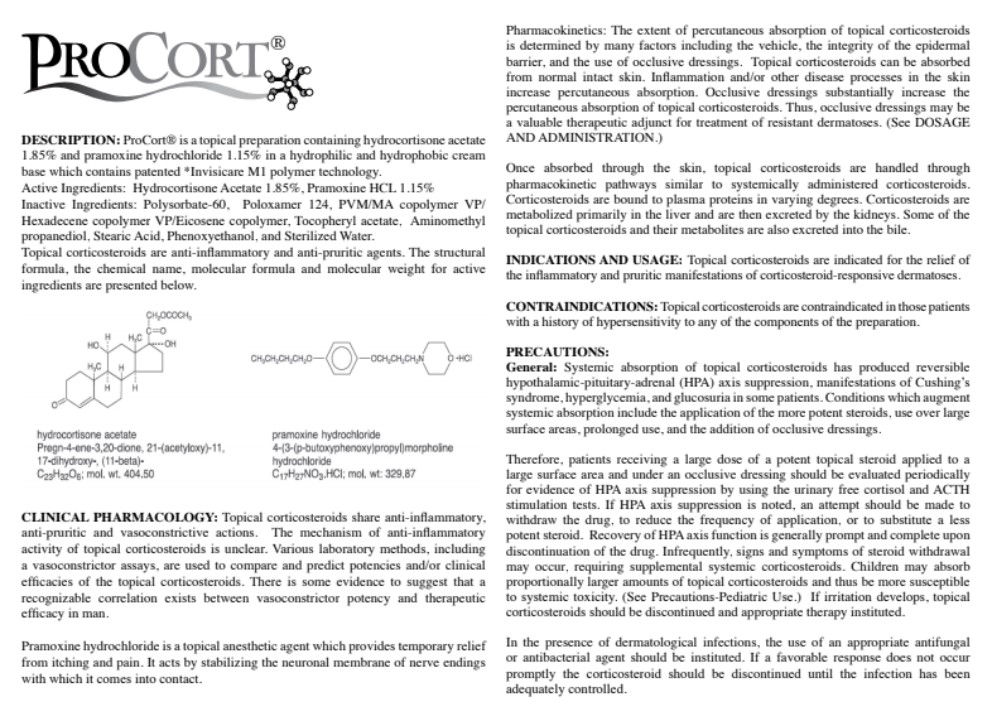
Topical corticosteroids are anti-inflammatory and anti-pruritic agents. The structural formula, the chemical name, molecular formula and molecular weight for active ingredients are presented below.
Procort Carton for 60g
See product literature for complete information.
Contents: Each gram of ProCort contains 1.85% (18.5 mg) Hydrocortisone acetate and 1.15% (11.5 mg) Pramoxine hydrochloride (HCI). Also contains 6% M1 polymer. Inactive ingredients: Polysorbate-60, Poloxamer 124, PVM/MA copolymer VP/Hexadecene copolymer VP/Eicosene copolymer, Tocopheryl acetate, Aminomethyl propanediol, Stearic Acid, Phenoxyenthanol, and Sterilized Water.
Dosage: Apply to affected are 3 - 4 times daily or as directed by your physician
Warning: Keep out of reach of children. Not fur use under diapers or occlusive dressings without physician supervision. for externam use only. Avoid contact with eyes. May discolor fabrics.
Storage: Store at room temperature 15°-30°C (59°-86°F). Keep tightly closed.
To Open: Remove foil tab or puncture foil seal with cap.
Applicator: Use applicator tip as directed by your physician.
DIRECTIONS FOR RECTAL ADMINISTRATION:
1. To open, remove foil tab or puncture foil seal with cap.
2. Remove the applicator's wrapping and attach the applicator to the tube.
3. Squeeze the tube to fill the applicator and libricate the tip with cream.
4. Gently insert the applicator into rectum and squeeze tube again to force the required amount of cream into rectum.
5. Wipe applicator tip clean, remove and discard.
6. Securely apply screw cap on tube.
NDC 50967-357-60
ProCort 1.85% hydrocortisone acetate - 1.15% pramoxine HCI
FOR EXTERNAL USE ONLY
Net Weight 60.0g (2.12 oz)
Distributed by: Women's Choice Pharmaceuticals, Gilbert, AZ 85233
www.wcpharma.com
877-774-4949
Invisicare® M1 Plymer Patent Numbers: 7,674,471, 6,756,059, 6,582,683
Structured Label Content
Indications and Usage (34067-9)
Topical corticosteroids are indicated for the relief of
the inflammatory and pruritic manifestations of corticosteroid-responsive dermatoses.
Dosage and Administration (34068-7)
topical corticosteroids are generally applied to the affected area as a thin film 3 to 4 times daily, depending on the severity of the condition. Occlusive dressing may be used for the management of psoriasis or recalcitrant conditions. If an infection develops, the use of occlusive dressings should be discontinued and appropriate antimicrobial therapy instituted.
Directions for rectal administration:
1. To open, remove foil, tab or puncture foil seal with cap.
2. Remove the applicator’s wrapping and attach the applicator to the tube.
3. Squeeze the tube to fill the applicator and lubricate the tip with cream.
4. Gently insert the applicator into rectum and squeeze tube begin to force the required amount of cream into rectum.
5. Wipe applicator tip clean remove and discard.
6. Securely apply screw cap on tube.
Dosage Forms and Strengths (34069-5)
hydrocortisone acetate 1.85%, Pramoxine HCL 1.15% is a topical cream and supplied in the following:
60 gram tube kit (NDC# 50967–357–60), each containing a 60 g tube and/15 single use app applicators.
2 gram Sample Kit (NDC# 50967–357–02), each containing a 2g tube and/1 single use applicator
Contraindications (34070-3)
Topical corticosteroids are contraindicated in those patients
with a history of hypersensitivity to any of the components of the preparation.
Section 34084-4 (34084-4)
The following local adverse reactions are reported in frequently with topical corticosteroids, but may occur more frequently with the use of occlusive dressings. These reactions are listed in an approximate decreasing order of occurrence; itching, burning, skin irritation.
Section 34088-5 (34088-5)
topically applied corticosteroids can be absorbed in sufficient amounts to produce systemic effects. (See precautions.)
Section 34090-1 (34090-1)
Topical corticosteroids share anti-inflammatory,
anti-pruritic and vasoconstrictive actions. The mechanism of anti-inflammatory
activity of topical corticosteroids is unclear. Various laboratory methods, including
a vasoconstrictor assays, are used to compare and predict potencies and/or clinical
efficacies of the topical corticosteroids. There is some evidence to suggest that a
recognizable correlation exists between vasoconstrictor potency and therapeutic
efficacy in man.
Pramoxine hydrochloride is a topical anesthetic agent which provides temporary relief
from itching and pain. It acts by stabilizing the neuronal membrane of nerve endings
with which it comes into contact.
Pharmacokinetics: The extent of percutaneous absorption of topical corticosteroids
is determined by many factors including the vehicle, the integrity of the epidermal
barrier, and the use of occlusive dressings. Topical corticosteroids can be absorbed
from normal intact skin. Inflammation and/or other disease processes in the skin
increase percutaneous absorption. Occlusive dressings substantially increase the
percutaneous absorption of topical corticosteroids. Thus, occlusive dressings may be
a valuable therapeutic adjunct for treatment of resistant dermatoses. (See DOSAGE
AND ADMINISTRATION.)
Once absorbed through the skin, topical corticosteroids are handled through
pharmacokinetic pathways similar to systemically administered corticosteroids.
Corticosteroids are bound to plasma proteins in varying degrees. Corticosteroids are
metabolized primarily in the liver and are then excreted by the kidneys. Some of the
topical corticosteroids and their metabolites are also excreted into the bile.
Section 42230-3 (42230-3)
PROCORT ®
Section 42232-9 (42232-9)
General: Systemic absorption of topical corticosteroids has produced reversible
hypothalamic-pituitary-adrenal (HPA) axis suppression, manifestations of Cushing’s
syndrome, hyperglycemia, and glucosuria in some patients. Conditions which augment
systemic absorption include the application of the more potent steroids, use over large
surface areas, prolonged use, and the addition of occlusive dressings.
Therefore, patients receiving a large dose of a potent topical steroid applied to a
large surface area and under an occlusive dressing should be evaluated periodically
for evidence of HPA axis suppression by using the urinary free cortisol and ACTH
stimulation tests. If HPA axis suppression is noted, an attempt should be made to
withdraw the drug, to reduce the frequency of application, or to substitute a less
potent steroid. Recovery of HPA axis function is generally prompt and complete upon
discontinuation of the drug. Infrequently, signs and symptoms of steroid withdrawal
may occur, requiring supplemental systemic corticosteroids. Children may absorb
proportionally larger amounts of topical corticosteroids and thus be more susceptible
to systemic toxicity. (See Precautions-Pediatric Use.) If irritation develops, topical
corticosteroids should be discontinued and appropriate therapy instituted.
In the presence of dermatological infections, the use of an appropriate antifungal
or antibacterial agent should be instituted. If a favorable response does not occur
promptly the corticosteroid should be discontinued until the infection has been
adequately controlled.
Information for the Patient: Patients using topical corticosteroids should receive the following information and instructions:
1. This medications is to be used as directed by the physician. It is for external use only. Avoid contact with the eyes.
2. Patients should be advised not to use this medication for any disorder other than for which it was prescribed.
3. The treated skin area should not be bandaged or otherwise covered or wrapped as to be occlusive unless directed by the physician.
4. Patient should report any signs of local adverse reactions especially under occlusive dressings.
5. Parents of pediatric patients should be advised not to use tight-fitting diapers or plastic pants on a child being treated in the diaper area, as these garment may constitute occlusive dressings.
Laboratory Tests: The following tests may be helpful in evaluating the HPA axis suppression: Urinary free cortisol test. ACTH stimulation test
Carcinogenesis, mutagenesis, and Impairment of Fertility: Long-term animal studies have not been performed to evaluate the carcinogenic potential or the effect on fertility of topical corticosteroids. Studies to determine mutagenecity with prednisolone and hydrocortisone have revealed negative results.
Pregnancy: Teratogenic Effects: Pregnancy Category C: Corticosteroids are generally teratogenic in laboratory animals when administered systemically at relatively low dosage levels. The more potent coricosteroids have been shown to be teratogenic after dermal application in laboratory animals. There are no adequate and well-controlled studeis in pregnant women on teratogenic effects from topically applied corticosteroids. Therefore, topical corticosteroids should be used during pregnancy only if the potential benefit justifies the potential risk to the fetus. Drugs of this class should not be used extensively on pregnant patients, in large amounts, or for prolonged periods of time.
Nursing Mothers:It is not known whether topical administration of corticosteroids could result in sufficient systemic absorption to produce detectable amounts in breast milk. Systemically administered corticosteroids are secreted into breast milk in quantitites NOT likely to have deleterious effect on the infant. Nevertheless, caution should be exercised when topical corticosteroids are administered to a nursing woman.
Pediatric Use: Pediatric patients may demonstrate greater susceptibility to topical corticosteroid induced HPA axis suppression and Cushing's syndrome, and intracranial hypertension have been reported in children receiving topical corticosteroids.
Manifestations of adrenal suppression in children include linear growth retardation, delayed weight gain, low plasma cortisol levels, and absence of response to ACTH stimulation. Manifestations of intracranial hypertension include bulging fontanelles, headaches, and bilateral papilledema.
Administration of topical corticosteroids to children should be limited to the least amount compatible with an effective therapeutic regimen. Chronic corticosteroid therapy may interfere with the growth and development of children.
Section 44425-7 (44425-7)
ProCort® insert registered symbol,storage condition: store at 25°C (77°F); excursions permitted to 15–30°C (59 to 86°F.)[see USP controlled room temperature]. Rx only.
Distributed by: Women’s Choice, Pharmaceuticals, Berwyn, PA 19312
Www.wcpharma.com
Section 51945-4 (51945-4)
Description: (DESCRIPTION:)
ProCort® is a topical preparation containing hydrocortisone acetate 1.85% and pramoxine hydrochloride 1.15% in a hydrophilic and hydrophobic cream base which contains patented *Invisicare M1 polymer technology.
Active Ingredients: Hydrocortisone Acetate 1.85%, Pramoxine HCL 1.15%
Inactive Ingredients: Polysorbate-60, Poloxamer 124, PVM/MA copolymer VP/Hexadecene copolymer VP/Eicosene copolymer, Tocopheryl acetate, Aminomethyl propanediol, Stearic Acid, Phenoxyethanol, and Sterilized Water.
Topical corticosteroids are anti-inflammatory and anti-pruritic agents. The structural formula, the chemical name, molecular formula and molecular weight for active ingredients are presented below.
Procort Carton for 60g (ProCort carton for 60g)
See product literature for complete information.
Contents: Each gram of ProCort contains 1.85% (18.5 mg) Hydrocortisone acetate and 1.15% (11.5 mg) Pramoxine hydrochloride (HCI). Also contains 6% M1 polymer. Inactive ingredients: Polysorbate-60, Poloxamer 124, PVM/MA copolymer VP/Hexadecene copolymer VP/Eicosene copolymer, Tocopheryl acetate, Aminomethyl propanediol, Stearic Acid, Phenoxyenthanol, and Sterilized Water.
Dosage: Apply to affected are 3 - 4 times daily or as directed by your physician
Warning: Keep out of reach of children. Not fur use under diapers or occlusive dressings without physician supervision. for externam use only. Avoid contact with eyes. May discolor fabrics.
Storage: Store at room temperature 15°-30°C (59°-86°F). Keep tightly closed.
To Open: Remove foil tab or puncture foil seal with cap.
Applicator: Use applicator tip as directed by your physician.
DIRECTIONS FOR RECTAL ADMINISTRATION:
1. To open, remove foil tab or puncture foil seal with cap.
2. Remove the applicator's wrapping and attach the applicator to the tube.
3. Squeeze the tube to fill the applicator and libricate the tip with cream.
4. Gently insert the applicator into rectum and squeeze tube again to force the required amount of cream into rectum.
5. Wipe applicator tip clean, remove and discard.
6. Securely apply screw cap on tube.
NDC 50967-357-60
ProCort 1.85% hydrocortisone acetate - 1.15% pramoxine HCI
FOR EXTERNAL USE ONLY
Net Weight 60.0g (2.12 oz)
Distributed by: Women's Choice Pharmaceuticals, Gilbert, AZ 85233
www.wcpharma.com
877-774-4949
Invisicare® M1 Plymer Patent Numbers: 7,674,471, 6,756,059, 6,582,683
Advanced Ingredient Data
Raw Label Data
All Sections (JSON)
Additional Information
Back to search View SPL set listing Open on DailyMed ↗
Source: dailymed · Ingested: 2026-02-15T11:46:53.181063 · Updated: 2026-03-14T22:25:56.100461