august 2017
8841ab4d-674d-4beb-88a5-13e35f6005cc
34391-3
HUMAN PRESCRIPTION DRUG LABEL
Drug Facts
Composition & Product
Identifiers & Packaging
Indications and Usage
Cysto-Conray II is indicated for use in retrograde cystography and cystourethrography.
Contraindications
See WARNINGS concerning inadvertant intrathecal administration.
Adverse Reactions
Irritation of the bladder or ureter, common to some degree to all contrast media administered for retrograde urographic procedures, may occasionally occur. As with all contrast media, intravasation may lead to hypersensitivity reactions such as a sense of warmth, flushing, sneezing, sweating, chills, fever, urticaria, laryngeal edema, bronchospasm, hypertension, hypotension, cardiac arrhythmias and cardiac arrest. Adverse reactions associated with procedural technique include injury to the urethra, bladder, ureter, and introduction of infection. In the event of serious or anaphylactoid reactions, it should be kept in mind that the reactions known to occur with intravenous administration of radiopaque contrast materials are possible.
How Supplied
Cysto-Conray ® II Glass Bottles NDC Number 12 x 250 mL single dose bottles 0019-0862-50
Description
NOT FOR INTRAVASCULAR ADMINISTRATION NOT FOR INTRATHECAL USE
Medication Information
Recent Major Changes
NOT FOR INTRAVASCULAR ADMINISTRATION
NOT FOR INTRATHECAL USE
Indications and Usage
Cysto-Conray II is indicated for use in retrograde cystography and cystourethrography.
Contraindications
See WARNINGS concerning inadvertant intrathecal administration.
Adverse Reactions
Irritation of the bladder or ureter, common to some degree to all contrast media administered for retrograde urographic procedures, may occasionally occur.
As with all contrast media, intravasation may lead to hypersensitivity reactions such as a sense of warmth, flushing, sneezing, sweating, chills, fever, urticaria, laryngeal edema, bronchospasm, hypertension, hypotension, cardiac arrhythmias and cardiac arrest.
Adverse reactions associated with procedural technique include injury to the urethra, bladder, ureter, and introduction of infection.
In the event of serious or anaphylactoid reactions, it should be kept in mind that the reactions known to occur with intravenous administration of radiopaque contrast materials are possible.
How Supplied
| Cysto-Conray® II Glass Bottles | NDC Number |
| 12 x 250 mL single dose bottles | 0019-0862-50 |
Description
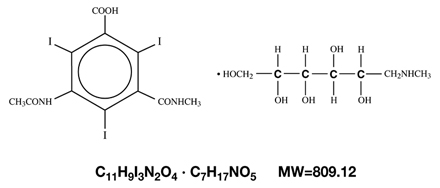
Cysto-Conray II is a sterile aqueous solution intended for instillation as a diagnostic radiopaque medium. Cysto-Conray II contains 17.2% w/v iothalamate meglumine which is 1-Deoxy-1-(methylamino)-D-glucitol 5-acetamido-2,4,6-triiodo-N-methylisophthalamate (salt) and has the following structural formula:
Each milliliter of Cysto-Conray II contains 172 mg of iothalamate meglumine, equivalent to 81 mg (8.1% w/v) of organically bound iodine, 0.110 mg edetate calcium disodium as a stabilizer and 0.115 mg of monobasic sodium phosphate as a buffer.
Cysto-Conray II is hypertonic under conditions of use and is supplied in containers from which the air has been displaced by nitrogen. The pH of Cysto-Conray II is
6.6 to 7.6.
Section 42229-5
SEVERE ADVERSE EVENTS – INADVERTENT INTRATHECAL ADMINISTRATION: Serious adverse reactions have been reported due to the inadvertent intrathecal administration of iodinated contrast media that are not indicated for intrathecal use. These serious adverse reactions include: death, convulsions, cerebral hemorrhage, coma, paralysis, arachnoiditis, acute renal failure, cardiac arrest, seizures, rhabdomyolysis, hyperthermia, and brain edema. Special attention must be given to ensure that this drug product is not administered intrathecally.
General
Diagnostic procedures which involve the use of radiopaque diagnostic agents should be carried out under the direction of personnel with the prerequisite training and with a thorough knowledge of the particular procedure to be performed. Appropriate facilities should be available for coping with any complication of the procedure, as well as for emergency treatment of severe reactions to the contrast agent itself. After administration of the radiocontrast agent, competent personnel and emergency facilities should be available for at least 30 to 60 minutes since delayed reactions have occurred (see ADVERSE REACTIONS ).
The possibility of an idiosyncratic reaction in susceptible patients should always be considered (see ADVERSE REACTIONS ). The susceptible population includes patients with a history of a previous reaction to a contrast medium, patients with a known sensitivity to iodine per se and patients with a known clinical hypersensitivity: bronchial asthma, hay fever and food allergies.
A positive history of allergies or hypersensitivity does not arbitrarily contraindicate the use of a contrast agent where a diagnostic procedure is thought essential, but caution should be exercised (see ADVERSE REACTIONS ). Premedication with antihistamines or corticosteroids to avoid or minimize possible allergic reactions in such patients should be considered. Recent reports indicate that such pre-treatment does not prevent serious life-threatening reactions, but may reduce both their incidence and severity.
Since these procedures require instrumentation, special precautions should be observed in those patients known to have an acute urinary tract infection.
Filling of the bladder should be done at a steady rate, exercising caution to avoid excessive pressure. Sterile procedures should be employed in administration.
Storage
Store at 20° to 25°C (68° to 77°F) [see USP Controlled Room Temperature]. Exposing this product to very cold temperatures may result in crystallization of the salt. If this occurs, the containers should be brought to room temperature. Shake vigorously to assure complete dissolution of any crystals. The speed of dissolution may be increased by heating with circulating warm air. Before use, examine the product to assure that all solids are redissolved and that the container and closure have not been damaged.
This product is sensitive to light and must be protected from strong daylight or direct exposure to the sun.
As with all contrast media, the containers should be inspected prior to use to ensure that breakage or other damage has not occurred during shipping and handling. All containers should be inspected for closure integrity. Damaged containers should not be used.
Manufactured by:
Liebel-Flarsheim Company LLC
Raleigh, NC 27616
Made in USA
GBT 0862A0817
Revised 08/17
Guerbet
Administration
Sterile catherization is essential. Cysto-Conray II may be introduced by gravity flow using an appropriate venoclysis set or by syringe. Excessive pressure should be avoided with any method of administration.
Nursing Mothers
Iothalamate salts are excreted unchanged in human milk. Although it has not been established that serious adverse reactions occur in nursing infants, because of the potential for adverse reactions, caution should be exercised when Cysto-Conray II is administered to a nursing woman.
Use in Pregnancy
Category C. Animal reproduction studies have not been conducted with Cysto-Conray II. It is also not known whether this drug can cause fetal harm when administered to a pregnant woman or can affect reproduction capacity. Cysto-Conray II should be used in pregnant women only if clearly needed.
Patient Preparation
Unless contraindicated, an appropriate laxative is given the night before the examination.
Clinical Pharmacology
The most important characteristic of contrast media is the iodine content. The relatively high atomic weight of iodine contributes sufficient radiodensity for radiographic contrast.
Following instillation by sterile catheter, Cysto-Conray II provides for visualization of the lower urinary tract. Clinical literature reports indicate that routinely less than 1 percent of a retrograde urographic radiopaque is absorbed systemically, however, as much as 12 percent absorption was observed with pyelorenal back flow and may produce iodine medicated thyrotropic effects described under PRECAUTIONS .
Radiographic Technique
The radiographic procedure normally employed for cystography and cystourethrography should be employed. A preliminary radiograph is recommended before the contrast agent is administered.
Information for the Patient
Patients receiving diagnostic agents for instillation urography should be instructed to:
- Inform your physician if you are pregnant.
- Inform your physician if you are allergic to any food, drugs or dyes used for x-ray procedures (see PRECAUTIONS, General ).
- Consult with your physician if, at some future date, any thyroid tests are planned. The iodine in this agent may interfere with later thyroid tests.
- Inform your physician about any other medications you are currently taking.
Drug/laboratory Test Interaction
Thyroid Function Tests – If indicated, these tests generally should be performed prior to the administration of any iodinated agent. However, thyroid function can be evaluated after use of these agents by using T3 resin uptake or free thyroxine assays.
Carcinogenesis, Mutagenesis, Impairment of Fertility
No long-term animal studies have been performed to evaluate carcinogenic potential, mutagenic potential or whether this drug affects fertility in males or females.
Package Label Principal Display Panel Cysto Conray™ll Label
Not For Intravascular Administration
Sterile Solution
Cysto-Conray® ll
250 mL
NDC 0019-0862-50
Iothalamate Meglumine Injection USP 17.2%
81 mg/mL Organically Bound Iodine
For Retrograde Cystography and Cystourethrography
NOT FOR INTRATHECAL USE
Rx Only
Protect from light • Store at 20° to 25°C (68° to 77°F) [see USP Controlled Room Temperature].
Each mL contains 172 mg iothalamate meglumine, 0.110 mg edetate calcium disodium as a stabilizer, and 0.115 mg monobasic sodium phosphate as a buffer.
Single dose container • Discard unused portion
Usual Dosage: See Package Insert.
10230419
Guerbet
Manufactured by:
Liebel-Flarsheim Company LLC
Raleigh, NC 27616
Made in USA
Structured Label Content
Recent Major Changes (34066-1)
NOT FOR INTRAVASCULAR ADMINISTRATION
NOT FOR INTRATHECAL USE
Indications and Usage (INDICATIONS AND USAGE)
Cysto-Conray II is indicated for use in retrograde cystography and cystourethrography.
Contraindications (CONTRAINDICATIONS)
See WARNINGS concerning inadvertant intrathecal administration.
Adverse Reactions (ADVERSE REACTIONS)
Irritation of the bladder or ureter, common to some degree to all contrast media administered for retrograde urographic procedures, may occasionally occur.
As with all contrast media, intravasation may lead to hypersensitivity reactions such as a sense of warmth, flushing, sneezing, sweating, chills, fever, urticaria, laryngeal edema, bronchospasm, hypertension, hypotension, cardiac arrhythmias and cardiac arrest.
Adverse reactions associated with procedural technique include injury to the urethra, bladder, ureter, and introduction of infection.
In the event of serious or anaphylactoid reactions, it should be kept in mind that the reactions known to occur with intravenous administration of radiopaque contrast materials are possible.
How Supplied (HOW SUPPLIED)
| Cysto-Conray® II Glass Bottles | NDC Number |
| 12 x 250 mL single dose bottles | 0019-0862-50 |
Description (DESCRIPTION)
Cysto-Conray II is a sterile aqueous solution intended for instillation as a diagnostic radiopaque medium. Cysto-Conray II contains 17.2% w/v iothalamate meglumine which is 1-Deoxy-1-(methylamino)-D-glucitol 5-acetamido-2,4,6-triiodo-N-methylisophthalamate (salt) and has the following structural formula:
Each milliliter of Cysto-Conray II contains 172 mg of iothalamate meglumine, equivalent to 81 mg (8.1% w/v) of organically bound iodine, 0.110 mg edetate calcium disodium as a stabilizer and 0.115 mg of monobasic sodium phosphate as a buffer.
Cysto-Conray II is hypertonic under conditions of use and is supplied in containers from which the air has been displaced by nitrogen. The pH of Cysto-Conray II is
6.6 to 7.6.
Section 42229-5 (42229-5)
SEVERE ADVERSE EVENTS – INADVERTENT INTRATHECAL ADMINISTRATION: Serious adverse reactions have been reported due to the inadvertent intrathecal administration of iodinated contrast media that are not indicated for intrathecal use. These serious adverse reactions include: death, convulsions, cerebral hemorrhage, coma, paralysis, arachnoiditis, acute renal failure, cardiac arrest, seizures, rhabdomyolysis, hyperthermia, and brain edema. Special attention must be given to ensure that this drug product is not administered intrathecally.
General
Diagnostic procedures which involve the use of radiopaque diagnostic agents should be carried out under the direction of personnel with the prerequisite training and with a thorough knowledge of the particular procedure to be performed. Appropriate facilities should be available for coping with any complication of the procedure, as well as for emergency treatment of severe reactions to the contrast agent itself. After administration of the radiocontrast agent, competent personnel and emergency facilities should be available for at least 30 to 60 minutes since delayed reactions have occurred (see ADVERSE REACTIONS ).
The possibility of an idiosyncratic reaction in susceptible patients should always be considered (see ADVERSE REACTIONS ). The susceptible population includes patients with a history of a previous reaction to a contrast medium, patients with a known sensitivity to iodine per se and patients with a known clinical hypersensitivity: bronchial asthma, hay fever and food allergies.
A positive history of allergies or hypersensitivity does not arbitrarily contraindicate the use of a contrast agent where a diagnostic procedure is thought essential, but caution should be exercised (see ADVERSE REACTIONS ). Premedication with antihistamines or corticosteroids to avoid or minimize possible allergic reactions in such patients should be considered. Recent reports indicate that such pre-treatment does not prevent serious life-threatening reactions, but may reduce both their incidence and severity.
Since these procedures require instrumentation, special precautions should be observed in those patients known to have an acute urinary tract infection.
Filling of the bladder should be done at a steady rate, exercising caution to avoid excessive pressure. Sterile procedures should be employed in administration.
Storage
Store at 20° to 25°C (68° to 77°F) [see USP Controlled Room Temperature]. Exposing this product to very cold temperatures may result in crystallization of the salt. If this occurs, the containers should be brought to room temperature. Shake vigorously to assure complete dissolution of any crystals. The speed of dissolution may be increased by heating with circulating warm air. Before use, examine the product to assure that all solids are redissolved and that the container and closure have not been damaged.
This product is sensitive to light and must be protected from strong daylight or direct exposure to the sun.
As with all contrast media, the containers should be inspected prior to use to ensure that breakage or other damage has not occurred during shipping and handling. All containers should be inspected for closure integrity. Damaged containers should not be used.
Manufactured by:
Liebel-Flarsheim Company LLC
Raleigh, NC 27616
Made in USA
GBT 0862A0817
Revised 08/17
Guerbet
Administration
Sterile catherization is essential. Cysto-Conray II may be introduced by gravity flow using an appropriate venoclysis set or by syringe. Excessive pressure should be avoided with any method of administration.
Nursing Mothers
Iothalamate salts are excreted unchanged in human milk. Although it has not been established that serious adverse reactions occur in nursing infants, because of the potential for adverse reactions, caution should be exercised when Cysto-Conray II is administered to a nursing woman.
Use in Pregnancy
Category C. Animal reproduction studies have not been conducted with Cysto-Conray II. It is also not known whether this drug can cause fetal harm when administered to a pregnant woman or can affect reproduction capacity. Cysto-Conray II should be used in pregnant women only if clearly needed.
Patient Preparation
Unless contraindicated, an appropriate laxative is given the night before the examination.
Clinical Pharmacology (CLINICAL PHARMACOLOGY)
The most important characteristic of contrast media is the iodine content. The relatively high atomic weight of iodine contributes sufficient radiodensity for radiographic contrast.
Following instillation by sterile catheter, Cysto-Conray II provides for visualization of the lower urinary tract. Clinical literature reports indicate that routinely less than 1 percent of a retrograde urographic radiopaque is absorbed systemically, however, as much as 12 percent absorption was observed with pyelorenal back flow and may produce iodine medicated thyrotropic effects described under PRECAUTIONS .
Radiographic Technique
The radiographic procedure normally employed for cystography and cystourethrography should be employed. A preliminary radiograph is recommended before the contrast agent is administered.
Information for the Patient
Patients receiving diagnostic agents for instillation urography should be instructed to:
- Inform your physician if you are pregnant.
- Inform your physician if you are allergic to any food, drugs or dyes used for x-ray procedures (see PRECAUTIONS, General ).
- Consult with your physician if, at some future date, any thyroid tests are planned. The iodine in this agent may interfere with later thyroid tests.
- Inform your physician about any other medications you are currently taking.
Drug/laboratory Test Interaction (Drug/Laboratory Test Interaction)
Thyroid Function Tests – If indicated, these tests generally should be performed prior to the administration of any iodinated agent. However, thyroid function can be evaluated after use of these agents by using T3 resin uptake or free thyroxine assays.
Carcinogenesis, Mutagenesis, Impairment of Fertility
No long-term animal studies have been performed to evaluate carcinogenic potential, mutagenic potential or whether this drug affects fertility in males or females.
Package Label Principal Display Panel Cysto Conray™ll Label (PACKAGE LABEL - PRINCIPAL DISPLAY PANEL - Cysto-Conray™ll Label)
Not For Intravascular Administration
Sterile Solution
Cysto-Conray® ll
250 mL
NDC 0019-0862-50
Iothalamate Meglumine Injection USP 17.2%
81 mg/mL Organically Bound Iodine
For Retrograde Cystography and Cystourethrography
NOT FOR INTRATHECAL USE
Rx Only
Protect from light • Store at 20° to 25°C (68° to 77°F) [see USP Controlled Room Temperature].
Each mL contains 172 mg iothalamate meglumine, 0.110 mg edetate calcium disodium as a stabilizer, and 0.115 mg monobasic sodium phosphate as a buffer.
Single dose container • Discard unused portion
Usual Dosage: See Package Insert.
10230419
Guerbet
Manufactured by:
Liebel-Flarsheim Company LLC
Raleigh, NC 27616
Made in USA
Advanced Ingredient Data
Raw Label Data
All Sections (JSON)
Additional Information
Back to search View SPL set listing Open on DailyMed ↗
Source: dailymed · Ingested: 2026-02-15T11:35:42.882370 · Updated: 2026-03-14T21:44:12.080357