Reblozyl
82f4d266-3f52-41eb-86ba-0abf3cf468e8
34391-3
HUMAN PRESCRIPTION DRUG LABEL
Drug Facts
Composition & Product
Identifiers & Packaging
Indications and Usage
REBLOZYL is an erythroid maturation agent indicated for the treatment of: • Anemia in adult patients with beta thalassemia who require regular red blood cell (RBC) transfusions ( 1.1 ). • Anemia without previous erythropoiesis stimulating agent use (ESA-naïve) in adult patients with very low- to intermediate-risk myelodysplastic syndromes (MDS) who may require regular red blood cell (RBC) transfusions ( 1.2 ). • Anemia failing an erythropoiesis stimulating agent and requiring 2 or more RBC units over 8 weeks in adult patients with very low- to intermediate-risk myelodysplastic syndromes with ring sideroblasts (MDS-RS) or with myelodysplastic/myeloproliferative neoplasm with ring sideroblasts and thrombocytosis (MDS/MPN-RS-T) ( 1.3 ). • Limitations of Use: REBLOZYL is not indicated for use as a substitute for RBC transfusions in patients who require immediate correction of anemia ( 1.4 ).
Dosage and Administration
• Beta thalassemia: The recommended starting dose is 1 mg/kg once every 3 weeks by subcutaneous injection. Increase dose if patient has no reduction in RBC transfusion burden to a maximum of 1.25 mg/kg ( 2.1 ). • Myelodysplastic Syndromes: The recommended starting dose is 1 mg/kg once every 3 weeks by subcutaneous injection. o For ESA-naïve MDS, increase dose to maintain patient’s hemoglobin concentrations within the target range of 10 g/dL to 12 g/dL to a maximum of 1.75 mg/kg ( 2.2 ). o For ESA-refractory or intolerant MDS, increase dose if patient is not RBC transfusion-free to a maximum of 1.75 mg/kg ( 2.2 ). • Review hemoglobin (Hgb) results prior to each administration ( 2.1 , 2.2 ). • See full prescribing information for preparation and administration instructions ( 2.3 ).
Contraindications
None.
Warnings and Precautions
• Thrombosis/Thromboembolism: Increased risk in patients with beta thalassemia. Monitor patients for signs and symptoms of thromboembolic events and institute treatment promptly ( 5.1 ). • Hypertension: Monitor blood pressure (BP) during treatment. Initiate anti-hypertensive treatment if necessary ( 5.2 ). • Extramedullary Hematopoietic (EMH) Masses: Increased risk in patients with beta thalassemia. Monitor patients for symptoms and signs or complications resulting from the EMH masses. Treat according to clinical guidelines and discontinue treatment in case of serious complications due to EMH masses ( 5.3 ). • Embryo-Fetal Toxicity: May cause fetal harm. Advise females of reproductive potential of the potential risk to a fetus and use of effective contraception ( 5.4 , 8.1 , 8.3 ).
Adverse Reactions
The following clinically significant adverse reactions are described elsewhere in the labeling: • Thrombosis/Thromboembolism [see Warnings and Precautions ( 5.1 )] • Hypertension [see Warnings and Precautions ( 5.2 )] • Extramedullary Hematopoietic Masses [see Warnings and Precautions ( 5.3 )]
How Supplied
REBLOZYL (luspatercept-aamt) for injection is a white to off-white lyophilized powder supplied in a single-dose vial. Each carton contains one vial. REBLOZYL 25 mg/vial (NDC 59572-711-01) REBLOZYL 75 mg/vial (NDC 59572-775-01)
Description
Dosage and Administration, Recommended Dosage for Beta Thalassemia ( 2.1 ) 2/2026 Dosage and Administration, Recommended Dosage for Myelodysplastic Syndromes Associated Anemia ( 2.2 ) 2/2026
Medication Information
Warnings and Precautions
• Thrombosis/Thromboembolism: Increased risk in patients with beta thalassemia. Monitor patients for signs and symptoms of thromboembolic events and institute treatment promptly ( 5.1 ). • Hypertension: Monitor blood pressure (BP) during treatment. Initiate anti-hypertensive treatment if necessary ( 5.2 ). • Extramedullary Hematopoietic (EMH) Masses: Increased risk in patients with beta thalassemia. Monitor patients for symptoms and signs or complications resulting from the EMH masses. Treat according to clinical guidelines and discontinue treatment in case of serious complications due to EMH masses ( 5.3 ). • Embryo-Fetal Toxicity: May cause fetal harm. Advise females of reproductive potential of the potential risk to a fetus and use of effective contraception ( 5.4 , 8.1 , 8.3 ).
Indications and Usage
REBLOZYL is an erythroid maturation agent indicated for the treatment of: • Anemia in adult patients with beta thalassemia who require regular red blood cell (RBC) transfusions ( 1.1 ). • Anemia without previous erythropoiesis stimulating agent use (ESA-naïve) in adult patients with very low- to intermediate-risk myelodysplastic syndromes (MDS) who may require regular red blood cell (RBC) transfusions ( 1.2 ). • Anemia failing an erythropoiesis stimulating agent and requiring 2 or more RBC units over 8 weeks in adult patients with very low- to intermediate-risk myelodysplastic syndromes with ring sideroblasts (MDS-RS) or with myelodysplastic/myeloproliferative neoplasm with ring sideroblasts and thrombocytosis (MDS/MPN-RS-T) ( 1.3 ). • Limitations of Use: REBLOZYL is not indicated for use as a substitute for RBC transfusions in patients who require immediate correction of anemia ( 1.4 ).
Dosage and Administration
• Beta thalassemia: The recommended starting dose is 1 mg/kg once every 3 weeks by subcutaneous injection. Increase dose if patient has no reduction in RBC transfusion burden to a maximum of 1.25 mg/kg ( 2.1 ). • Myelodysplastic Syndromes: The recommended starting dose is 1 mg/kg once every 3 weeks by subcutaneous injection. o For ESA-naïve MDS, increase dose to maintain patient’s hemoglobin concentrations within the target range of 10 g/dL to 12 g/dL to a maximum of 1.75 mg/kg ( 2.2 ). o For ESA-refractory or intolerant MDS, increase dose if patient is not RBC transfusion-free to a maximum of 1.75 mg/kg ( 2.2 ). • Review hemoglobin (Hgb) results prior to each administration ( 2.1 , 2.2 ). • See full prescribing information for preparation and administration instructions ( 2.3 ).
Contraindications
None.
Adverse Reactions
The following clinically significant adverse reactions are described elsewhere in the labeling: • Thrombosis/Thromboembolism [see Warnings and Precautions ( 5.1 )] • Hypertension [see Warnings and Precautions ( 5.2 )] • Extramedullary Hematopoietic Masses [see Warnings and Precautions ( 5.3 )]
How Supplied
REBLOZYL (luspatercept-aamt) for injection is a white to off-white lyophilized powder supplied in a single-dose vial. Each carton contains one vial. REBLOZYL 25 mg/vial (NDC 59572-711-01) REBLOZYL 75 mg/vial (NDC 59572-775-01)
Description
Dosage and Administration, Recommended Dosage for Beta Thalassemia ( 2.1 ) 2/2026 Dosage and Administration, Recommended Dosage for Myelodysplastic Syndromes Associated Anemia ( 2.2 ) 2/2026
|
PATIENT INFORMATION |
|
|
What is REBLOZYL? REBLOZYL is a prescription medicine used to treat anemia (low red blood cells) in adults with:
REBLOZYL is not for use as a substitute for RBC transfusions in people who need immediate treatment for anemia. |
|
|
Before receiving REBLOZYL, tell your healthcare provider about all of your medical conditions, including if you:
Tell your healthcare provider about all the medicines you take, including prescription and over-the-counter medicines, vitamins, and herbal supplements. |
|
|
How will I receive REBLOZYL?
If your scheduled REBLOZYL dose is delayed or missed, your healthcare provider will give your dose of REBLOZYL as soon as possible and continue your treatment as prescribed with at least 3 weeks between doses. |
|
|
What are the possible side effects of REBLOZYL?
The most common side effects of REBLOZYL include: |
|
|
|
|
REBLOZYL may cause fertility problems in females. This could affect your ability to become pregnant. Talk to your healthcare provider if this is a concern for you. |
|
|
General information about the safe and effective use of REBLOZYL.
|
|
|
What are the ingredients in REBLOZYL?
For more information, go to www.REBLOZYL.com or call 1-888-423-5436. |
|
|
Manufactured by: Celgene Corporation, a Bristol-Myers Squibb Company, 86 Morris Avenue, Summit, NJ 07901 REBLOZYL® is a registered trademark of Celgene Corporation, a Bristol-Myers Squibb Company. REBPPI V6 2/2026 |
This Patient Information has been approved by the U.S. Food and Drug Administration
Revised: February 2026
Section 42229-5
Dose Modifications for Response
Assess and review hemoglobin results prior to each administration of REBLOZYL. If an RBC transfusion occurred prior to dosing, use the pretransfusion hemoglobin for dose evaluation.
Dose modifications for response are provided in Table 1. Do not increase the dose beyond the maximum dose of 1.25 mg/kg.
In absence of transfusion, if hemoglobin increase is greater than 2 g/dL within 3 weeks or the predose hemoglobin is greater than or equal to 11.5 g/dL, reduce the dose or interrupt treatment with REBLOZYL as described in Table 1.
| * Do not increase the dose if the patient is experiencing an adverse reaction as described in Table 2. | |
|
|
REBLOZYL
|
|
Starting Dose |
|
|
Dose Increases for Insufficient Response |
|
|
If after at least 2 consecutive doses (6 weeks) at 1 mg/kg, a patient:
|
|
|
If after 3 consecutive doses (9 weeks) at 1.25 mg/kg, a patient:
|
|
|
Dose Modifications for Predose Hemoglobin Levels or Rapid Hemoglobin Rise |
|
|
Predose hemoglobin is greater than or equal to 11.5 g/dL in absence of transfusion |
|
|
Increase in hemoglobin greater than 2 g/dL within 3 weeks in absence of transfusion and
|
|
Section 43683-2
9.2 Abuse
Abuse is the intentional, non-therapeutic use of a drug, even once, for its desirable psychological or physiological effects. Abuse of REBLOZYL may be seen in athletes for the effects on erythropoiesis to enhance athletic performance. Abuse of drugs that increase erythropoiesis, such as REBLOZYL, by healthy persons may lead to polycythemia, which may be associated with life-threatening cardiovascular complications (e.g., stroke, myocardial infarction, and thromboembolism).
Luspatercept-aamt and its metabolites neither selectively penetrate the central nervous system, nor produce behavioral effects in animals that are consistent with central nervous system activity.
16.2 Storage
Store vials refrigerated at 2°C to 8°C (36°F to 46°F) in original carton to protect from light. Do not freeze.
11 Description
Luspatercept-aamt is an erythroid maturation agent. Luspatercept-aamt is a receptor fusion protein consisting of a modified extracellular domain of the human activin receptor type IIB linked to a human IgG1 Fc domain with a calculated molecular mass of approximately 76 kD. Luspatercept is produced in Chinese hamster ovary cells by recombinant DNA technology.
REBLOZYL (luspatercept-aamt) for injection is a sterile, preservative-free, white to off-white, lyophilized powder in single-dose vials for subcutaneous use after reconstitution.
Each 25 mg single-dose vial provides nominal 25 mg of luspatercept-aamt and citric acid monohydrate (0.085 mg), polysorbate 80 (0.10 mg), sucrose (45 mg), and tri-sodium citrate dihydrate (1.35 mg) at pH 6.5. After reconstitution with 0.68 mL Sterile Water for Injection USP, the resulting concentration is 25 mg/0.5 mL of luspatercept-aamt and the nominal deliverable volume is 0.5 mL.
Each 75 mg single-dose vial provides nominal 75 mg of luspatercept-aamt and citric acid monohydrate (0.254 mg), polysorbate 80 (0.30 mg), sucrose (135 mg), and tri-sodium citrate dihydrate (4.06 mg) at pH 6.5. After reconstitution with 1.6 mL Sterile Water for Injection USP, the resulting concentration is 75 mg/1.5 mL (50 mg/mL) of luspatercept-aamt and the nominal deliverable volume is 1.5 mL.
5.2 Hypertension
Hypertension was reported in 63/554 (11.4%) of REBLOZYL-treated patients. Across clinical studies, the incidence of Grade 3-4 hypertension ranged from 2% to 9.6%.
In adult patients with beta thalassemia with normal baseline blood pressure, 13 (6.2%) patients developed systolic blood pressure (SBP) ≥130 mm Hg and 33 (16.6%) patients developed diastolic blood pressure (DBP) ≥80 mm Hg.
In ESA-refractory or -intolerant adult patients with MDS with normal baseline blood pressure, 26 (30%) patients developed SBP ≥130 mm Hg and 23 (16%) patients developed DBP ≥80 mm Hg. In ESA-naïve adult patients with MDS with normal baseline blood pressure, 23 (36%) patients developed SBP ≥140 mm Hg and 11 (6%) patients developed DBP ≥80 mm Hg.
Monitor blood pressure prior to each administration. Manage new-onset hypertension or exacerbations of preexisting hypertension using anti-hypertensive agents.
16.1 How Supplied
REBLOZYL (luspatercept-aamt) for injection is a white to off-white lyophilized powder supplied in a single-dose vial. Each carton contains one vial.
REBLOZYL 25 mg/vial (NDC 59572-711-01)
REBLOZYL 75 mg/vial (NDC 59572-775-01)
8.4 Pediatric Use
Safety and effectiveness in pediatric patients have not been established. Based on findings in juvenile animals, REBLOZYL is not recommended for use in pediatric patients [see Nonclinical Toxicology (13.1)].
8.5 Geriatric Use
Clinical studies of REBLOZYL in beta thalassemia did not include sufficient numbers of patients age 65 years and older to determine whether they respond differently from younger patients.
Clinical studies of REBLOZYL for treatment of anemia in ESA-naïve and ESA-refractory or -intolerant MDS included 347 (82%) patients ≥ 65 years of age and 167 (39%) patients ≥ 75 years of age. No differences in safety or effectiveness were observed between older (≥ 65 years) and younger patients.
12.6 Immunogenicity
The observed incidence of anti-drug antibodies (ADA) is highly dependent on the sensitivity and specificity of the assay. Differences in assay methods preclude meaningful comparisons of the incidence of anti-drug antibodies in the studies described below with the incidence of anti-drug antibodies in other studies, including those of REBLOZYL or of other luspatercept products.
In the BELIEVE trial, the median duration of exposure was 64 weeks, with a median ADA sampling period of 50 weeks. Of the 220 patients in the BELIEVE trial with beta thalassemia who require regular RBC transfusions treated with REBLOZYL and evaluable for the presence of anti-luspatercept-aamt antibodies, 4 patients (1.81%) tested positive for treatment-emergent anti-luspatercept-aamt antibodies, including 2 patients (0.9%) who had neutralizing antibodies detected. The majority of anti-luspatercept-aamt antibodies were of low titers.
In the COMMANDS trial, the median duration of exposure was 42 weeks, with the median ADA sampling period of 27 weeks. In the MEDALIST trial, the median duration of exposure was 49 weeks, with the median ADA sampling period of 46 weeks. Of the 331 ESA-naïve (COMMANDS trial) and ESA-refractory or -intolerant (MEDALIST trial) patients with MDS who were treated with REBLOZYL, 21 patients (6.3%) tested positive for treatment-emergent anti-luspatercept-aamt antibodies, including 14 patients (4.2%) who had neutralizing antibodies. The majority of anti-luspatercept-aamt antibodies were of low titers.
There were no severe acute systemic hypersensitivity reactions reported for patients with anti-luspatercept-aamt antibodies in REBLOZYL clinical trials, and there was no association between hypersensitivity type reaction or injection site reaction and presence of anti-luspatercept-aamt antibodies. There was no apparent effect of anti-luspatercept-aamt antibodies on clinical response.
Anti-Drug Antibody Effects on Pharmacokinetics
Among patients in the BELIEVE trial with luspatercept-aamt exposure data available, luspatercept‑aamt mean trough concentration (Ctrough) was approximately 35% lower in 4 patients with beta thalassemia who tested positive for treatment‑emergent anti‑luspatercept‑aamt antibodies (2.19 μg/mL) compared to patients with beta thalassemia who did not develop treatment‑emergent anti‑luspatercept‑aamt antibodies (3.38 μg/mL). There is insufficient data to assess whether the observed anti-luspatercept-aamt antibody associated pharmacokinetic changes reduce effectiveness in patients with beta thalassemia.
Among 21 ESA-naïve and ESA-refractory or -intolerant patients with MDS in the COMMANDS and MEDALIST trials who tested positive for treatment-emergent anti‑luspatercept‑aamt antibodies, there were no identified clinically significant effects of anti‑luspatercept‑aamt antibodies on pharmacokinetics, pharmacodynamics, safety, or effectiveness of luspatercept‑aamt over the treatment duration.
4 Contraindications
None.
6 Adverse Reactions
1.1 Beta Thalassemia
REBLOZYL is indicated for the treatment of anemia in adult patients with beta thalassemia who require regular red blood cell (RBC) transfusions.
12.3 Pharmacokinetics
Luspatercept-aamt exhibited linear pharmacokinetics (PK) over the dose range of 0.2 to 1.25 mg/kg (0.2 to 1.25 times the recommended starting dosage) in patients with beta thalassemia, and from 0.125 mg/kg to 1.75 mg/kg (0.125 to 1.75 times the recommended starting dosage) in patients with MDS. The geometric mean (% coefficient of variation [%CV]) steady-state AUC at the starting dose of 1 mg/kg was 126 (35.9%) day•µg/mL for patients with beta thalassemia and 154 (37.4%) day•µg/mL for patients with MDS. Luspatercept-aamt serum concentration reached steady state after 3 doses when administered every 3 weeks. The accumulation ratio of luspatercept-aamt was approximately 1.5.
14.1 Beta Thalassemia
The efficacy of REBLOZYL was evaluated in adult patients with beta thalassemia in the BELIEVE trial (NCT02604433). BELIEVE was a multicenter, randomized, double-blind, placebo-controlled trial in which (n=336) patients with beta thalassemia requiring regular red blood cell transfusions (6-20 RBC units per 24 weeks) with no transfusion-free period greater than 35 days during that period were randomized 2:1 to REBLOZYL (n=224) or placebo (n=112). In BELIEVE, REBLOZYL was administered subcutaneously once every 3 weeks as long as a reduction in transfusion requirement was observed or until unacceptable toxicity. All patients were eligible to receive best supportive care, which included RBC transfusions; iron-chelating agents; use of antibiotic, antiviral, and antifungal therapy; and/or nutritional support, as needed.
The BELIEVE trial excluded patients with a diagnosis of Hemoglobin S/β-thalassemia or isolated alpha (α)-thalassemia (e.g., Hemoglobin H) or who had major organ damage (liver disease, heart disease, lung disease, renal insufficiency). Patients with recent deep vein thrombosis or stroke or recent use of ESA, immunosuppressant, or hydroxyurea therapy were also excluded. The median age was 30 years (range: 18-66). The trial was comprised of patients who were 42% male, 54.2% White, 34.8% Asian, and 0.3% Black or African American. The percent of patients reporting their race as “other” was 7.7%, and race was not collected or reported for 3% of patients.
Table 13 summarizes the baseline disease-related characteristics in the BELIEVE study.
| HbE=hemoglobin E. a "Missing" category includes patients in the population who had no result for the parameter listed. |
||
|
Disease Characteristic |
REBLOZYL
|
Placebo
|
|
Beta thalassemia diagnosis, n (%) |
||
|
Beta-thalassemia |
174 (77.7) |
83 (74.1) |
|
HbE/beta thalassemia |
31 (13.8) |
21 (18.8) |
|
Beta thalassemia combined with alpha-thalassemia |
18 (8) |
8 (7.1) |
|
Missing a |
1 (0.4) |
0 |
|
Baseline transfusion burden 12 weeks prior to randomization |
||
|
Median (min, max) (Units/12 weeks) |
6.12 (3, 14) |
6.27 (3, 12) |
|
Beta thalassemia gene mutation grouping, n (%) |
||
|
β0/β0 |
68 (30.4) |
35 (31.3) |
|
Non-β0/β0 |
155 (69.2) |
77 (68.8) |
|
Missing a |
1 (0.4) |
0 |
|
Baseline serum ferritin level (μg/L) |
||
|
N |
220 |
111 |
|
Median (min, max) |
1441.25 (88, 6400) |
1301.50 (136, 6400) |
|
Splenectomy, n (%) |
||
|
Yes |
129 (57.6) |
65 (58) |
|
No |
95 (42.4) |
47 (42) |
|
Age patient started regular transfusions (years) |
||
|
N |
169 |
85 |
|
Median (min, max) |
2 (0, 52) |
2 (0, 51) |
The efficacy of REBLOZYL in adult patients with beta thalassemia was established based upon the proportion of patients achieving RBC transfusion burden reduction (≥33% reduction from baseline) with a reduction of at least 2 units from Week 13 to Week 24.
Efficacy results are shown in Table 14.
|
Endpoint |
REBLOZYL
|
Placebo
|
Risk Difference
|
p-value |
|
≥33% Reduction from baseline in RBC transfusion burden with a reduction of at least 2 units for 12 consecutive weeks |
||||
|
Primary endpoint – Week 13 to Week 24 |
47 (21.0) |
5 (4.5) |
16.5 (9.9, 23.1) |
<0.0001 |
|
Week 37 to Week 48 |
44 (19.6) |
4 (3.6) |
16.1 (9.8, 22.4) |
<0.0001 |
|
≥50% Reduction from baseline in RBC transfusion burden with a reduction of at least 2 units for 12 consecutive weeks |
||||
|
Week 13 to Week 24 |
16 (7.1) |
2 (1.8) |
5.4 (1.2, 9.5) |
0.0402 |
|
Week 37 to Week 48 |
23 (10.3) |
1 (0.9) |
9.4 (5, 13.7) |
0.0017 |
1.4 Limitations of Use
REBLOZYL is not indicated for use as a substitute for RBC transfusions in patients who require immediate correction of anemia.
1 Indications and Usage
REBLOZYL is an erythroid maturation agent indicated for the treatment of:
-
•Anemia in adult patients with beta thalassemia who require regular red blood cell (RBC) transfusions (1.1).
-
•Anemia without previous erythropoiesis stimulating agent use (ESA-naïve) in adult patients with very low- to intermediate-risk myelodysplastic syndromes (MDS) who may require regular red blood cell (RBC) transfusions (1.2).
-
•Anemia failing an erythropoiesis stimulating agent and requiring 2 or more RBC units over 8 weeks in adult patients with very low- to intermediate-risk myelodysplastic syndromes with ring sideroblasts (MDS-RS) or with myelodysplastic/myeloproliferative neoplasm with ring sideroblasts and thrombocytosis (MDS/MPN-RS-T) (1.3).
-
•Limitations of Use: REBLOZYL is not indicated for use as a substitute for RBC transfusions in patients who require immediate correction of anemia (1.4).
12.1 Mechanism of Action
Luspatercept-aamt is a recombinant fusion protein that binds several endogenous TGF-β superfamily ligands, thereby diminishing Smad2/3 signaling. In models of β-thalassemia and MDS, luspatercept-aamt decreased abnormally elevated Smad2/3 signaling and improved hematology parameters associated with ineffective erythropoiesis in mice. Luspatercept-aamt promoted erythroid maturation through differentiation and increasing the percentage of late-stage erythroid precursors (normoblasts) in the bone marrow of mice and increased erythroid precursors in humans, thereby increasing erythropoiesis.
9.1 Controlled Substance
REBLOZYL contains luspatercept-aamt, which is not a controlled substance.
5.4 Embryo Fetal Toxicity
Based on findings from animal reproductive studies, REBLOZYL may cause fetal harm when administered to a pregnant woman. In animal reproduction studies, administration of luspatercept-aamt to pregnant rats and rabbits during organogenesis resulted in adverse developmental outcomes including increased embryo-fetal mortality, alterations to growth, and structural abnormalities at exposures (based on area under the curve [AUC]) above those occurring at the maximum recommended human dose (MRHD) of 1.75 mg/kg.
Advise pregnant women of the potential risk to a fetus. Advise females of reproductive potential to use an effective method of contraception during treatment with REBLOZYL and for at least 3 months after the final dose [see Use in Specific Populations (8.1, 8.3)].
5 Warnings and Precautions
-
•Thrombosis/Thromboembolism: Increased risk in patients with beta thalassemia. Monitor patients for signs and symptoms of thromboembolic events and institute treatment promptly (5.1).
-
•Hypertension: Monitor blood pressure (BP) during treatment. Initiate anti-hypertensive treatment if necessary (5.2).
-
•Extramedullary Hematopoietic (EMH) Masses: Increased risk in patients with beta thalassemia. Monitor patients for symptoms and signs or complications resulting from the EMH masses. Treat according to clinical guidelines and discontinue treatment in case of serious complications due to EMH masses (5.3).
-
•Embryo-Fetal Toxicity: May cause fetal harm. Advise females of reproductive potential of the potential risk to a fetus and use of effective contraception (5.4, 8.1, 8.3).
2 Dosage and Administration
-
•Beta thalassemia: The recommended starting dose is 1 mg/kg once every 3 weeks by subcutaneous injection. Increase dose if patient has no reduction in RBC transfusion burden to a maximum of 1.25 mg/kg (2.1).
-
•Myelodysplastic Syndromes: The recommended starting dose is 1 mg/kg once every 3 weeks by subcutaneous injection.
-
•Review hemoglobin (Hgb) results prior to each administration (2.1, 2.2).
-
•See full prescribing information for preparation and administration instructions (2.3).
3 Dosage Forms and Strengths
-
•For injection: 25 mg white to off-white lyophilized powder in a single-dose vial for reconstitution.
-
•For injection: 75 mg white to off-white lyophilized powder in a single-dose vial for reconstitution.
8 Use in Specific Populations
Lactation: Advise not to breastfeed (8.2).
5.1 Thrombosis/thromboembolism
In adult patients with beta thalassemia, thromboembolic events (TEE) were reported in 8/223 (3.6%) REBLOZYL-treated patients. Reported TEEs included deep vein thromboses, pulmonary embolus, portal vein thrombosis, and ischemic strokes. Patients with known risk factors for thromboembolism, e.g. splenectomy or concomitant use of hormone replacement therapy, may be at further increased risk of thromboembolic conditions. Consider thromboprophylaxis in patients with beta thalassemia at increased risk of TEE.
Monitor patients receiving REBLOZYL for signs and symptoms of thromboembolic events and institute treatment promptly.
6.1 Clinical Trials Experience
Because clinical trials are conducted under widely varying conditions, adverse reaction rates observed in the clinical trials of a drug cannot be directly compared to rates in the clinical trials of another drug and may not reflect the rates observed in practice.
The data in the WARNINGS AND PRECAUTIONS reflect exposure to REBLOZYL as a single agent administered across a range of doses (0.125 mg/kg to 1.75 mg/kg) in 571 patients in 4 trials.
17 Patient Counseling Information
Discuss the following with patients prior to and during treatment with REBLOZYL.
2.3 Preparation and Administration
REBLOZYL should be reconstituted and administered by a healthcare professional.
Reconstitute REBLOZYL with Sterile Water for Injection, USP only.
| Vial Size | Amount of Sterile Water for Injection, USP required for reconstitution | Final Concentration | Deliverable Volume |
|---|---|---|---|
|
25 mg vial |
0.68 mL |
25 mg/0.5 mL (50 mg/mL) |
0.5 mL |
|
75 mg vial |
1.6 mL |
75 mg/1.5 mL |
1.5 mL |
|
(50 mg/mL) |
Reconstitute the number of REBLOZYL vials to achieve the appropriate dose based on the patient’s weight. Use a syringe with suitable graduations for reconstitution to ensure accurate dosage.
5.3 Extramedullary Hematopoietic Masses
In adult patients with transfusion dependent beta thalassemia, EMH masses were observed in 3.2% of REBLOZYL-treated patients, with spinal cord compression symptoms due to EMH masses occurring in 1.9% of patients (BELIEVE and REBLOZYL long-term follow-up study).
In a study of adult patients with non-transfusion dependent beta thalassemia, a higher incidence of EMH masses was observed in 6.3% of REBLOZYL-treated patients vs. 2% of placebo-treated patients in the double-blind phase of the study, with spinal cord compression due to EMH masses occurring in 1 patient with a prior history of EMH. REBLOZYL is not indicated for use in patients with non-transfusion dependent beta-thalassemia.
Possible risk factors for the development of EMH masses in patients with beta thalassemia include history of EMH masses, splenectomy, splenomegaly, hepatomegaly, or low baseline hemoglobin (<8.5 g/dL). Signs and symptoms may vary depending on the anatomical location. Monitor patients with beta thalassemia at initiation and during treatment for symptoms and signs or complications resulting from the EMH masses and treat according to clinical guidelines. Discontinue treatment with REBLOZYL in case of serious complications due to EMH masses. Avoid use of REBLOZYL in patients requiring treatment to control the growth of EMH masses.
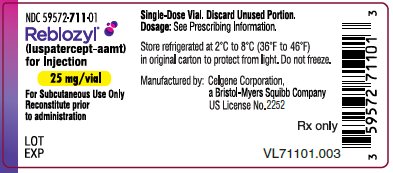
Principal Display Panel 25 Mg Vial Label
NDC 59572-711-01
Reblozyl®
(luspatercept-aamt)
for Injection
25 mg/vial
For Subcutaneous Use Only
Reconstitute prior
to administration
LOT
EXP
Principal Display Panel 75 Mg Vial Label
NDC 59572-775-01
Reblozyl®
(luspatercept-aamt)
for Injection
75 mg/vial
For Subcutaneous Use Only
Reconstitute prior
to administration
LOT
EXP
2.1 Recommended Dosage for Beta Thalassemia
The recommended starting dose of REBLOZYL is 1 mg/kg once every 3 weeks by subcutaneous injection for patients with beta thalassemia. Prior to each REBLOZYL dose, review the patient’s hemoglobin and transfusion record.
Titrate the dose based on responses according to Table 1. Interrupt treatment for adverse reactions as described in Table 2.
Discontinue REBLOZYL if no response as described in Table 1, or if unacceptable toxicity occurs at any time as described in Table 2.
If a planned administration of REBLOZYL is delayed or missed, administer REBLOZYL as soon as possible and continue dosing as prescribed, with at least 3 weeks between doses.
1.2 Myelodysplastic Syndromes Associated Anemia
REBLOZYL is indicated for the treatment of anemia without previous erythropoiesis stimulating agent use (ESA-naïve) in adult patients with very low- to intermediate-risk myelodysplastic syndromes (MDS) who may require regular red blood cell (RBC) transfusions.
Principal Display Panel 25 Mg Vial Carton Usa
NDC 59572-711-01
Rx only
Reblozyl®
(luspatercept-aamt)
for Injection
25 mg/vial
For Subcutaneous Use Only
Reconstitute with Sterile Water
for Injection USP, prior to
administration.
One Single-Dose Vial
Discard Unused Portion
Principal Display Panel 75 Mg Vial Carton Usa
NDC 59572-775-01
Rx only
Reblozyl®
(luspatercept-aamt)
for Injection
75 mg/vial
For Subcutaneous Use Only
Reconstitute with Sterile Water
for Injection USP, prior to
administration.
One Single-Dose Vial
Discard Unused Portion
Principal Display Panel 25 Mg Vial Carton Singapore
NDC 59572-711-01
Rx only
Reblozyl®
(luspatercept-aamt)
for Injection
25 mg/vial
For Subcutaneous Use Only
Reconstitute with Sterile Water
for Injection USP, prior to
administration.
One Single-Dose Vial
Discard Unused Portion
Principal Display Panel 75 Mg Vial Carton Singapore
NDC 59572-775-01
Rx only
Reblozyl®
(luspatercept-aamt)
for Injection
75 mg/vial
For Subcutaneous Use Only
Reconstitute with Sterile Water
for Injection USP, prior to
administration.
One Single-Dose Vial
Discard Unused Portion
13.1 Carcinogenesis, Mutagenesis, Impairment of Fertility
No carcinogenicity or mutagenicity studies have been conducted with luspatercept-aamt.
In a repeat-dose toxicity study, juvenile rats were administered luspatercept-aamt subcutaneously at 1, 3, or 10 mg/kg once every 2 weeks from postnatal day 7 to 91. Hematologic malignancies (granulocytic leukemia, lymphocytic leukemia, malignant lymphoma) were observed at 10 mg/kg resulting in exposures (based on area under the curve [AUC]) approximately 4.4 times the maximum recommended human dose (MRHD) of 1.75 mg/kg.
In a combined male and female fertility and early embryonic development study in rats, luspatercept-aamt was administered subcutaneously to animals at doses of 1 to 15 mg/kg. There were significant reductions in the average numbers of corpora lutea, implantations, and viable embryos in luspatercept-aamt-treated females. Effects on female fertility were observed at the highest dose with exposures (based on AUC) approximately 7-times the MRHD of 1.75 mg/kg. Adverse effects on fertility in female rats were reversible after a 14-week recovery period. No adverse effects were noted in male rats.
2.2 Recommended Dosage for Myelodysplastic Syndromes Associated Anemia
The recommended starting dosage of REBLOZYL is 1 mg/kg once every 3 weeks by subcutaneous injection for the treatment of anemia of MDS. Prior to each REBLOZYL dose, review the patient’s hemoglobin and transfusion record.
Titrate the dose based on responses according to Table 3 and Table 4. Interrupt treatment for adverse reactions as described in Table 5.
Discontinue REBLOZYL if no response as described in Table 3 and Table 4, or if unacceptable toxicity occurs at any time as described in Table 5.
If a planned administration of REBLOZYL is delayed or missed, administer REBLOZYL as soon as possible and continue dosing as prescribed, with at least 3 weeks between doses.
14.2 Treatment of Myelodysplastic Syndromes With Associated Anemia in Esa Naïve Patients
The efficacy of REBLOZYL was evaluated in the COMMANDS trial (NCT03682536), a multi‑center, open‑label, randomized active‑controlled trial comparing REBLOZYL versus epoetin alfa in patients with anemia due to IPSS‑R very low, low, or intermediate‑risk myelodysplastic syndromes or with myelodysplastic/myeloproliferative neoplasm with ring sideroblasts and thrombocytosis (MDS/MPN RS‑T) in ESA‑naïve patients (with endogenous sEPO levels of < 500 U/L) who require regular red blood cell transfusions. For eligibility, patients were required to have had 2 to 6 RBC units/8 weeks confirmed for a minimum of 8 weeks immediately preceding randomization.
The COMMANDS trial included 356 patients randomized 1:1 to REBLOZYL (N=178) or epoetin alfa (N=178). Randomization was stratified by RBC transfusion burden, RS status, and endogenous serum erythropoietin (sEPO) level at baseline. Treatment was started at 1 mg/kg subcutaneously every 3 weeks. Two dose level increases were allowed (to 1.33 mg/kg and to 1.75 mg/kg). Doses were held and subsequently reduced for adverse reactions, reduced if the hemoglobin increased by ≥ 2 g/dL from the prior cycle, and held if the predose hemoglobin was ≥ 12 g/dL.
All patients received best supportive care, which included RBC transfusions as needed. Patients were treated for 24 weeks and were assessed for efficacy at that time point. Treatment beyond 24 weeks was optional based upon response to treatment and absence of disease progression.
The median age of the 356 study participants was 74 years (range: 33, 93 years). The trial population was 56% male and 44% female; 79.5% were White, 0.6% Black or African American, 12.1% Asian, and race was not reported in 7.9% of patients. Ethnicities were reported as 85.4% for Not Hispanic or Latino patients, 6.5% for Hispanic or Latino patients, 7.6% for patients with no ethnicity reported, and 0.6% were unknown. IPSS‑R risk classification at baseline was 9.3% very low, 72.2% low, 17.4% intermediate, 0.3% high, and 0.8% missing. Table 15 summarizes the baseline disease‑related characteristics in the COMMANDS study.
|
Disease Characteristic |
REBLOZYL (N=178) |
Epoetin Alfa (N=178) |
|
Hemoglobin (g/dL) – n (%) |
||
|
Median (min, max) |
7.80 (4.7, 9.2) |
7.80 (4.5, 10.2) |
|
Serum EPO (U/L) – n (%) |
||
|
Median (min, max) |
78.7 (7.8, 495.8) |
85.9 (4.6, 462.5) |
|
IPSS-R risk classification at baseline – n (%) |
||
|
Very low |
16 (9.0) |
17 (9.6) |
|
Low |
126 (70.8) |
131 (73.6) |
|
Intermediate |
34 (19.1) |
28 (15.7) |
|
High |
1 (0.6) |
0 (0) |
|
Missing |
1 (0.6) |
2 (1.1) |
|
Ring sideroblast status (per WHO criteria) – n (%) |
||
|
RS+ |
130 (73.0) |
128 (71.9) |
|
RS- |
48 (27.0) |
49 (27.5) |
|
Missing |
0 (0) |
1 (0.6) |
|
SF3B1 mutation status – n (%) |
||
|
Mutated |
111 (62.4) |
99 (55.6) |
|
Non-mutated |
65 (36.5) |
72 (40.4) |
|
Missing |
2 (1.1) |
7 (3.9) |
The efficacy of REBLOZYL in the treatment of anemia in ESA‑naïve adult patients with MDS was established at the time of the interim efficacy analysis based upon the proportion of patients who experienced both red blood cell transfusion independence (RBC‑TI) [defined as the absence of any RBC transfusion during any consecutive 12‑week period] and an associated concurrent mean improvement in hemoglobin by at least 1.5 g/dL for any consecutive 12 week period during Weeks 1-24.
At the time of the interim efficacy analysis, 301 subjects were included in the efficacy analysis, of which 147 were in the luspatercept arm and 154 were in the epoetin alfa arm, which is about 85% of the total information. The key efficacy results are shown in Table 16.
| EOT = End of treatment; HI-E = Hematologic Improvement – Erythroid Response; NE = Not Estimable; RBC-TI = red blood cell transfusion independence a The majority of study participants (>90%) were outside of the United States and a non-U.S.-licensed epoetin alfa product was used in the control arm for such patients. Direct comparisons have not been established between REBLOZYL and U.S. licensed epoetin alfa product for the treatment of patients with anemia due to IPSS-R very low, low, or intermediate-risk myelodysplastic syndromes or MDS/MPN RS-T in ESA-naïve patients. b Common rate difference is based on the Mantel-Haenszel stratum weights. c Based on CMH test stratified by baseline RBC transfusion burden (< 4, ≥ 4 pRBC units), RS status (RS+, RS-) and sEPO level (≤ 200, > 200 U/L). 2-sided p-value is presented. The statistical significance level at the second interim analysis is two-sided p-value 0.03. |
||
|
Endpoint |
REBLOZYL (N=147) |
Epoetin Alfa a (N=154) |
|
RBC-TI for ≥12 weeks with associated concurrent mean Hgb increase of ≥ 1.5 g/dL (Weeks 1-24) |
||
|
Response rate, n (%) (95% CI) |
86 (58.5) (50.1, 66.6) |
48 (31.2) (24.0, 39.1) |
|
Common Rate Difference (95% CI) b |
26.6 (15.8, 37.4) |
|
|
p-value c |
<0.0001 |
|
|
Mean Hgb increase ≥ 1.5 g/dL (Weeks 1-24) |
||
|
Response rate, n (%) (95% CI) |
106 (72.1) (64.1, 79.2) |
75 (48.7) (40.6, 56.9) |
|
Common Rate Difference (95% CI) b |
23.2 (12.2, 34.1) |
|
|
HI-E per IWG ≥8 weeks (Weeks 1-24) |
||
|
Response rate, n (%) (95% CI) |
109 (74.1) (66.3, 81.0) |
79 (51.3) (43.1, 59.4) |
|
Common Rate Difference (95% CI) b |
22.3 (11.8, 32.8) |
|
|
p-value c |
<0.0001 |
|
|
RBC-TI for 24 weeks (Weeks 1-24) |
||
|
Response rate, n (%) (95% CI) |
70 (47.6) (39.3, 56.0) |
45 (29.2) (22.2, 37.1) |
|
Common Rate Difference (95% CI) b |
17.0 (6.7, 27.2) |
|
|
p-value c |
0.0012 |
|
|
RBC-TI for ≥12 weeks (Weeks 1-24) |
||
|
Response rate, n (%) (95% CI) |
98 (66.7) (58.4, 74.2) |
71 (46.1) (38.1, 54.3) |
|
Common Rate Difference (95% CI) b |
19.1 (8.6, 29.6) |
|
|
p-value c |
0.0003 |
No major outliers were observed in clinically relevant baseline demographic and disease characteristic subgroups.
1.3 Myelodysplastic Syndromes With Ring Sideroblasts Or Myelodysplastic/ Myeloproliferative Neoplasm With Ring Sideroblasts and Thrombocytosis Associated Anemia
REBLOZYL is indicated for the treatment of anemia failing an erythropoiesis stimulating agent and requiring 2 or more red blood cell units over 8 weeks in adult patients with very low- to intermediate-risk myelodysplastic syndromes with ring sideroblasts (MDS-RS) or with myelodysplastic/myeloproliferative neoplasm with ring sideroblasts and thrombocytosis (MDS/MPN-RS-T).
14.3 Myelodysplastic Syndromes With Ring Sideroblasts Or Myelodysplastic/myeloproliferative Neoplasm With Ring Sideroblasts and Thrombocytosis Associated Anemia in Esa Refractory Or Intolerant Patients
The efficacy of REBLOZYL was evaluated in the MEDALIST trial (NCT02631070), a multi-center, randomized, double-blind, placebo-controlled trial in patients with IPSS-R very low, low, or intermediate-risk myelodysplastic syndromes who have ring sideroblasts and require red blood cell transfusions (2 or more RBC units over 8 weeks). For eligibility, patients were required to have had an inadequate response to prior treatment with an erythropoiesis-stimulating agent (ESA), be intolerant of ESAs, or have a serum erythropoietin > 200 U/L. The MEDALIST trial excluded patients with deletion 5q (del 5q), white blood cell count > 13 Gi/L, neutrophils < 0.5 Gi/L, platelets < 50 Gi/L, or with prior use of a disease modifying agent for treatment of MDS.
The MEDALIST trial included 229 patients randomized 2:1 to REBLOZYL (n=153) or placebo (n=76). Randomization was stratified by baseline RBC transfusion burden and baseline IPSS-R. Treatment was started at 1 mg/kg subcutaneously every 3 weeks; the dose could be increased after completion of the first 2 cycles if the patient had at least one RBC transfusion in the prior 6 weeks. Two dose level increases were allowed (to 1.33 mg/kg and to 1.75 mg/kg). Doses were held and subsequently reduced for adverse reactions, reduced if the hemoglobin increased by ≥ 2 g/dL from the prior cycle, and held if the predose hemoglobin was ≥ 11.5 g/dL.
All patients received best supportive care, which included RBC transfusions as needed. The primary efficacy assessment was conducted after completion of 24 weeks on study drug. Patients with a decrease in transfusion requirement or increase in hemoglobin could continue on blinded study drug thereafter until unacceptable toxicity, loss of efficacy, or disease progression.
The median age of the 229 study participants was 71 years (range: 26, 95 years). The trial population was 63% male and 69% White. Table 17 summarizes the baseline disease-related characteristics in the MEDALIST study.
| EPO=erythropoietin; IPSS R=International Prognostic Scoring System-Revised; ITT=intent-to-treat; MDS=myelodysplastic syndromes; RARS=refractory anemia with ring sideroblasts; RBC=red blood cell; RCMD=refractory cytopenia with multilineage dysplasia; SD=standard deviation; WHO=World Health Organization. a Time since original MDS diagnosis was defined as the number of years from the date of original diagnosis to the date of informed consent. b Baseline EPO was defined as the highest EPO value within 35 days of the first dose of study drug. c Includes MDS-RS-MLD and MDS-RS-SLD. d Includes MDS-EB-1, MDS-EB-2, and MDS-U. |
||
|
Disease Characteristic |
REBLOZYL
|
Placebo
|
|
Time Since Original MDS Diagnosis a (months) |
||
|
Median (range) |
44.0 (3, 421) |
36.1 (4, 193) |
|
Serum EPO (U/L) Categories b, n (%) |
||
|
< 200 |
88 (57.5) |
50 (65.8) |
|
200 to 500 |
43 (28.1) |
15 (19.7) |
|
> 500 |
21 (13.7) |
11 (14.5) |
|
Missing |
1 (0.7) |
0 |
|
Diagnosis per WHO Criteria, n (%) |
||
|
MDS-RS c |
135 (88.2) |
65 (85.5) |
|
MDS/MPN-RS-T |
14 (9.2) |
9 (11.8) |
|
Other d |
4 (2.6) |
2 (2.6) |
|
IPSS-R Classification Risk Category, n (%) |
||
|
Very low |
18 (11.8) |
6 (7.9) |
|
Low |
109 (71.2) |
57 (75) |
|
Intermediate |
25 (16.3) |
13 (17.1) |
|
High |
1 (0.7) |
0 |
|
RBC Transfusions/8 Weeks Over 16 Weeks Categories, n (%) |
||
|
< 4 units |
46 (30.1) |
20 (26.3) |
|
≥ 4 and < 6 units |
41 (26.8) |
23 (30.3) |
|
≥ 6 units |
66 (43.1) |
33 (43.4) |
The efficacy of REBLOZYL in adult patients with MDS-RS and MDS-RS-T was established based upon the proportion of patients who were red blood cell transfusion independent (RBC-TI), defined as the absence of any RBC transfusion during any consecutive 8-week period occurring entirely within Weeks 1 through 24.
The efficacy results are shown in Tables 18 and 19.
| * The median (range) duration of treatment was 49 weeks (6 to 114 weeks) on the REBLOZYL arm and 24 weeks (7 to 89 weeks) on the placebo arm. | ||||
|
Endpoint |
REBLOZYL
|
Placebo
|
Common Risk Difference
|
p-value |
|
RBC-TI ≥ 8 weeks during Weeks 1-24 |
58 (37.9) |
10 (13.2) |
24.6 |
<0.0001 |
|
RBC-TI ≥ 12 weeks during Weeks 1-24 |
43 (28.1) |
6 (7.9) |
20.0 |
0.0002 |
|
RBC-TI ≥ 12 weeks during Weeks 1-48* |
51 (33.3) |
9 (11.8) |
21.4 |
0.0003 |
Table 19 shows the proportion of patients who achieved RBC-TI ≥ 8 weeks during Weeks 1-24 by diagnosis and baseline transfusion requirement.
|
a Includes MDS-EB-1, MDS-EB-2, and MDS-U. b Includes patients who received 3.5 units. c Includes patients who received 5.5 units. |
||||
|
Responders / N |
% Response (95% CI) |
|||
|
REBLOZYL |
Placebo |
REBLOZYL |
Placebo |
|
|
WHO 2016 Diagnosis |
||||
|
MDS-RS |
46 / 135 |
8 / 65 |
34.1 (26.1, 42.7) |
12.3 (5.5, 22.8) |
|
MDS/MPN-RS-T |
9 / 14 |
2 / 9 |
64.3 (35.1, 87.2) |
22.2 (2.8, 60.0) |
|
Other a |
3 / 4 |
0 / 2 |
75.0 (19.4, 99.4) |
0.0 (0.0, 84.2) |
|
Baseline RBC Transfusion Burden |
||||
|
2 - 3 units/8 weeks b |
37 / 46 |
8 / 20 |
80.4 (66.1, 90.6) |
40.0 (19.1, 63.9) |
|
4 - 5 units/8 weeks c |
15 / 41 |
1 / 23 |
36.6 (22.1, 53.1) |
4.3 (0.1, 21.9) |
|
≥ 6 units/8 weeks |
6 / 66 |
1 / 33 |
9.1 (3.4, 18.7) |
3.0 (0.1, 15.8) |
Structured Label Content
|
PATIENT INFORMATION |
|
|
What is REBLOZYL? REBLOZYL is a prescription medicine used to treat anemia (low red blood cells) in adults with:
REBLOZYL is not for use as a substitute for RBC transfusions in people who need immediate treatment for anemia. |
|
|
Before receiving REBLOZYL, tell your healthcare provider about all of your medical conditions, including if you:
Tell your healthcare provider about all the medicines you take, including prescription and over-the-counter medicines, vitamins, and herbal supplements. |
|
|
How will I receive REBLOZYL?
If your scheduled REBLOZYL dose is delayed or missed, your healthcare provider will give your dose of REBLOZYL as soon as possible and continue your treatment as prescribed with at least 3 weeks between doses. |
|
|
What are the possible side effects of REBLOZYL?
The most common side effects of REBLOZYL include: |
|
|
|
|
REBLOZYL may cause fertility problems in females. This could affect your ability to become pregnant. Talk to your healthcare provider if this is a concern for you. |
|
|
General information about the safe and effective use of REBLOZYL.
|
|
|
What are the ingredients in REBLOZYL?
For more information, go to www.REBLOZYL.com or call 1-888-423-5436. |
|
|
Manufactured by: Celgene Corporation, a Bristol-Myers Squibb Company, 86 Morris Avenue, Summit, NJ 07901 REBLOZYL® is a registered trademark of Celgene Corporation, a Bristol-Myers Squibb Company. REBPPI V6 2/2026 |
This Patient Information has been approved by the U.S. Food and Drug Administration
Revised: February 2026
Section 42229-5 (42229-5)
Dose Modifications for Response
Assess and review hemoglobin results prior to each administration of REBLOZYL. If an RBC transfusion occurred prior to dosing, use the pretransfusion hemoglobin for dose evaluation.
Dose modifications for response are provided in Table 1. Do not increase the dose beyond the maximum dose of 1.25 mg/kg.
In absence of transfusion, if hemoglobin increase is greater than 2 g/dL within 3 weeks or the predose hemoglobin is greater than or equal to 11.5 g/dL, reduce the dose or interrupt treatment with REBLOZYL as described in Table 1.
| * Do not increase the dose if the patient is experiencing an adverse reaction as described in Table 2. | |
|
|
REBLOZYL
|
|
Starting Dose |
|
|
Dose Increases for Insufficient Response |
|
|
If after at least 2 consecutive doses (6 weeks) at 1 mg/kg, a patient:
|
|
|
If after 3 consecutive doses (9 weeks) at 1.25 mg/kg, a patient:
|
|
|
Dose Modifications for Predose Hemoglobin Levels or Rapid Hemoglobin Rise |
|
|
Predose hemoglobin is greater than or equal to 11.5 g/dL in absence of transfusion |
|
|
Increase in hemoglobin greater than 2 g/dL within 3 weeks in absence of transfusion and
|
|
Section 43683-2 (43683-2)
9.2 Abuse
Abuse is the intentional, non-therapeutic use of a drug, even once, for its desirable psychological or physiological effects. Abuse of REBLOZYL may be seen in athletes for the effects on erythropoiesis to enhance athletic performance. Abuse of drugs that increase erythropoiesis, such as REBLOZYL, by healthy persons may lead to polycythemia, which may be associated with life-threatening cardiovascular complications (e.g., stroke, myocardial infarction, and thromboembolism).
Luspatercept-aamt and its metabolites neither selectively penetrate the central nervous system, nor produce behavioral effects in animals that are consistent with central nervous system activity.
16.2 Storage
Store vials refrigerated at 2°C to 8°C (36°F to 46°F) in original carton to protect from light. Do not freeze.
11 Description (11 DESCRIPTION)
Luspatercept-aamt is an erythroid maturation agent. Luspatercept-aamt is a receptor fusion protein consisting of a modified extracellular domain of the human activin receptor type IIB linked to a human IgG1 Fc domain with a calculated molecular mass of approximately 76 kD. Luspatercept is produced in Chinese hamster ovary cells by recombinant DNA technology.
REBLOZYL (luspatercept-aamt) for injection is a sterile, preservative-free, white to off-white, lyophilized powder in single-dose vials for subcutaneous use after reconstitution.
Each 25 mg single-dose vial provides nominal 25 mg of luspatercept-aamt and citric acid monohydrate (0.085 mg), polysorbate 80 (0.10 mg), sucrose (45 mg), and tri-sodium citrate dihydrate (1.35 mg) at pH 6.5. After reconstitution with 0.68 mL Sterile Water for Injection USP, the resulting concentration is 25 mg/0.5 mL of luspatercept-aamt and the nominal deliverable volume is 0.5 mL.
Each 75 mg single-dose vial provides nominal 75 mg of luspatercept-aamt and citric acid monohydrate (0.254 mg), polysorbate 80 (0.30 mg), sucrose (135 mg), and tri-sodium citrate dihydrate (4.06 mg) at pH 6.5. After reconstitution with 1.6 mL Sterile Water for Injection USP, the resulting concentration is 75 mg/1.5 mL (50 mg/mL) of luspatercept-aamt and the nominal deliverable volume is 1.5 mL.
5.2 Hypertension
Hypertension was reported in 63/554 (11.4%) of REBLOZYL-treated patients. Across clinical studies, the incidence of Grade 3-4 hypertension ranged from 2% to 9.6%.
In adult patients with beta thalassemia with normal baseline blood pressure, 13 (6.2%) patients developed systolic blood pressure (SBP) ≥130 mm Hg and 33 (16.6%) patients developed diastolic blood pressure (DBP) ≥80 mm Hg.
In ESA-refractory or -intolerant adult patients with MDS with normal baseline blood pressure, 26 (30%) patients developed SBP ≥130 mm Hg and 23 (16%) patients developed DBP ≥80 mm Hg. In ESA-naïve adult patients with MDS with normal baseline blood pressure, 23 (36%) patients developed SBP ≥140 mm Hg and 11 (6%) patients developed DBP ≥80 mm Hg.
Monitor blood pressure prior to each administration. Manage new-onset hypertension or exacerbations of preexisting hypertension using anti-hypertensive agents.
16.1 How Supplied
REBLOZYL (luspatercept-aamt) for injection is a white to off-white lyophilized powder supplied in a single-dose vial. Each carton contains one vial.
REBLOZYL 25 mg/vial (NDC 59572-711-01)
REBLOZYL 75 mg/vial (NDC 59572-775-01)
8.4 Pediatric Use
Safety and effectiveness in pediatric patients have not been established. Based on findings in juvenile animals, REBLOZYL is not recommended for use in pediatric patients [see Nonclinical Toxicology (13.1)].
8.5 Geriatric Use
Clinical studies of REBLOZYL in beta thalassemia did not include sufficient numbers of patients age 65 years and older to determine whether they respond differently from younger patients.
Clinical studies of REBLOZYL for treatment of anemia in ESA-naïve and ESA-refractory or -intolerant MDS included 347 (82%) patients ≥ 65 years of age and 167 (39%) patients ≥ 75 years of age. No differences in safety or effectiveness were observed between older (≥ 65 years) and younger patients.
12.6 Immunogenicity
The observed incidence of anti-drug antibodies (ADA) is highly dependent on the sensitivity and specificity of the assay. Differences in assay methods preclude meaningful comparisons of the incidence of anti-drug antibodies in the studies described below with the incidence of anti-drug antibodies in other studies, including those of REBLOZYL or of other luspatercept products.
In the BELIEVE trial, the median duration of exposure was 64 weeks, with a median ADA sampling period of 50 weeks. Of the 220 patients in the BELIEVE trial with beta thalassemia who require regular RBC transfusions treated with REBLOZYL and evaluable for the presence of anti-luspatercept-aamt antibodies, 4 patients (1.81%) tested positive for treatment-emergent anti-luspatercept-aamt antibodies, including 2 patients (0.9%) who had neutralizing antibodies detected. The majority of anti-luspatercept-aamt antibodies were of low titers.
In the COMMANDS trial, the median duration of exposure was 42 weeks, with the median ADA sampling period of 27 weeks. In the MEDALIST trial, the median duration of exposure was 49 weeks, with the median ADA sampling period of 46 weeks. Of the 331 ESA-naïve (COMMANDS trial) and ESA-refractory or -intolerant (MEDALIST trial) patients with MDS who were treated with REBLOZYL, 21 patients (6.3%) tested positive for treatment-emergent anti-luspatercept-aamt antibodies, including 14 patients (4.2%) who had neutralizing antibodies. The majority of anti-luspatercept-aamt antibodies were of low titers.
There were no severe acute systemic hypersensitivity reactions reported for patients with anti-luspatercept-aamt antibodies in REBLOZYL clinical trials, and there was no association between hypersensitivity type reaction or injection site reaction and presence of anti-luspatercept-aamt antibodies. There was no apparent effect of anti-luspatercept-aamt antibodies on clinical response.
Anti-Drug Antibody Effects on Pharmacokinetics
Among patients in the BELIEVE trial with luspatercept-aamt exposure data available, luspatercept‑aamt mean trough concentration (Ctrough) was approximately 35% lower in 4 patients with beta thalassemia who tested positive for treatment‑emergent anti‑luspatercept‑aamt antibodies (2.19 μg/mL) compared to patients with beta thalassemia who did not develop treatment‑emergent anti‑luspatercept‑aamt antibodies (3.38 μg/mL). There is insufficient data to assess whether the observed anti-luspatercept-aamt antibody associated pharmacokinetic changes reduce effectiveness in patients with beta thalassemia.
Among 21 ESA-naïve and ESA-refractory or -intolerant patients with MDS in the COMMANDS and MEDALIST trials who tested positive for treatment-emergent anti‑luspatercept‑aamt antibodies, there were no identified clinically significant effects of anti‑luspatercept‑aamt antibodies on pharmacokinetics, pharmacodynamics, safety, or effectiveness of luspatercept‑aamt over the treatment duration.
4 Contraindications (4 CONTRAINDICATIONS)
None.
6 Adverse Reactions (6 ADVERSE REACTIONS)
1.1 Beta Thalassemia
REBLOZYL is indicated for the treatment of anemia in adult patients with beta thalassemia who require regular red blood cell (RBC) transfusions.
12.3 Pharmacokinetics
Luspatercept-aamt exhibited linear pharmacokinetics (PK) over the dose range of 0.2 to 1.25 mg/kg (0.2 to 1.25 times the recommended starting dosage) in patients with beta thalassemia, and from 0.125 mg/kg to 1.75 mg/kg (0.125 to 1.75 times the recommended starting dosage) in patients with MDS. The geometric mean (% coefficient of variation [%CV]) steady-state AUC at the starting dose of 1 mg/kg was 126 (35.9%) day•µg/mL for patients with beta thalassemia and 154 (37.4%) day•µg/mL for patients with MDS. Luspatercept-aamt serum concentration reached steady state after 3 doses when administered every 3 weeks. The accumulation ratio of luspatercept-aamt was approximately 1.5.
14.1 Beta Thalassemia
The efficacy of REBLOZYL was evaluated in adult patients with beta thalassemia in the BELIEVE trial (NCT02604433). BELIEVE was a multicenter, randomized, double-blind, placebo-controlled trial in which (n=336) patients with beta thalassemia requiring regular red blood cell transfusions (6-20 RBC units per 24 weeks) with no transfusion-free period greater than 35 days during that period were randomized 2:1 to REBLOZYL (n=224) or placebo (n=112). In BELIEVE, REBLOZYL was administered subcutaneously once every 3 weeks as long as a reduction in transfusion requirement was observed or until unacceptable toxicity. All patients were eligible to receive best supportive care, which included RBC transfusions; iron-chelating agents; use of antibiotic, antiviral, and antifungal therapy; and/or nutritional support, as needed.
The BELIEVE trial excluded patients with a diagnosis of Hemoglobin S/β-thalassemia or isolated alpha (α)-thalassemia (e.g., Hemoglobin H) or who had major organ damage (liver disease, heart disease, lung disease, renal insufficiency). Patients with recent deep vein thrombosis or stroke or recent use of ESA, immunosuppressant, or hydroxyurea therapy were also excluded. The median age was 30 years (range: 18-66). The trial was comprised of patients who were 42% male, 54.2% White, 34.8% Asian, and 0.3% Black or African American. The percent of patients reporting their race as “other” was 7.7%, and race was not collected or reported for 3% of patients.
Table 13 summarizes the baseline disease-related characteristics in the BELIEVE study.
| HbE=hemoglobin E. a "Missing" category includes patients in the population who had no result for the parameter listed. |
||
|
Disease Characteristic |
REBLOZYL
|
Placebo
|
|
Beta thalassemia diagnosis, n (%) |
||
|
Beta-thalassemia |
174 (77.7) |
83 (74.1) |
|
HbE/beta thalassemia |
31 (13.8) |
21 (18.8) |
|
Beta thalassemia combined with alpha-thalassemia |
18 (8) |
8 (7.1) |
|
Missing a |
1 (0.4) |
0 |
|
Baseline transfusion burden 12 weeks prior to randomization |
||
|
Median (min, max) (Units/12 weeks) |
6.12 (3, 14) |
6.27 (3, 12) |
|
Beta thalassemia gene mutation grouping, n (%) |
||
|
β0/β0 |
68 (30.4) |
35 (31.3) |
|
Non-β0/β0 |
155 (69.2) |
77 (68.8) |
|
Missing a |
1 (0.4) |
0 |
|
Baseline serum ferritin level (μg/L) |
||
|
N |
220 |
111 |
|
Median (min, max) |
1441.25 (88, 6400) |
1301.50 (136, 6400) |
|
Splenectomy, n (%) |
||
|
Yes |
129 (57.6) |
65 (58) |
|
No |
95 (42.4) |
47 (42) |
|
Age patient started regular transfusions (years) |
||
|
N |
169 |
85 |
|
Median (min, max) |
2 (0, 52) |
2 (0, 51) |
The efficacy of REBLOZYL in adult patients with beta thalassemia was established based upon the proportion of patients achieving RBC transfusion burden reduction (≥33% reduction from baseline) with a reduction of at least 2 units from Week 13 to Week 24.
Efficacy results are shown in Table 14.
|
Endpoint |
REBLOZYL
|
Placebo
|
Risk Difference
|
p-value |
|
≥33% Reduction from baseline in RBC transfusion burden with a reduction of at least 2 units for 12 consecutive weeks |
||||
|
Primary endpoint – Week 13 to Week 24 |
47 (21.0) |
5 (4.5) |
16.5 (9.9, 23.1) |
<0.0001 |
|
Week 37 to Week 48 |
44 (19.6) |
4 (3.6) |
16.1 (9.8, 22.4) |
<0.0001 |
|
≥50% Reduction from baseline in RBC transfusion burden with a reduction of at least 2 units for 12 consecutive weeks |
||||
|
Week 13 to Week 24 |
16 (7.1) |
2 (1.8) |
5.4 (1.2, 9.5) |
0.0402 |
|
Week 37 to Week 48 |
23 (10.3) |
1 (0.9) |
9.4 (5, 13.7) |
0.0017 |
1.4 Limitations of Use
REBLOZYL is not indicated for use as a substitute for RBC transfusions in patients who require immediate correction of anemia.
1 Indications and Usage (1 INDICATIONS AND USAGE)
REBLOZYL is an erythroid maturation agent indicated for the treatment of:
-
•Anemia in adult patients with beta thalassemia who require regular red blood cell (RBC) transfusions (1.1).
-
•Anemia without previous erythropoiesis stimulating agent use (ESA-naïve) in adult patients with very low- to intermediate-risk myelodysplastic syndromes (MDS) who may require regular red blood cell (RBC) transfusions (1.2).
-
•Anemia failing an erythropoiesis stimulating agent and requiring 2 or more RBC units over 8 weeks in adult patients with very low- to intermediate-risk myelodysplastic syndromes with ring sideroblasts (MDS-RS) or with myelodysplastic/myeloproliferative neoplasm with ring sideroblasts and thrombocytosis (MDS/MPN-RS-T) (1.3).
-
•Limitations of Use: REBLOZYL is not indicated for use as a substitute for RBC transfusions in patients who require immediate correction of anemia (1.4).
12.1 Mechanism of Action
Luspatercept-aamt is a recombinant fusion protein that binds several endogenous TGF-β superfamily ligands, thereby diminishing Smad2/3 signaling. In models of β-thalassemia and MDS, luspatercept-aamt decreased abnormally elevated Smad2/3 signaling and improved hematology parameters associated with ineffective erythropoiesis in mice. Luspatercept-aamt promoted erythroid maturation through differentiation and increasing the percentage of late-stage erythroid precursors (normoblasts) in the bone marrow of mice and increased erythroid precursors in humans, thereby increasing erythropoiesis.
9.1 Controlled Substance
REBLOZYL contains luspatercept-aamt, which is not a controlled substance.
5.4 Embryo Fetal Toxicity (5.4 Embryo-Fetal Toxicity)
Based on findings from animal reproductive studies, REBLOZYL may cause fetal harm when administered to a pregnant woman. In animal reproduction studies, administration of luspatercept-aamt to pregnant rats and rabbits during organogenesis resulted in adverse developmental outcomes including increased embryo-fetal mortality, alterations to growth, and structural abnormalities at exposures (based on area under the curve [AUC]) above those occurring at the maximum recommended human dose (MRHD) of 1.75 mg/kg.
Advise pregnant women of the potential risk to a fetus. Advise females of reproductive potential to use an effective method of contraception during treatment with REBLOZYL and for at least 3 months after the final dose [see Use in Specific Populations (8.1, 8.3)].
5 Warnings and Precautions (5 WARNINGS AND PRECAUTIONS)
-
•Thrombosis/Thromboembolism: Increased risk in patients with beta thalassemia. Monitor patients for signs and symptoms of thromboembolic events and institute treatment promptly (5.1).
-
•Hypertension: Monitor blood pressure (BP) during treatment. Initiate anti-hypertensive treatment if necessary (5.2).
-
•Extramedullary Hematopoietic (EMH) Masses: Increased risk in patients with beta thalassemia. Monitor patients for symptoms and signs or complications resulting from the EMH masses. Treat according to clinical guidelines and discontinue treatment in case of serious complications due to EMH masses (5.3).
-
•Embryo-Fetal Toxicity: May cause fetal harm. Advise females of reproductive potential of the potential risk to a fetus and use of effective contraception (5.4, 8.1, 8.3).
2 Dosage and Administration (2 DOSAGE AND ADMINISTRATION)
-
•Beta thalassemia: The recommended starting dose is 1 mg/kg once every 3 weeks by subcutaneous injection. Increase dose if patient has no reduction in RBC transfusion burden to a maximum of 1.25 mg/kg (2.1).
-
•Myelodysplastic Syndromes: The recommended starting dose is 1 mg/kg once every 3 weeks by subcutaneous injection.
-
•Review hemoglobin (Hgb) results prior to each administration (2.1, 2.2).
-
•See full prescribing information for preparation and administration instructions (2.3).
3 Dosage Forms and Strengths (3 DOSAGE FORMS AND STRENGTHS)
-
•For injection: 25 mg white to off-white lyophilized powder in a single-dose vial for reconstitution.
-
•For injection: 75 mg white to off-white lyophilized powder in a single-dose vial for reconstitution.
8 Use in Specific Populations (8 USE IN SPECIFIC POPULATIONS)
Lactation: Advise not to breastfeed (8.2).
5.1 Thrombosis/thromboembolism (5.1 Thrombosis/Thromboembolism)
In adult patients with beta thalassemia, thromboembolic events (TEE) were reported in 8/223 (3.6%) REBLOZYL-treated patients. Reported TEEs included deep vein thromboses, pulmonary embolus, portal vein thrombosis, and ischemic strokes. Patients with known risk factors for thromboembolism, e.g. splenectomy or concomitant use of hormone replacement therapy, may be at further increased risk of thromboembolic conditions. Consider thromboprophylaxis in patients with beta thalassemia at increased risk of TEE.
Monitor patients receiving REBLOZYL for signs and symptoms of thromboembolic events and institute treatment promptly.
6.1 Clinical Trials Experience
Because clinical trials are conducted under widely varying conditions, adverse reaction rates observed in the clinical trials of a drug cannot be directly compared to rates in the clinical trials of another drug and may not reflect the rates observed in practice.
The data in the WARNINGS AND PRECAUTIONS reflect exposure to REBLOZYL as a single agent administered across a range of doses (0.125 mg/kg to 1.75 mg/kg) in 571 patients in 4 trials.
17 Patient Counseling Information (17 PATIENT COUNSELING INFORMATION)
Discuss the following with patients prior to and during treatment with REBLOZYL.
2.3 Preparation and Administration
REBLOZYL should be reconstituted and administered by a healthcare professional.
Reconstitute REBLOZYL with Sterile Water for Injection, USP only.
| Vial Size | Amount of Sterile Water for Injection, USP required for reconstitution | Final Concentration | Deliverable Volume |
|---|---|---|---|
|
25 mg vial |
0.68 mL |
25 mg/0.5 mL (50 mg/mL) |
0.5 mL |
|
75 mg vial |
1.6 mL |
75 mg/1.5 mL |
1.5 mL |
|
(50 mg/mL) |
Reconstitute the number of REBLOZYL vials to achieve the appropriate dose based on the patient’s weight. Use a syringe with suitable graduations for reconstitution to ensure accurate dosage.
5.3 Extramedullary Hematopoietic Masses
In adult patients with transfusion dependent beta thalassemia, EMH masses were observed in 3.2% of REBLOZYL-treated patients, with spinal cord compression symptoms due to EMH masses occurring in 1.9% of patients (BELIEVE and REBLOZYL long-term follow-up study).
In a study of adult patients with non-transfusion dependent beta thalassemia, a higher incidence of EMH masses was observed in 6.3% of REBLOZYL-treated patients vs. 2% of placebo-treated patients in the double-blind phase of the study, with spinal cord compression due to EMH masses occurring in 1 patient with a prior history of EMH. REBLOZYL is not indicated for use in patients with non-transfusion dependent beta-thalassemia.
Possible risk factors for the development of EMH masses in patients with beta thalassemia include history of EMH masses, splenectomy, splenomegaly, hepatomegaly, or low baseline hemoglobin (<8.5 g/dL). Signs and symptoms may vary depending on the anatomical location. Monitor patients with beta thalassemia at initiation and during treatment for symptoms and signs or complications resulting from the EMH masses and treat according to clinical guidelines. Discontinue treatment with REBLOZYL in case of serious complications due to EMH masses. Avoid use of REBLOZYL in patients requiring treatment to control the growth of EMH masses.
Principal Display Panel 25 Mg Vial Label (PRINCIPAL DISPLAY PANEL - 25 mg Vial Label)
NDC 59572-711-01
Reblozyl®
(luspatercept-aamt)
for Injection
25 mg/vial
For Subcutaneous Use Only
Reconstitute prior
to administration
LOT
EXP
Principal Display Panel 75 Mg Vial Label (PRINCIPAL DISPLAY PANEL - 75 mg Vial Label)
NDC 59572-775-01
Reblozyl®
(luspatercept-aamt)
for Injection
75 mg/vial
For Subcutaneous Use Only
Reconstitute prior
to administration
LOT
EXP
2.1 Recommended Dosage for Beta Thalassemia
The recommended starting dose of REBLOZYL is 1 mg/kg once every 3 weeks by subcutaneous injection for patients with beta thalassemia. Prior to each REBLOZYL dose, review the patient’s hemoglobin and transfusion record.
Titrate the dose based on responses according to Table 1. Interrupt treatment for adverse reactions as described in Table 2.
Discontinue REBLOZYL if no response as described in Table 1, or if unacceptable toxicity occurs at any time as described in Table 2.
If a planned administration of REBLOZYL is delayed or missed, administer REBLOZYL as soon as possible and continue dosing as prescribed, with at least 3 weeks between doses.
1.2 Myelodysplastic Syndromes Associated Anemia
REBLOZYL is indicated for the treatment of anemia without previous erythropoiesis stimulating agent use (ESA-naïve) in adult patients with very low- to intermediate-risk myelodysplastic syndromes (MDS) who may require regular red blood cell (RBC) transfusions.
Principal Display Panel 25 Mg Vial Carton Usa (PRINCIPAL DISPLAY PANEL - 25 mg Vial Carton - USA)
NDC 59572-711-01
Rx only
Reblozyl®
(luspatercept-aamt)
for Injection
25 mg/vial
For Subcutaneous Use Only
Reconstitute with Sterile Water
for Injection USP, prior to
administration.
One Single-Dose Vial
Discard Unused Portion
Principal Display Panel 75 Mg Vial Carton Usa (PRINCIPAL DISPLAY PANEL - 75 mg Vial Carton - USA)
NDC 59572-775-01
Rx only
Reblozyl®
(luspatercept-aamt)
for Injection
75 mg/vial
For Subcutaneous Use Only
Reconstitute with Sterile Water
for Injection USP, prior to
administration.
One Single-Dose Vial
Discard Unused Portion
Principal Display Panel 25 Mg Vial Carton Singapore (PRINCIPAL DISPLAY PANEL - 25 mg Vial Carton - Singapore)
NDC 59572-711-01
Rx only
Reblozyl®
(luspatercept-aamt)
for Injection
25 mg/vial
For Subcutaneous Use Only
Reconstitute with Sterile Water
for Injection USP, prior to
administration.
One Single-Dose Vial
Discard Unused Portion
Principal Display Panel 75 Mg Vial Carton Singapore (PRINCIPAL DISPLAY PANEL - 75 mg Vial Carton - Singapore)
NDC 59572-775-01
Rx only
Reblozyl®
(luspatercept-aamt)
for Injection
75 mg/vial
For Subcutaneous Use Only
Reconstitute with Sterile Water
for Injection USP, prior to
administration.
One Single-Dose Vial
Discard Unused Portion
13.1 Carcinogenesis, Mutagenesis, Impairment of Fertility
No carcinogenicity or mutagenicity studies have been conducted with luspatercept-aamt.
In a repeat-dose toxicity study, juvenile rats were administered luspatercept-aamt subcutaneously at 1, 3, or 10 mg/kg once every 2 weeks from postnatal day 7 to 91. Hematologic malignancies (granulocytic leukemia, lymphocytic leukemia, malignant lymphoma) were observed at 10 mg/kg resulting in exposures (based on area under the curve [AUC]) approximately 4.4 times the maximum recommended human dose (MRHD) of 1.75 mg/kg.
In a combined male and female fertility and early embryonic development study in rats, luspatercept-aamt was administered subcutaneously to animals at doses of 1 to 15 mg/kg. There were significant reductions in the average numbers of corpora lutea, implantations, and viable embryos in luspatercept-aamt-treated females. Effects on female fertility were observed at the highest dose with exposures (based on AUC) approximately 7-times the MRHD of 1.75 mg/kg. Adverse effects on fertility in female rats were reversible after a 14-week recovery period. No adverse effects were noted in male rats.
2.2 Recommended Dosage for Myelodysplastic Syndromes Associated Anemia
The recommended starting dosage of REBLOZYL is 1 mg/kg once every 3 weeks by subcutaneous injection for the treatment of anemia of MDS. Prior to each REBLOZYL dose, review the patient’s hemoglobin and transfusion record.
Titrate the dose based on responses according to Table 3 and Table 4. Interrupt treatment for adverse reactions as described in Table 5.
Discontinue REBLOZYL if no response as described in Table 3 and Table 4, or if unacceptable toxicity occurs at any time as described in Table 5.
If a planned administration of REBLOZYL is delayed or missed, administer REBLOZYL as soon as possible and continue dosing as prescribed, with at least 3 weeks between doses.
14.2 Treatment of Myelodysplastic Syndromes With Associated Anemia in Esa Naïve Patients (14.2 Treatment of Myelodysplastic Syndromes with Associated Anemia in ESA-naïve Patients)
The efficacy of REBLOZYL was evaluated in the COMMANDS trial (NCT03682536), a multi‑center, open‑label, randomized active‑controlled trial comparing REBLOZYL versus epoetin alfa in patients with anemia due to IPSS‑R very low, low, or intermediate‑risk myelodysplastic syndromes or with myelodysplastic/myeloproliferative neoplasm with ring sideroblasts and thrombocytosis (MDS/MPN RS‑T) in ESA‑naïve patients (with endogenous sEPO levels of < 500 U/L) who require regular red blood cell transfusions. For eligibility, patients were required to have had 2 to 6 RBC units/8 weeks confirmed for a minimum of 8 weeks immediately preceding randomization.
The COMMANDS trial included 356 patients randomized 1:1 to REBLOZYL (N=178) or epoetin alfa (N=178). Randomization was stratified by RBC transfusion burden, RS status, and endogenous serum erythropoietin (sEPO) level at baseline. Treatment was started at 1 mg/kg subcutaneously every 3 weeks. Two dose level increases were allowed (to 1.33 mg/kg and to 1.75 mg/kg). Doses were held and subsequently reduced for adverse reactions, reduced if the hemoglobin increased by ≥ 2 g/dL from the prior cycle, and held if the predose hemoglobin was ≥ 12 g/dL.
All patients received best supportive care, which included RBC transfusions as needed. Patients were treated for 24 weeks and were assessed for efficacy at that time point. Treatment beyond 24 weeks was optional based upon response to treatment and absence of disease progression.
The median age of the 356 study participants was 74 years (range: 33, 93 years). The trial population was 56% male and 44% female; 79.5% were White, 0.6% Black or African American, 12.1% Asian, and race was not reported in 7.9% of patients. Ethnicities were reported as 85.4% for Not Hispanic or Latino patients, 6.5% for Hispanic or Latino patients, 7.6% for patients with no ethnicity reported, and 0.6% were unknown. IPSS‑R risk classification at baseline was 9.3% very low, 72.2% low, 17.4% intermediate, 0.3% high, and 0.8% missing. Table 15 summarizes the baseline disease‑related characteristics in the COMMANDS study.
|
Disease Characteristic |
REBLOZYL (N=178) |
Epoetin Alfa (N=178) |
|
Hemoglobin (g/dL) – n (%) |
||
|
Median (min, max) |
7.80 (4.7, 9.2) |
7.80 (4.5, 10.2) |
|
Serum EPO (U/L) – n (%) |
||
|
Median (min, max) |
78.7 (7.8, 495.8) |
85.9 (4.6, 462.5) |
|
IPSS-R risk classification at baseline – n (%) |
||
|
Very low |
16 (9.0) |
17 (9.6) |
|
Low |
126 (70.8) |
131 (73.6) |
|
Intermediate |
34 (19.1) |
28 (15.7) |
|
High |
1 (0.6) |
0 (0) |
|
Missing |
1 (0.6) |
2 (1.1) |
|
Ring sideroblast status (per WHO criteria) – n (%) |
||
|
RS+ |
130 (73.0) |
128 (71.9) |
|
RS- |
48 (27.0) |
49 (27.5) |
|
Missing |
0 (0) |
1 (0.6) |
|
SF3B1 mutation status – n (%) |
||
|
Mutated |
111 (62.4) |
99 (55.6) |
|
Non-mutated |
65 (36.5) |
72 (40.4) |
|
Missing |
2 (1.1) |
7 (3.9) |
The efficacy of REBLOZYL in the treatment of anemia in ESA‑naïve adult patients with MDS was established at the time of the interim efficacy analysis based upon the proportion of patients who experienced both red blood cell transfusion independence (RBC‑TI) [defined as the absence of any RBC transfusion during any consecutive 12‑week period] and an associated concurrent mean improvement in hemoglobin by at least 1.5 g/dL for any consecutive 12 week period during Weeks 1-24.
At the time of the interim efficacy analysis, 301 subjects were included in the efficacy analysis, of which 147 were in the luspatercept arm and 154 were in the epoetin alfa arm, which is about 85% of the total information. The key efficacy results are shown in Table 16.
| EOT = End of treatment; HI-E = Hematologic Improvement – Erythroid Response; NE = Not Estimable; RBC-TI = red blood cell transfusion independence a The majority of study participants (>90%) were outside of the United States and a non-U.S.-licensed epoetin alfa product was used in the control arm for such patients. Direct comparisons have not been established between REBLOZYL and U.S. licensed epoetin alfa product for the treatment of patients with anemia due to IPSS-R very low, low, or intermediate-risk myelodysplastic syndromes or MDS/MPN RS-T in ESA-naïve patients. b Common rate difference is based on the Mantel-Haenszel stratum weights. c Based on CMH test stratified by baseline RBC transfusion burden (< 4, ≥ 4 pRBC units), RS status (RS+, RS-) and sEPO level (≤ 200, > 200 U/L). 2-sided p-value is presented. The statistical significance level at the second interim analysis is two-sided p-value 0.03. |
||
|
Endpoint |
REBLOZYL (N=147) |
Epoetin Alfa a (N=154) |
|
RBC-TI for ≥12 weeks with associated concurrent mean Hgb increase of ≥ 1.5 g/dL (Weeks 1-24) |
||
|
Response rate, n (%) (95% CI) |
86 (58.5) (50.1, 66.6) |
48 (31.2) (24.0, 39.1) |
|
Common Rate Difference (95% CI) b |
26.6 (15.8, 37.4) |
|
|
p-value c |
<0.0001 |
|
|
Mean Hgb increase ≥ 1.5 g/dL (Weeks 1-24) |
||
|
Response rate, n (%) (95% CI) |
106 (72.1) (64.1, 79.2) |
75 (48.7) (40.6, 56.9) |
|
Common Rate Difference (95% CI) b |
23.2 (12.2, 34.1) |
|
|
HI-E per IWG ≥8 weeks (Weeks 1-24) |
||
|
Response rate, n (%) (95% CI) |
109 (74.1) (66.3, 81.0) |
79 (51.3) (43.1, 59.4) |
|
Common Rate Difference (95% CI) b |
22.3 (11.8, 32.8) |
|
|
p-value c |
<0.0001 |
|
|
RBC-TI for 24 weeks (Weeks 1-24) |
||
|
Response rate, n (%) (95% CI) |
70 (47.6) (39.3, 56.0) |
45 (29.2) (22.2, 37.1) |
|
Common Rate Difference (95% CI) b |
17.0 (6.7, 27.2) |
|
|
p-value c |
0.0012 |
|
|
RBC-TI for ≥12 weeks (Weeks 1-24) |
||
|
Response rate, n (%) (95% CI) |
98 (66.7) (58.4, 74.2) |
71 (46.1) (38.1, 54.3) |
|
Common Rate Difference (95% CI) b |
19.1 (8.6, 29.6) |
|
|
p-value c |
0.0003 |
No major outliers were observed in clinically relevant baseline demographic and disease characteristic subgroups.
1.3 Myelodysplastic Syndromes With Ring Sideroblasts Or Myelodysplastic/ Myeloproliferative Neoplasm With Ring Sideroblasts and Thrombocytosis Associated Anemia (1.3 Myelodysplastic Syndromes with Ring Sideroblasts or Myelodysplastic/ Myeloproliferative Neoplasm with Ring Sideroblasts and Thrombocytosis Associated Anemia)
REBLOZYL is indicated for the treatment of anemia failing an erythropoiesis stimulating agent and requiring 2 or more red blood cell units over 8 weeks in adult patients with very low- to intermediate-risk myelodysplastic syndromes with ring sideroblasts (MDS-RS) or with myelodysplastic/myeloproliferative neoplasm with ring sideroblasts and thrombocytosis (MDS/MPN-RS-T).
14.3 Myelodysplastic Syndromes With Ring Sideroblasts Or Myelodysplastic/myeloproliferative Neoplasm With Ring Sideroblasts and Thrombocytosis Associated Anemia in Esa Refractory Or Intolerant Patients (14.3 Myelodysplastic Syndromes with Ring Sideroblasts or Myelodysplastic/Myeloproliferative Neoplasm with Ring Sideroblasts and Thrombocytosis Associated Anemia in ESA-refractory or -intolerant Patients)
The efficacy of REBLOZYL was evaluated in the MEDALIST trial (NCT02631070), a multi-center, randomized, double-blind, placebo-controlled trial in patients with IPSS-R very low, low, or intermediate-risk myelodysplastic syndromes who have ring sideroblasts and require red blood cell transfusions (2 or more RBC units over 8 weeks). For eligibility, patients were required to have had an inadequate response to prior treatment with an erythropoiesis-stimulating agent (ESA), be intolerant of ESAs, or have a serum erythropoietin > 200 U/L. The MEDALIST trial excluded patients with deletion 5q (del 5q), white blood cell count > 13 Gi/L, neutrophils < 0.5 Gi/L, platelets < 50 Gi/L, or with prior use of a disease modifying agent for treatment of MDS.
The MEDALIST trial included 229 patients randomized 2:1 to REBLOZYL (n=153) or placebo (n=76). Randomization was stratified by baseline RBC transfusion burden and baseline IPSS-R. Treatment was started at 1 mg/kg subcutaneously every 3 weeks; the dose could be increased after completion of the first 2 cycles if the patient had at least one RBC transfusion in the prior 6 weeks. Two dose level increases were allowed (to 1.33 mg/kg and to 1.75 mg/kg). Doses were held and subsequently reduced for adverse reactions, reduced if the hemoglobin increased by ≥ 2 g/dL from the prior cycle, and held if the predose hemoglobin was ≥ 11.5 g/dL.
All patients received best supportive care, which included RBC transfusions as needed. The primary efficacy assessment was conducted after completion of 24 weeks on study drug. Patients with a decrease in transfusion requirement or increase in hemoglobin could continue on blinded study drug thereafter until unacceptable toxicity, loss of efficacy, or disease progression.
The median age of the 229 study participants was 71 years (range: 26, 95 years). The trial population was 63% male and 69% White. Table 17 summarizes the baseline disease-related characteristics in the MEDALIST study.
| EPO=erythropoietin; IPSS R=International Prognostic Scoring System-Revised; ITT=intent-to-treat; MDS=myelodysplastic syndromes; RARS=refractory anemia with ring sideroblasts; RBC=red blood cell; RCMD=refractory cytopenia with multilineage dysplasia; SD=standard deviation; WHO=World Health Organization. a Time since original MDS diagnosis was defined as the number of years from the date of original diagnosis to the date of informed consent. b Baseline EPO was defined as the highest EPO value within 35 days of the first dose of study drug. c Includes MDS-RS-MLD and MDS-RS-SLD. d Includes MDS-EB-1, MDS-EB-2, and MDS-U. |
||
|
Disease Characteristic |
REBLOZYL
|
Placebo
|
|
Time Since Original MDS Diagnosis a (months) |
||
|
Median (range) |
44.0 (3, 421) |
36.1 (4, 193) |
|
Serum EPO (U/L) Categories b, n (%) |
||
|
< 200 |
88 (57.5) |
50 (65.8) |
|
200 to 500 |
43 (28.1) |
15 (19.7) |
|
> 500 |
21 (13.7) |
11 (14.5) |
|
Missing |
1 (0.7) |
0 |
|
Diagnosis per WHO Criteria, n (%) |
||
|
MDS-RS c |
135 (88.2) |
65 (85.5) |
|
MDS/MPN-RS-T |
14 (9.2) |
9 (11.8) |
|
Other d |
4 (2.6) |
2 (2.6) |
|
IPSS-R Classification Risk Category, n (%) |
||
|
Very low |
18 (11.8) |
6 (7.9) |
|
Low |
109 (71.2) |
57 (75) |
|
Intermediate |
25 (16.3) |
13 (17.1) |
|
High |
1 (0.7) |
0 |
|
RBC Transfusions/8 Weeks Over 16 Weeks Categories, n (%) |
||
|
< 4 units |
46 (30.1) |
20 (26.3) |
|
≥ 4 and < 6 units |
41 (26.8) |
23 (30.3) |
|
≥ 6 units |
66 (43.1) |
33 (43.4) |
The efficacy of REBLOZYL in adult patients with MDS-RS and MDS-RS-T was established based upon the proportion of patients who were red blood cell transfusion independent (RBC-TI), defined as the absence of any RBC transfusion during any consecutive 8-week period occurring entirely within Weeks 1 through 24.
The efficacy results are shown in Tables 18 and 19.
| * The median (range) duration of treatment was 49 weeks (6 to 114 weeks) on the REBLOZYL arm and 24 weeks (7 to 89 weeks) on the placebo arm. | ||||
|
Endpoint |
REBLOZYL
|
Placebo
|
Common Risk Difference
|
p-value |
|
RBC-TI ≥ 8 weeks during Weeks 1-24 |
58 (37.9) |
10 (13.2) |
24.6 |
<0.0001 |
|
RBC-TI ≥ 12 weeks during Weeks 1-24 |
43 (28.1) |
6 (7.9) |
20.0 |
0.0002 |
|
RBC-TI ≥ 12 weeks during Weeks 1-48* |
51 (33.3) |
9 (11.8) |
21.4 |
0.0003 |
Table 19 shows the proportion of patients who achieved RBC-TI ≥ 8 weeks during Weeks 1-24 by diagnosis and baseline transfusion requirement.
|
a Includes MDS-EB-1, MDS-EB-2, and MDS-U. b Includes patients who received 3.5 units. c Includes patients who received 5.5 units. |
||||
|
Responders / N |
% Response (95% CI) |
|||
|
REBLOZYL |
Placebo |
REBLOZYL |
Placebo |
|
|
WHO 2016 Diagnosis |
||||
|
MDS-RS |
46 / 135 |
8 / 65 |
34.1 (26.1, 42.7) |
12.3 (5.5, 22.8) |
|
MDS/MPN-RS-T |
9 / 14 |
2 / 9 |
64.3 (35.1, 87.2) |
22.2 (2.8, 60.0) |
|
Other a |
3 / 4 |
0 / 2 |
75.0 (19.4, 99.4) |
0.0 (0.0, 84.2) |
|
Baseline RBC Transfusion Burden |
||||
|
2 - 3 units/8 weeks b |
37 / 46 |
8 / 20 |
80.4 (66.1, 90.6) |
40.0 (19.1, 63.9) |
|
4 - 5 units/8 weeks c |
15 / 41 |
1 / 23 |
36.6 (22.1, 53.1) |
4.3 (0.1, 21.9) |
|
≥ 6 units/8 weeks |
6 / 66 |
1 / 33 |
9.1 (3.4, 18.7) |
3.0 (0.1, 15.8) |
Advanced Ingredient Data
Raw Label Data
All Sections (JSON)
Additional Information
Back to search View SPL set listing Open on DailyMed ↗
Source: dailymed · Ingested: 2026-02-15T11:41:15.991189 · Updated: 2026-03-14T22:52:05.339754