Pyridostigmine Bromide
7cf12f6c-4c6c-474b-895a-93151d657ca6
34391-3
HUMAN PRESCRIPTION DRUG LABEL
Drug Facts
Composition & Product
Identifiers & Packaging
Description
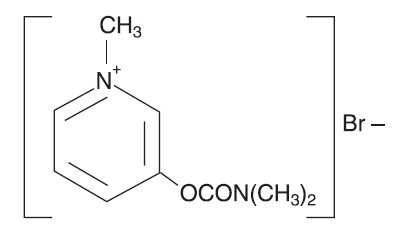
Pyridostigmine Bromide is an orally active cholinesterase inhibitor. Chemically, pyridostigmine bromide is 3-hydroxy-1-methylpyridinium bromide dimethylcarbamate. Its structural formula is: Pyridostigmine Bromide Extended-release Tablets contain 180 mg pyridostigmine bromide; each tablet also contains carnauba wax, corn-derived proteins, isopropyl alcohol, magnesium stearate, silica gel, tribasic calcium phosphate and water.
Dosage and Administration
Pyridostigmine Bromide Extended-release Tablets each contain 180 mg pyridostigmine bromide. This form provides uniformly slow release, hence prolonged duration of drug action; it facilitates control of myasthenic symptoms with fewer individual doses daily. The immediate effect of a 180 mg Pyridostigmine Bromide Extended-release Tablet is about equal to that of a 60 mg Pyridostigmine Bromide Tablet; however, its duration of effectiveness, although varying in individual patients, averages 2½ times that of a 60 mg dose. Dosage The size and frequency of the dosage must be adjusted to the needs of the individual patient. One to three 180 mg tablets, once or twice daily, will usually be sufficient to control symptoms; however, the needs of certain individuals may vary markedly from this average. The interval between doses should be at least 6 hours. For optimum control, it may be necessary to use the more rapidly acting regular tablets or oral solution in conjunction with extended-release tablets therapy. NOTE: For information on a diagnostic test for myasthenia gravis, and for the evaluation and stabilization of therapy, please see product literature on Tensilon (edrophonium chloride).
Contraindications
Pyridostigmine Bromide Extended-release Tablets are contraindicated in mechanical intestinal or urinary obstruction, and particular caution should be used in its administration to patients with bronchial asthma. Care should be observed in the use of atropine for counteracting side effects, as discussed below.
Adverse Reactions
The side effects of Pyridostigmine Bromide Extended-release Tablets are most commonly related to overdosage and generally are of two varieties, muscarinic and nicotinic. Among those in the former group are nausea, vomiting, diarrhea, abdominal cramps, increased peristalsis, increased salivation, increased bronchial secretions, miosis and diaphoresis. Nicotinic side effects are comprised chiefly of muscle cramps, fasciculation and weakness. Muscarinic side effects can usually be counteracted by atropine, but for reasons shown in the preceding section the expedient is not without danger. As with any compound containing the bromide radical, a skin rash may be seen in an occasional patient. Such reactions usually subside promptly upon discontinuance of the medication. To report SUSPECTED ADVERSE REACTIONS, contact Oceanside Pharmaceuticals at 1-800-321-4576 or FDA at 1-800-FDA-1088 or www.fda.gov/medwatch.
How Supplied
Pyridostigmine Bromide Extended-release Tablets are available as light straw-colored, capsule-shaped tablets containing 180 mg pyridostigmine bromide in bottles of 30 (NDC 68682-301-30). Each tablet is engraved “MES V 180” on one side and is single-scored on the other. Note: Because of the hygroscopic nature of the Extended-release Tablets, mottling may occur. This does not affect their efficacy. Store Pyridostigmine Extended-release Tablets at 25°C (77°F); excursions permitted to 15° to 30°C (59° to 86°F). Keep Pyridostigmine Bromide Extended-release Tablets in a dry place with the silica gel enclosed.
Medication Information
Dosage and Administration
Pyridostigmine Bromide Extended-release Tablets each contain 180 mg pyridostigmine bromide. This form provides uniformly slow release, hence prolonged duration of drug action; it facilitates control of myasthenic symptoms with fewer individual doses daily. The immediate effect of a 180 mg Pyridostigmine Bromide Extended-release Tablet is about equal to that of a 60 mg Pyridostigmine Bromide Tablet; however, its duration of effectiveness, although varying in individual patients, averages 2½ times that of a 60 mg dose.
Dosage
The size and frequency of the dosage must be adjusted to the needs of the individual patient.
One to three 180 mg tablets, once or twice daily, will usually be sufficient to control symptoms; however, the needs of certain individuals may vary markedly from this average. The interval between doses should be at least 6 hours. For optimum control, it may be necessary to use the more rapidly acting regular tablets or oral solution in conjunction with extended-release tablets therapy.
NOTE: For information on a diagnostic test for myasthenia gravis, and for the evaluation and stabilization of therapy, please see product literature on Tensilon (edrophonium chloride).
Contraindications
Pyridostigmine Bromide Extended-release Tablets are contraindicated in mechanical intestinal or urinary obstruction, and particular caution should be used in its administration to patients with bronchial asthma. Care should be observed in the use of atropine for counteracting side effects, as discussed below.
Adverse Reactions
The side effects of Pyridostigmine Bromide Extended-release Tablets are most commonly related to overdosage and generally are of two varieties, muscarinic and nicotinic. Among those in the former group are nausea, vomiting, diarrhea, abdominal cramps, increased peristalsis, increased salivation, increased bronchial secretions, miosis and diaphoresis. Nicotinic side effects are comprised chiefly of muscle cramps, fasciculation and weakness. Muscarinic side effects can usually be counteracted by atropine, but for reasons shown in the preceding section the expedient is not without danger. As with any compound containing the bromide radical, a skin rash may be seen in an occasional patient. Such reactions usually subside promptly upon discontinuance of the medication.
To report SUSPECTED ADVERSE REACTIONS, contact Oceanside Pharmaceuticals at 1-800-321-4576 or FDA at 1-800-FDA-1088 or www.fda.gov/medwatch.
How Supplied
Pyridostigmine Bromide Extended-release Tabletsare available as light straw-colored, capsule-shaped tablets containing 180 mg pyridostigmine bromide in bottles of 30 (NDC 68682-301-30). Each tablet is engraved “MES V 180” on one side and is single-scored on the other.
Note: Because of the hygroscopic nature of the Extended-release Tablets, mottling may occur. This does not affect their efficacy.
Store Pyridostigmine Extended-release Tablets at 25°C (77°F); excursions permitted to 15° to 30°C (59° to 86°F). Keep Pyridostigmine Bromide Extended-release Tablets in a dry place with the silica gel enclosed.
Description
Pyridostigmine Bromide is an orally active cholinesterase inhibitor. Chemically, pyridostigmine bromide is 3-hydroxy-1-methylpyridinium bromide dimethylcarbamate. Its structural formula is:
Pyridostigmine Bromide Extended-release Tablets contain 180 mg pyridostigmine bromide; each tablet also contains carnauba wax, corn-derived proteins, isopropyl alcohol, magnesium stearate, silica gel, tribasic calcium phosphate and water.
Actions
Pyridostigmine bromide inhibits the destruction of acetylcholine by cholinesterase and thereby permits freer transmission of nerve impulses across the neuromuscular junction. Pyridostigmine is an analog of neostigmine (Prostigmin), but differs from it in certain clinically significant respects; for example, pyridostigmine is characterized by a longer duration of action and fewer gastrointestinal side effects.
Warnings
Although failure of patients to show clinical improvement may reflect underdosage, it can also be indicative of overdosage. As is true of all cholinergic drugs, overdosage of Pyridostigmine Bromide Extended-release Tablets may result in cholinergic crisis, a state characterized by increasing muscle weakness which, through involvement of the muscles of respiration, may lead to death. Myasthenic crisis due to an increase in the severity of the disease is also accompanied by extreme muscle weakness, and thus may be difficult to distinguish from cholinergic crisis on a symptomatic basis. Such differentiation is extremely important, since increases in doses of Pyridostigmine Bromide Extended-release Tablets or other drugs of this class in the presence of cholinergic crisis or of a refractory or “insensitive” state could have grave consequences. Osserman and Genkins1, indicate that the differential diagnosis of the two types of crisis may require the use of Tensilon (edrophonium chloride) as well as clinical judgment. The treatment of the two conditions obviously differs radically. Whereas the presence of myasthenic crisis suggests the need for more intensive anticholinesterase therapy, the diagnosis of cholinergic crisis, according to Osserman and Genkins1,calls for the prompt withdrawal of all drugs of this type. The immediate use of atropine in cholinergic crisis is also recommended.
Atropine may also be used to abolish or obtund gastrointestinal side effects or other muscarinic reactions; but such use, by masking signs of overdosage, can lead to inadvertent induction of cholinergic crisis.
For detailed information on the management of patients with myasthenia gravis, the physician is referred to one of the excellent reviews such as those by Osserman and Genkins2, Grob3 or Schwab.4,5
Indication
Pyridostigmine Bromide Extended-release Tablets are useful in the treatment of myasthenia gravis.
Precaution
Pyridostigmine is mainly excreted unchanged by the kidney.6,7,8 Therefore, lower doses may be required in patients with renal disease, and treatment should be based on titration of drug dosage to effect.6,7
References
-
1.Osserman KE, Genkins G. Studies in myasthenia gravis: Reduction in mortality rate after crisis. JAMA. Jan 1963; 183:97-101.
-
2.Osserman KE, Genkins G. Studies in myasthenia gravis. NY State J Med. June 1961; 61:2076-2085.
-
3.Grob D. Myasthenia gravis. A review of pathogenesis and treatment. Arch Intern Med. Oct 1961; 108:615-638.
-
4.Schwab RS. Management of myasthenia gravis. New Eng J Med. Mar 1963; 268:596-597.
-
5.Schwab RS. Management of myasthenia gravis. New Eng J Med. Mar 1963; 268:717-719.
-
6.Cronnelly R, Stanski DR, Miller RD, Sheiner LB. Pyridostigmine kinetics with and without renal function. Clin Pharmacol Ther. 1980; 28: No. 1, 78-81.
-
7.Miller RD. Pharmacodynamics and pharmacokinetics of anticholinesterase. In: Ruegheimer E, Zindler M, ed. Anaesthesiology. (Hamburg, Germany: Congress; Sep 14-21, 1980; 222-223.) (Int Congr. No. 538), Amsterdam, Netherlands: Excerpta Medica; 1981.
-
8.Breyer-Pfaff U, Maier U, Brinkmann AM, Schumm F. Pyridostigmine kinetics in healthy subjects and patients with myasthenia gravis. Clin Pharmacol Ther. 1985; 5:495-501.
Distributed by:
Oceanside Pharmaceuticals, a division of
Bausch Health US, LLC
Bridgewater, NJ 08807 USA
Manufactured by:
Bausch Health Companies Inc.
Laval, Quebec H7L 4A8, Canada
© 2020 Bausch Health Companies Inc.
or its affiliates
Rev. September 2020
9472403 20001104D
Pediatric Use
Safety and effectiveness in pediatric patients have not been established.
Usage in Pregnancy
The safety of Pyridostigmine Bromide Extended-release Tablets during pregnancy or lactation in humans has not been established. Therefore, use of Pyridostigmine Bromide Extended-release Tablets in women who may become pregnant requires weighing the drug’s potential benefits against its possible hazards to mother and child.
Package/label Principal Display Panel – 180 Mg Tablets
NDC 68682-301-30
Rx only
PYRIDOSTIGMINE
BROMIDE
EXTENDED-
RELEASE TABLETS,
180 mg
Each extended-release tablet contains
180 mg pyridostigmine bromide in a
specially constructed tablet for
sustained release
30 Tablets
OCEANSIDE
PHARMACEUTICALS
Structured Label Content
Actions (ACTIONS)
Pyridostigmine bromide inhibits the destruction of acetylcholine by cholinesterase and thereby permits freer transmission of nerve impulses across the neuromuscular junction. Pyridostigmine is an analog of neostigmine (Prostigmin), but differs from it in certain clinically significant respects; for example, pyridostigmine is characterized by a longer duration of action and fewer gastrointestinal side effects.
Warnings (WARNINGS)
Although failure of patients to show clinical improvement may reflect underdosage, it can also be indicative of overdosage. As is true of all cholinergic drugs, overdosage of Pyridostigmine Bromide Extended-release Tablets may result in cholinergic crisis, a state characterized by increasing muscle weakness which, through involvement of the muscles of respiration, may lead to death. Myasthenic crisis due to an increase in the severity of the disease is also accompanied by extreme muscle weakness, and thus may be difficult to distinguish from cholinergic crisis on a symptomatic basis. Such differentiation is extremely important, since increases in doses of Pyridostigmine Bromide Extended-release Tablets or other drugs of this class in the presence of cholinergic crisis or of a refractory or “insensitive” state could have grave consequences. Osserman and Genkins1, indicate that the differential diagnosis of the two types of crisis may require the use of Tensilon (edrophonium chloride) as well as clinical judgment. The treatment of the two conditions obviously differs radically. Whereas the presence of myasthenic crisis suggests the need for more intensive anticholinesterase therapy, the diagnosis of cholinergic crisis, according to Osserman and Genkins1,calls for the prompt withdrawal of all drugs of this type. The immediate use of atropine in cholinergic crisis is also recommended.
Atropine may also be used to abolish or obtund gastrointestinal side effects or other muscarinic reactions; but such use, by masking signs of overdosage, can lead to inadvertent induction of cholinergic crisis.
For detailed information on the management of patients with myasthenia gravis, the physician is referred to one of the excellent reviews such as those by Osserman and Genkins2, Grob3 or Schwab.4,5
Indication (INDICATION)
Pyridostigmine Bromide Extended-release Tablets are useful in the treatment of myasthenia gravis.
Precaution (PRECAUTION)
Pyridostigmine is mainly excreted unchanged by the kidney.6,7,8 Therefore, lower doses may be required in patients with renal disease, and treatment should be based on titration of drug dosage to effect.6,7
References (REFERENCES)
-
1.Osserman KE, Genkins G. Studies in myasthenia gravis: Reduction in mortality rate after crisis. JAMA. Jan 1963; 183:97-101.
-
2.Osserman KE, Genkins G. Studies in myasthenia gravis. NY State J Med. June 1961; 61:2076-2085.
-
3.Grob D. Myasthenia gravis. A review of pathogenesis and treatment. Arch Intern Med. Oct 1961; 108:615-638.
-
4.Schwab RS. Management of myasthenia gravis. New Eng J Med. Mar 1963; 268:596-597.
-
5.Schwab RS. Management of myasthenia gravis. New Eng J Med. Mar 1963; 268:717-719.
-
6.Cronnelly R, Stanski DR, Miller RD, Sheiner LB. Pyridostigmine kinetics with and without renal function. Clin Pharmacol Ther. 1980; 28: No. 1, 78-81.
-
7.Miller RD. Pharmacodynamics and pharmacokinetics of anticholinesterase. In: Ruegheimer E, Zindler M, ed. Anaesthesiology. (Hamburg, Germany: Congress; Sep 14-21, 1980; 222-223.) (Int Congr. No. 538), Amsterdam, Netherlands: Excerpta Medica; 1981.
-
8.Breyer-Pfaff U, Maier U, Brinkmann AM, Schumm F. Pyridostigmine kinetics in healthy subjects and patients with myasthenia gravis. Clin Pharmacol Ther. 1985; 5:495-501.
Distributed by:
Oceanside Pharmaceuticals, a division of
Bausch Health US, LLC
Bridgewater, NJ 08807 USA
Manufactured by:
Bausch Health Companies Inc.
Laval, Quebec H7L 4A8, Canada
© 2020 Bausch Health Companies Inc.
or its affiliates
Rev. September 2020
9472403 20001104D
Description (DESCRIPTION)
Pyridostigmine Bromide is an orally active cholinesterase inhibitor. Chemically, pyridostigmine bromide is 3-hydroxy-1-methylpyridinium bromide dimethylcarbamate. Its structural formula is:
Pyridostigmine Bromide Extended-release Tablets contain 180 mg pyridostigmine bromide; each tablet also contains carnauba wax, corn-derived proteins, isopropyl alcohol, magnesium stearate, silica gel, tribasic calcium phosphate and water.
How Supplied (HOW SUPPLIED)
Pyridostigmine Bromide Extended-release Tabletsare available as light straw-colored, capsule-shaped tablets containing 180 mg pyridostigmine bromide in bottles of 30 (NDC 68682-301-30). Each tablet is engraved “MES V 180” on one side and is single-scored on the other.
Note: Because of the hygroscopic nature of the Extended-release Tablets, mottling may occur. This does not affect their efficacy.
Store Pyridostigmine Extended-release Tablets at 25°C (77°F); excursions permitted to 15° to 30°C (59° to 86°F). Keep Pyridostigmine Bromide Extended-release Tablets in a dry place with the silica gel enclosed.
Pediatric Use
Safety and effectiveness in pediatric patients have not been established.
Adverse Reactions (ADVERSE REACTIONS)
The side effects of Pyridostigmine Bromide Extended-release Tablets are most commonly related to overdosage and generally are of two varieties, muscarinic and nicotinic. Among those in the former group are nausea, vomiting, diarrhea, abdominal cramps, increased peristalsis, increased salivation, increased bronchial secretions, miosis and diaphoresis. Nicotinic side effects are comprised chiefly of muscle cramps, fasciculation and weakness. Muscarinic side effects can usually be counteracted by atropine, but for reasons shown in the preceding section the expedient is not without danger. As with any compound containing the bromide radical, a skin rash may be seen in an occasional patient. Such reactions usually subside promptly upon discontinuance of the medication.
To report SUSPECTED ADVERSE REACTIONS, contact Oceanside Pharmaceuticals at 1-800-321-4576 or FDA at 1-800-FDA-1088 or www.fda.gov/medwatch.
Contraindications (CONTRAINDICATIONS)
Pyridostigmine Bromide Extended-release Tablets are contraindicated in mechanical intestinal or urinary obstruction, and particular caution should be used in its administration to patients with bronchial asthma. Care should be observed in the use of atropine for counteracting side effects, as discussed below.
Usage in Pregnancy
The safety of Pyridostigmine Bromide Extended-release Tablets during pregnancy or lactation in humans has not been established. Therefore, use of Pyridostigmine Bromide Extended-release Tablets in women who may become pregnant requires weighing the drug’s potential benefits against its possible hazards to mother and child.
Dosage and Administration (DOSAGE AND ADMINISTRATION)
Pyridostigmine Bromide Extended-release Tablets each contain 180 mg pyridostigmine bromide. This form provides uniformly slow release, hence prolonged duration of drug action; it facilitates control of myasthenic symptoms with fewer individual doses daily. The immediate effect of a 180 mg Pyridostigmine Bromide Extended-release Tablet is about equal to that of a 60 mg Pyridostigmine Bromide Tablet; however, its duration of effectiveness, although varying in individual patients, averages 2½ times that of a 60 mg dose.
Dosage
The size and frequency of the dosage must be adjusted to the needs of the individual patient.
One to three 180 mg tablets, once or twice daily, will usually be sufficient to control symptoms; however, the needs of certain individuals may vary markedly from this average. The interval between doses should be at least 6 hours. For optimum control, it may be necessary to use the more rapidly acting regular tablets or oral solution in conjunction with extended-release tablets therapy.
NOTE: For information on a diagnostic test for myasthenia gravis, and for the evaluation and stabilization of therapy, please see product literature on Tensilon (edrophonium chloride).
Package/label Principal Display Panel – 180 Mg Tablets (PACKAGE/LABEL PRINCIPAL DISPLAY PANEL – 180 mg tablets)
NDC 68682-301-30
Rx only
PYRIDOSTIGMINE
BROMIDE
EXTENDED-
RELEASE TABLETS,
180 mg
Each extended-release tablet contains
180 mg pyridostigmine bromide in a
specially constructed tablet for
sustained release
30 Tablets
OCEANSIDE
PHARMACEUTICALS
Advanced Ingredient Data
Raw Label Data
All Sections (JSON)
Additional Information
Back to search View SPL set listing Open on DailyMed ↗
Source: dailymed · Ingested: 2026-02-15T11:35:34.987145 · Updated: 2026-03-14T21:43:47.347133