Eucrisa
609b77de-1ca3-4783-b8f5-01a9c0f1d77d
34391-3
HUMAN PRESCRIPTION DRUG LABEL
Drug Facts
Composition & Product
Identifiers & Packaging
Indications and Usage
EUCRISA is indicated for topical treatment of mild to moderate atopic dermatitis in adult and pediatric patients 3 months of age and older.
Dosage and Administration
Apply a thin layer of EUCRISA twice daily to affected areas. Once clinical effect is achieved, consider reducing application to once daily [see Clinical Studies (14) ] . EUCRISA is for topical use only and not for ophthalmic, oral, or intravaginal use.
Contraindications
EUCRISA is contraindicated in patients with known hypersensitivity to crisaborole or any component of the formulation. [see Warnings and Precautions (5.1) ]
Warnings and Precautions
Hypersensitivity reactions : If signs and symptoms of hypersensitivity occur, discontinue EUCRISA immediately and initiate appropriate therapy. ( 5.1 )
Adverse Reactions
The most common adverse reaction occurring in ≥1% in subjects is application site pain. ( 6.1 ) To report SUSPECTED ADVERSE REACTIONS, contact Pfizer Inc. at 1-800-438-1985 or FDA at 1-800-FDA-1088 or www.fda.gov/medwatch.
How Supplied
EUCRISA is a white to off-white ointment containing 2% crisaborole and is supplied in 60 g and 100 g laminate tubes. 60 g tube: NDC 55724-211-21 100 g tube: NDC 55724-211-11
Storage and Handling
Store at 20°C–25°C (68°F–77°F); excursions permitted to 15°C–30°C (59°F–86°F). [see USP Controlled Room Temperature]. Keep tube tightly closed.
Description
EUCRISA is indicated for topical treatment of mild to moderate atopic dermatitis in adult and pediatric patients 3 months of age and older.
Medication Information
Warnings and Precautions
Hypersensitivity reactions : If signs and symptoms of hypersensitivity occur, discontinue EUCRISA immediately and initiate appropriate therapy. ( 5.1 )
Indications and Usage
EUCRISA is indicated for topical treatment of mild to moderate atopic dermatitis in adult and pediatric patients 3 months of age and older.
Dosage and Administration
Apply a thin layer of EUCRISA twice daily to affected areas. Once clinical effect is achieved, consider reducing application to once daily [see Clinical Studies (14) ] . EUCRISA is for topical use only and not for ophthalmic, oral, or intravaginal use.
Contraindications
EUCRISA is contraindicated in patients with known hypersensitivity to crisaborole or any component of the formulation. [see Warnings and Precautions (5.1) ]
Adverse Reactions
The most common adverse reaction occurring in ≥1% in subjects is application site pain. ( 6.1 ) To report SUSPECTED ADVERSE REACTIONS, contact Pfizer Inc. at 1-800-438-1985 or FDA at 1-800-FDA-1088 or www.fda.gov/medwatch.
Storage and Handling
Store at 20°C–25°C (68°F–77°F); excursions permitted to 15°C–30°C (59°F–86°F). [see USP Controlled Room Temperature]. Keep tube tightly closed.
How Supplied
EUCRISA is a white to off-white ointment containing 2% crisaborole and is supplied in 60 g and 100 g laminate tubes. 60 g tube: NDC 55724-211-21 100 g tube: NDC 55724-211-11
Description
EUCRISA is indicated for topical treatment of mild to moderate atopic dermatitis in adult and pediatric patients 3 months of age and older.
Section 42229-5
Risk Summary
Available data from case reports with EUCRISA use in pregnant women are insufficient to inform a drug-associated risk for major birth defects, miscarriage, or other adverse maternal or fetal outcomes. In animal reproduction studies, there were no adverse developmental effects observed with oral administration of crisaborole in pregnant rats and rabbits during organogenesis at doses up to 3 and 2 times, respectively, the maximum recommended human dose (MRHD) (see Data ).
The background risk of major birth defects and miscarriage for the indicated population is unknown. All pregnancies carry some risk of birth defect, loss, or other adverse outcomes. The background risk of major birth defects in the U.S. general population is 2% to 4% and of miscarriage is 15% to 20% of clinically recognized pregnancies.
Section 42230-3
|
This Patient Information has been approved by the U.S. Food and Drug Administration. |
Revised: 4/2023 |
|
PATIENT INFORMATION
|
|
|
Important information: EUCRISA is for use on skin (topical use) only. Do not use EUCRISA in your eyes, mouth, or vagina. |
|
|
What is EUCRISA? EUCRISA is a prescription medicine used on the skin (topical) to treat mild to moderate eczema (atopic dermatitis) in adults and children 3 months of age and older. It is not known if EUCRISA is safe and effective in children under 3 months of age. |
|
|
Who should not use EUCRISA? Do not use EUCRISA if you are allergic to crisaborole or any of the ingredients in EUCRISA. See the end of this Patient Information leaflet for a complete list of ingredients in EUCRISA. |
|
|
Before using EUCRISA, tell your healthcare provider about all of your medical conditions, including if you:
Tell your healthcare provider about all the medicines you take, including prescription and over-the-counter medicines, vitamins, and herbal supplements. |
|
|
How should I use EUCRISA?
|
|
|
What are the possible side effects of EUCRISA? EUCRISA may cause side effects.
|
|
|
|
|
|
|
|
|
The most common side effect of EUCRISA is application site pain, such as burning or stinging. This is not the only possible side effect of EUCRISA. Call your doctor for medical advice about side effects. You may report side effects to FDA at 1-800-FDA-1088. |
|
|
How should I store EUCRISA?
Keep EUCRISA and all medicines out of the reach of children. |
|
|
General information about the safe and effective use of EUCRISA Medicines are sometimes prescribed for purposes other than those listed in a Patient Information leaflet. Do not use EUCRISA for a condition for which it was not prescribed. Do not give EUCRISA to other people, even if they have the same symptoms that you have. It may harm them. You can ask your pharmacist or healthcare provider for information about EUCRISA that is written for healthcare professionals. |
|
|
What are the ingredients in EUCRISA? Active ingredient: crisaborole Inactive ingredients: white petrolatum, propylene glycol, mono- and di-glycerides, paraffin, butylated hydroxytoluene, and edetate calcium disodium. LAB-0917-5.0 For more information, call 1-866-EUCRISA [1-866-382-7472] or go to www.EUCRISA.com |
11 Description
EUCRISA contains 2% crisaborole (w/w) in a petrolatum-based, white to off-white ointment and is for topical use. The active ingredient, crisaborole, is a phosphodiesterase-4 (PDE-4) inhibitor.
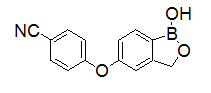
Crisaborole is described chemically as 5-(4-cyanophenoxy)-1,3-dihydro-1-hydroxy-[2,1]-benzoxaborole. The empirical formula is C14H10BNO3 and the molecular weight is 251.1 g/mol.
The structural formula is represented below:
Crisaborole drug substance is freely soluble in common organic solvents such as isopropyl alcohol and propylene glycol, and insoluble in water.
Each gram of EUCRISA contains 20 mg of crisaborole in an ointment containing white petrolatum, propylene glycol, mono- and di-glycerides, paraffin, butylated hydroxytoluene, and edetate calcium disodium.
16.1 How Supplied
EUCRISA is a white to off-white ointment containing 2% crisaborole and is supplied in 60 g and 100 g laminate tubes.
60 g tube: NDC 55724-211-21
100 g tube: NDC 55724-211-11
8.4 Pediatric Use
The safety and effectiveness of EUCRISA have been established in pediatric patients ages 3 months and older for topical treatment of mild to moderate atopic dermatitis. Use of EUCRISA administered twice daily in this age group is supported by data from two 28-day adequate, vehicle-controlled safety and efficacy trials (1,313 pediatric subjects ages 2 years to 17 years of whom 874 received EUCRISA), a 28-day open-label, safety and pharmacokinetics (PK) trial (137 subjects ages 3 months to less than 2 years who received EUCRISA), and another trial with an open-label period of up to 8 weeks (327 pediatric subjects ages 5 months to less than 18 years who received EUCRISA) [see Clinical Pharmacology (12.3) and Clinical Studies (14)].
The safety and effectiveness of EUCRISA in pediatric patients below the age of 3 months have not been established.
8.5 Geriatric Use
Clinical studies of EUCRISA did not include sufficient numbers of subjects age 65 and over to determine whether they respond differently from younger subjects.
14 Clinical Studies
Two multicenter, randomized, double-blind, parallel-group, vehicle-controlled trials (Trials 1 and 2) treated a total of 1522 subjects 2 to 79 years of age (86.3% of subjects were 2 to 17 years of age) with a 5% to 95% treatable BSA. At baseline, 38.5% of the subjects had an Investigator's Static Global Assessment [ISGA] of mild (2), and 61.5% had an ISGA of moderate (3), in the overall assessment of atopic dermatitis (erythema, induration/papulation, and oozing/crusting) on a severity scale of 0 to 4.
In both trials, subjects were randomized 2:1 to receive EUCRISA or vehicle applied twice daily for 28 days. The primary efficacy endpoint was the proportion of subjects at Day 29 who achieved success, defined as an ISGA grade of clear (0) or almost clear (1) with a 2-grade or greater improvement from baseline, comparing EUCRISA-treated subjects to vehicle-treated subjects.
Efficacy results from the two trials are summarized in Table 2.
| Trial 1 | Trial 2 | |||
|---|---|---|---|---|
|
EUCRISA Twice Daily (N=503) |
Vehicle Twice Daily (N=256) |
EUCRISA
Twice Daily (N=513) |
Vehicle Twice Daily (N=250) |
|
|
Success in ISGA Defined as an ISGA of clear (0) or almost clear (1) with a 2-grade or greater improvement from baseline.
|
32.8% |
25.4% |
31.4% |
18.0% |
The success rates over time are presented in Figure 1.
|
Figure 1: Success in ISGA Success is defined as an ISGA of clear (0) or almost clear (1) with a 2-grade or greater improvement from baseline.
Over Time in Subjects with Mild to Moderate Atopic Dermatitis
|
|
|
Trial 1 |
Trial 2 |
One randomized, double-blind, vehicle-controlled trial (Trial 3) assessed the efficacy and safety of EUCRISA once daily over 52 weeks in pediatric (3 months to less than 18 years of age) and adult subjects with mild to moderate atopic dermatitis, who achieved success on EUCRISA twice daily during open-label treatment of up to 8 weeks.
A total of 497 subjects 3 months of age and older with a 2% to 90% treatable BSA, entered into an open-label period to receive EUCRISA twice daily for up to 8 weeks. At baseline, 327 (66%) of subjects were 3 months to less than 18 years of age, 66% of the subjects had an ISGA of moderate (3), and 34% had an ISGA of mild (2), in the overall assessment of atopic dermatitis (erythema, induration/papulation, and oozing/crusting) on a severity scale of 0 to 4.
Of the 497, a total of 254 subjects 3 months of age and older, who achieved both ISGA success (score of clear [0] or almost clear [1] with a ≥2 grade improvement from baseline) and EASI50 response (at least 50% improvement from baseline in EASI scores) were randomized 1:1 into a double-blind period to receive EUCRISA once daily or vehicle for 52 weeks or until they developed a flare. At the beginning of the double-blind period, 59% of the subjects had an ISGA of almost clear (1) and 41% had an ISGA of clear (0).
Figure 2 presents the percentage of subjects maintaining an ISGA of clear or almost clear through Week 52.
Figure 2: Percentage of Subjects Maintaining ISGA of Clear or Almost Clear Through Week 52
4 Contraindications
EUCRISA is contraindicated in patients with known hypersensitivity to crisaborole or any component of the formulation. [see Warnings and Precautions (5.1)]
6 Adverse Reactions
The most common adverse reaction occurring in ≥1% in subjects is application site pain. (6.1)
To report SUSPECTED ADVERSE REACTIONS, contact Pfizer Inc. at 1-800-438-1985 or FDA at 1-800-FDA-1088 or
www.fda.gov/medwatch.
1 Indications and Usage
EUCRISA is indicated for topical treatment of mild to moderate atopic dermatitis in adult and pediatric patients 3 months of age and older.
12.1 Mechanism of Action
Crisaborole is a phosphodiesterase 4 (PDE-4) inhibitor. PDE-4 inhibition results in increased intracellular cyclic adenosine monophosphate (cAMP) levels. The specific mechanism(s) by which crisaborole exerts its therapeutic action for the treatment of atopic dermatitis is not well defined.
16.2 Storage and Handling
Store at 20°C–25°C (68°F–77°F); excursions permitted to 15°C–30°C (59°F–86°F).
[see USP Controlled Room Temperature].
Keep tube tightly closed.
5 Warnings and Precautions
Hypersensitivity reactions: If signs and symptoms of hypersensitivity occur, discontinue EUCRISA immediately and initiate appropriate therapy. (5.1)
2 Dosage and Administration
Apply a thin layer of EUCRISA twice daily to affected areas. Once clinical effect is achieved, consider reducing application to once daily [see Clinical Studies (14) ].
EUCRISA is for topical use only and not for ophthalmic, oral, or intravaginal use.
3 Dosage Forms and Strengths
Ointment: 20 mg of crisaborole per gram (2%) of white to off-white ointment.
6.2 Postmarketing Experience
The following adverse reactions have been identified during postapproval use of EUCRISA. Because these reactions are reported voluntarily from a population of uncertain size, it is not always possible to reliably estimate their frequency or establish a causal relationship to drug exposure:
Skin and Subcutaneous: allergic contact dermatitis
5.1 Hypersensitivity Reactions
Hypersensitivity reactions, including contact urticaria, have occurred in patients treated with EUCRISA. Hypersensitivity should be suspected in the event of severe pruritus, swelling and erythema at the application site or at a distant site. If signs and symptoms of hypersensitivity occur, discontinue EUCRISA immediately and initiate appropriate therapy.
6.1 Clinical Trials Experience
Because clinical trials are conducted under widely varying conditions, adverse reaction rates observed in the clinical trials of a drug cannot be directly compared to rates in the clinical trials of another drug and may not reflect the rates observed in practice.
In two double-blind, vehicle-controlled clinical trials (Trial 1 and Trial 2), 1012 subjects 2 to 79 years of age with mild to moderate atopic dermatitis were treated with EUCRISA twice daily for 4 weeks. The adverse reaction reported by ≥1% of EUCRISA-treated subjects is listed in Table 1.
| Adverse Reaction |
EUCRISA
Twice Daily N=1012 n (%) |
Vehicle Twice Daily N=499 n (%) |
|---|---|---|
|
Application site pain Refers to skin sensations such as burning or stinging.
|
45 (4) |
6 (1) |
Less common (<1%) adverse reactions in subjects treated with EUCRISA included contact urticaria [see Warnings and Precautions (5.1)].
In one double-blind, vehicle-controlled trial including an initial open-label period (Trial 3), 497 subjects 3 months of age and older with mild to moderate atopic dermatitis received EUCRISA twice daily for up to 8 weeks. This was followed by a double-blind period, during which 135 subjects out of 270 randomized subjects received EUCRISA and 135 subjects received vehicle once daily for 52 weeks or until they developed a flare. The adverse reactions observed in the open-label period were similar to the known safety profile of twice daily treatment with EUCRISA. The adverse reactions observed with once daily treatment were similar to vehicle [see Clinical Studies (14)].
17 Patient Counseling Information
Advise the patient or caregivers to read the FDA-approved patient labeling (Patient Information).
Principal Display Panel 60 G Tube Label
eucrisa®
(crisaborole) ointment 2%
NDC 55724-211-21
60 g
Rx only
For Topical Use Only.
Not for ophthalmic, oral, or intravaginal use.
Principal Display Panel 60 G Tube Carton
eucrisa®
(crisaborole) ointment 2%
For Topical Use Only.
Not for ophthalmic, oral, or intravaginal use.
NDC 55724-211-21
60 g
Rx only
Principal Display Panel 60 G Tube Label Sample
eucrisa®
(crisaborole) ointment 2%
PROFESSIONAL SAMPLE - NOT FOR SALE
NDC 55724-211-23
60 g
Rx only
For Topical Use Only.
Not for ophthalmic, oral, or intravaginal use.
Principal Display Panel 60 G Tube Carton Sample
eucrisa®
(crisaborole) ointment 2%
PROFESSIONAL SAMPLE - NOT FOR SALE
For Topical Use Only.
Not for ophthalmic, oral, or intravaginal use.
NDC 55724-211-23
60 g
Rx only
13.1 Carcinogenesis, Mutagenesis, Impairment of Fertility
In an oral carcinogenicity study in Sprague-Dawley rats, oral doses of 30, 100, or 300 mg/kg/day crisaborole were administered to rats once daily. A crisaborole-related increased incidence of benign granular cell tumors in the uterus with cervix and vagina (combined) was noted in 300 mg/kg/day crisaborole treated female rats (2 times the MRHD on an AUC comparison basis). The clinical relevance of this finding is unknown.
In a dermal carcinogenicity study in CD-1 mice, topical doses of 2%, 5%, or 7% crisaborole ointment were administered once daily. No crisaborole-related neoplastic findings were noted at topical doses up to 7% crisaborole ointment (1 times the MRHD on an AUC comparison basis).
Crisaborole revealed no evidence of mutagenic or clastogenic potential based on the results of two in vitro genotoxicity tests (Ames assay and human lymphocyte chromosomal aberration assay) and one in vivo genotoxicity test (rat micronucleus assay).
No effects on fertility were observed in male or female rats that were administered oral doses up to 600 mg/kg/day crisaborole (13 times the MRHD on an AUC comparison basis) prior to and during early pregnancy.
Structured Label Content
Section 42229-5 (42229-5)
Risk Summary
Available data from case reports with EUCRISA use in pregnant women are insufficient to inform a drug-associated risk for major birth defects, miscarriage, or other adverse maternal or fetal outcomes. In animal reproduction studies, there were no adverse developmental effects observed with oral administration of crisaborole in pregnant rats and rabbits during organogenesis at doses up to 3 and 2 times, respectively, the maximum recommended human dose (MRHD) (see Data ).
The background risk of major birth defects and miscarriage for the indicated population is unknown. All pregnancies carry some risk of birth defect, loss, or other adverse outcomes. The background risk of major birth defects in the U.S. general population is 2% to 4% and of miscarriage is 15% to 20% of clinically recognized pregnancies.
Section 42230-3 (42230-3)
|
This Patient Information has been approved by the U.S. Food and Drug Administration. |
Revised: 4/2023 |
|
PATIENT INFORMATION
|
|
|
Important information: EUCRISA is for use on skin (topical use) only. Do not use EUCRISA in your eyes, mouth, or vagina. |
|
|
What is EUCRISA? EUCRISA is a prescription medicine used on the skin (topical) to treat mild to moderate eczema (atopic dermatitis) in adults and children 3 months of age and older. It is not known if EUCRISA is safe and effective in children under 3 months of age. |
|
|
Who should not use EUCRISA? Do not use EUCRISA if you are allergic to crisaborole or any of the ingredients in EUCRISA. See the end of this Patient Information leaflet for a complete list of ingredients in EUCRISA. |
|
|
Before using EUCRISA, tell your healthcare provider about all of your medical conditions, including if you:
Tell your healthcare provider about all the medicines you take, including prescription and over-the-counter medicines, vitamins, and herbal supplements. |
|
|
How should I use EUCRISA?
|
|
|
What are the possible side effects of EUCRISA? EUCRISA may cause side effects.
|
|
|
|
|
|
|
|
|
The most common side effect of EUCRISA is application site pain, such as burning or stinging. This is not the only possible side effect of EUCRISA. Call your doctor for medical advice about side effects. You may report side effects to FDA at 1-800-FDA-1088. |
|
|
How should I store EUCRISA?
Keep EUCRISA and all medicines out of the reach of children. |
|
|
General information about the safe and effective use of EUCRISA Medicines are sometimes prescribed for purposes other than those listed in a Patient Information leaflet. Do not use EUCRISA for a condition for which it was not prescribed. Do not give EUCRISA to other people, even if they have the same symptoms that you have. It may harm them. You can ask your pharmacist or healthcare provider for information about EUCRISA that is written for healthcare professionals. |
|
|
What are the ingredients in EUCRISA? Active ingredient: crisaborole Inactive ingredients: white petrolatum, propylene glycol, mono- and di-glycerides, paraffin, butylated hydroxytoluene, and edetate calcium disodium. LAB-0917-5.0 For more information, call 1-866-EUCRISA [1-866-382-7472] or go to www.EUCRISA.com |
11 Description (11 DESCRIPTION)
EUCRISA contains 2% crisaborole (w/w) in a petrolatum-based, white to off-white ointment and is for topical use. The active ingredient, crisaborole, is a phosphodiesterase-4 (PDE-4) inhibitor.
Crisaborole is described chemically as 5-(4-cyanophenoxy)-1,3-dihydro-1-hydroxy-[2,1]-benzoxaborole. The empirical formula is C14H10BNO3 and the molecular weight is 251.1 g/mol.
The structural formula is represented below:
Crisaborole drug substance is freely soluble in common organic solvents such as isopropyl alcohol and propylene glycol, and insoluble in water.
Each gram of EUCRISA contains 20 mg of crisaborole in an ointment containing white petrolatum, propylene glycol, mono- and di-glycerides, paraffin, butylated hydroxytoluene, and edetate calcium disodium.
16.1 How Supplied
EUCRISA is a white to off-white ointment containing 2% crisaborole and is supplied in 60 g and 100 g laminate tubes.
60 g tube: NDC 55724-211-21
100 g tube: NDC 55724-211-11
8.4 Pediatric Use
The safety and effectiveness of EUCRISA have been established in pediatric patients ages 3 months and older for topical treatment of mild to moderate atopic dermatitis. Use of EUCRISA administered twice daily in this age group is supported by data from two 28-day adequate, vehicle-controlled safety and efficacy trials (1,313 pediatric subjects ages 2 years to 17 years of whom 874 received EUCRISA), a 28-day open-label, safety and pharmacokinetics (PK) trial (137 subjects ages 3 months to less than 2 years who received EUCRISA), and another trial with an open-label period of up to 8 weeks (327 pediatric subjects ages 5 months to less than 18 years who received EUCRISA) [see Clinical Pharmacology (12.3) and Clinical Studies (14)].
The safety and effectiveness of EUCRISA in pediatric patients below the age of 3 months have not been established.
8.5 Geriatric Use
Clinical studies of EUCRISA did not include sufficient numbers of subjects age 65 and over to determine whether they respond differently from younger subjects.
14 Clinical Studies (14 CLINICAL STUDIES)
Two multicenter, randomized, double-blind, parallel-group, vehicle-controlled trials (Trials 1 and 2) treated a total of 1522 subjects 2 to 79 years of age (86.3% of subjects were 2 to 17 years of age) with a 5% to 95% treatable BSA. At baseline, 38.5% of the subjects had an Investigator's Static Global Assessment [ISGA] of mild (2), and 61.5% had an ISGA of moderate (3), in the overall assessment of atopic dermatitis (erythema, induration/papulation, and oozing/crusting) on a severity scale of 0 to 4.
In both trials, subjects were randomized 2:1 to receive EUCRISA or vehicle applied twice daily for 28 days. The primary efficacy endpoint was the proportion of subjects at Day 29 who achieved success, defined as an ISGA grade of clear (0) or almost clear (1) with a 2-grade or greater improvement from baseline, comparing EUCRISA-treated subjects to vehicle-treated subjects.
Efficacy results from the two trials are summarized in Table 2.
| Trial 1 | Trial 2 | |||
|---|---|---|---|---|
|
EUCRISA Twice Daily (N=503) |
Vehicle Twice Daily (N=256) |
EUCRISA
Twice Daily (N=513) |
Vehicle Twice Daily (N=250) |
|
|
Success in ISGA Defined as an ISGA of clear (0) or almost clear (1) with a 2-grade or greater improvement from baseline.
|
32.8% |
25.4% |
31.4% |
18.0% |
The success rates over time are presented in Figure 1.
|
Figure 1: Success in ISGA Success is defined as an ISGA of clear (0) or almost clear (1) with a 2-grade or greater improvement from baseline.
Over Time in Subjects with Mild to Moderate Atopic Dermatitis
|
|
|
Trial 1 |
Trial 2 |
One randomized, double-blind, vehicle-controlled trial (Trial 3) assessed the efficacy and safety of EUCRISA once daily over 52 weeks in pediatric (3 months to less than 18 years of age) and adult subjects with mild to moderate atopic dermatitis, who achieved success on EUCRISA twice daily during open-label treatment of up to 8 weeks.
A total of 497 subjects 3 months of age and older with a 2% to 90% treatable BSA, entered into an open-label period to receive EUCRISA twice daily for up to 8 weeks. At baseline, 327 (66%) of subjects were 3 months to less than 18 years of age, 66% of the subjects had an ISGA of moderate (3), and 34% had an ISGA of mild (2), in the overall assessment of atopic dermatitis (erythema, induration/papulation, and oozing/crusting) on a severity scale of 0 to 4.
Of the 497, a total of 254 subjects 3 months of age and older, who achieved both ISGA success (score of clear [0] or almost clear [1] with a ≥2 grade improvement from baseline) and EASI50 response (at least 50% improvement from baseline in EASI scores) were randomized 1:1 into a double-blind period to receive EUCRISA once daily or vehicle for 52 weeks or until they developed a flare. At the beginning of the double-blind period, 59% of the subjects had an ISGA of almost clear (1) and 41% had an ISGA of clear (0).
Figure 2 presents the percentage of subjects maintaining an ISGA of clear or almost clear through Week 52.
Figure 2: Percentage of Subjects Maintaining ISGA of Clear or Almost Clear Through Week 52
4 Contraindications (4 CONTRAINDICATIONS)
EUCRISA is contraindicated in patients with known hypersensitivity to crisaborole or any component of the formulation. [see Warnings and Precautions (5.1)]
6 Adverse Reactions (6 ADVERSE REACTIONS)
The most common adverse reaction occurring in ≥1% in subjects is application site pain. (6.1)
To report SUSPECTED ADVERSE REACTIONS, contact Pfizer Inc. at 1-800-438-1985 or FDA at 1-800-FDA-1088 or
www.fda.gov/medwatch.
1 Indications and Usage (1 INDICATIONS AND USAGE)
EUCRISA is indicated for topical treatment of mild to moderate atopic dermatitis in adult and pediatric patients 3 months of age and older.
12.1 Mechanism of Action
Crisaborole is a phosphodiesterase 4 (PDE-4) inhibitor. PDE-4 inhibition results in increased intracellular cyclic adenosine monophosphate (cAMP) levels. The specific mechanism(s) by which crisaborole exerts its therapeutic action for the treatment of atopic dermatitis is not well defined.
16.2 Storage and Handling
Store at 20°C–25°C (68°F–77°F); excursions permitted to 15°C–30°C (59°F–86°F).
[see USP Controlled Room Temperature].
Keep tube tightly closed.
5 Warnings and Precautions (5 WARNINGS AND PRECAUTIONS)
Hypersensitivity reactions: If signs and symptoms of hypersensitivity occur, discontinue EUCRISA immediately and initiate appropriate therapy. (5.1)
2 Dosage and Administration (2 DOSAGE AND ADMINISTRATION)
Apply a thin layer of EUCRISA twice daily to affected areas. Once clinical effect is achieved, consider reducing application to once daily [see Clinical Studies (14) ].
EUCRISA is for topical use only and not for ophthalmic, oral, or intravaginal use.
3 Dosage Forms and Strengths (3 DOSAGE FORMS AND STRENGTHS)
Ointment: 20 mg of crisaborole per gram (2%) of white to off-white ointment.
6.2 Postmarketing Experience
The following adverse reactions have been identified during postapproval use of EUCRISA. Because these reactions are reported voluntarily from a population of uncertain size, it is not always possible to reliably estimate their frequency or establish a causal relationship to drug exposure:
Skin and Subcutaneous: allergic contact dermatitis
5.1 Hypersensitivity Reactions
Hypersensitivity reactions, including contact urticaria, have occurred in patients treated with EUCRISA. Hypersensitivity should be suspected in the event of severe pruritus, swelling and erythema at the application site or at a distant site. If signs and symptoms of hypersensitivity occur, discontinue EUCRISA immediately and initiate appropriate therapy.
6.1 Clinical Trials Experience
Because clinical trials are conducted under widely varying conditions, adverse reaction rates observed in the clinical trials of a drug cannot be directly compared to rates in the clinical trials of another drug and may not reflect the rates observed in practice.
In two double-blind, vehicle-controlled clinical trials (Trial 1 and Trial 2), 1012 subjects 2 to 79 years of age with mild to moderate atopic dermatitis were treated with EUCRISA twice daily for 4 weeks. The adverse reaction reported by ≥1% of EUCRISA-treated subjects is listed in Table 1.
| Adverse Reaction |
EUCRISA
Twice Daily N=1012 n (%) |
Vehicle Twice Daily N=499 n (%) |
|---|---|---|
|
Application site pain Refers to skin sensations such as burning or stinging.
|
45 (4) |
6 (1) |
Less common (<1%) adverse reactions in subjects treated with EUCRISA included contact urticaria [see Warnings and Precautions (5.1)].
In one double-blind, vehicle-controlled trial including an initial open-label period (Trial 3), 497 subjects 3 months of age and older with mild to moderate atopic dermatitis received EUCRISA twice daily for up to 8 weeks. This was followed by a double-blind period, during which 135 subjects out of 270 randomized subjects received EUCRISA and 135 subjects received vehicle once daily for 52 weeks or until they developed a flare. The adverse reactions observed in the open-label period were similar to the known safety profile of twice daily treatment with EUCRISA. The adverse reactions observed with once daily treatment were similar to vehicle [see Clinical Studies (14)].
17 Patient Counseling Information (17 PATIENT COUNSELING INFORMATION)
Advise the patient or caregivers to read the FDA-approved patient labeling (Patient Information).
Principal Display Panel 60 G Tube Label (PRINCIPAL DISPLAY PANEL - 60 g Tube Label)
eucrisa®
(crisaborole) ointment 2%
NDC 55724-211-21
60 g
Rx only
For Topical Use Only.
Not for ophthalmic, oral, or intravaginal use.
Principal Display Panel 60 G Tube Carton (PRINCIPAL DISPLAY PANEL - 60 g Tube Carton)
eucrisa®
(crisaborole) ointment 2%
For Topical Use Only.
Not for ophthalmic, oral, or intravaginal use.
NDC 55724-211-21
60 g
Rx only
Principal Display Panel 60 G Tube Label Sample (PRINCIPAL DISPLAY PANEL - 60 g Tube Label - Sample)
eucrisa®
(crisaborole) ointment 2%
PROFESSIONAL SAMPLE - NOT FOR SALE
NDC 55724-211-23
60 g
Rx only
For Topical Use Only.
Not for ophthalmic, oral, or intravaginal use.
Principal Display Panel 60 G Tube Carton Sample (PRINCIPAL DISPLAY PANEL - 60 g Tube Carton - Sample)
eucrisa®
(crisaborole) ointment 2%
PROFESSIONAL SAMPLE - NOT FOR SALE
For Topical Use Only.
Not for ophthalmic, oral, or intravaginal use.
NDC 55724-211-23
60 g
Rx only
13.1 Carcinogenesis, Mutagenesis, Impairment of Fertility
In an oral carcinogenicity study in Sprague-Dawley rats, oral doses of 30, 100, or 300 mg/kg/day crisaborole were administered to rats once daily. A crisaborole-related increased incidence of benign granular cell tumors in the uterus with cervix and vagina (combined) was noted in 300 mg/kg/day crisaborole treated female rats (2 times the MRHD on an AUC comparison basis). The clinical relevance of this finding is unknown.
In a dermal carcinogenicity study in CD-1 mice, topical doses of 2%, 5%, or 7% crisaborole ointment were administered once daily. No crisaborole-related neoplastic findings were noted at topical doses up to 7% crisaborole ointment (1 times the MRHD on an AUC comparison basis).
Crisaborole revealed no evidence of mutagenic or clastogenic potential based on the results of two in vitro genotoxicity tests (Ames assay and human lymphocyte chromosomal aberration assay) and one in vivo genotoxicity test (rat micronucleus assay).
No effects on fertility were observed in male or female rats that were administered oral doses up to 600 mg/kg/day crisaborole (13 times the MRHD on an AUC comparison basis) prior to and during early pregnancy.
Advanced Ingredient Data
Raw Label Data
All Sections (JSON)
Additional Information
Back to search View SPL set listing Open on DailyMed ↗
Source: dailymed · Ingested: 2026-02-15T11:49:46.215840 · Updated: 2026-03-14T22:34:35.027987