Rituxan Hycela
3e5b7e82-f018-4eaf-ae78-d6145a906b20
34391-3
HUMAN PRESCRIPTION DRUG LABEL
Drug Facts
Composition & Product
Identifiers & Packaging
Indications and Usage
RITUXAN HYCELA is a combination of rituximab, a CD20-directed cytolytic antibody, and hyaluronidase human, an endoglycosidase, indicated for the treatment of adult patients with: Follicular Lymphoma (FL) ( 1.1 ) Relapsed or refractory, follicular lymphoma as a single agent Previously untreated follicular lymphoma in combination with first line chemotherapy and, in patients achieving a complete or partial response to rituximab in combination with chemotherapy, as single-agent maintenance therapy Non-progressing (including stable disease), follicular lymphoma as a single agent after first-line cyclophosphamide, vincristine, and prednisone (CVP) chemotherapy Diffuse Large B-cell Lymphoma (DLBCL) ( 1.2 ) Previously untreated diffuse large B-cell lymphoma in combination with cyclophosphamide, doxorubicin, vincristine, prednisone (CHOP) or other anthracycline-based chemotherapy regimens Chronic Lymphocytic Leukemia (CLL) ( 1.3 ) Previously untreated and previously treated CLL in combination with fludarabine and cyclophosphamide (FC) Limitations of Use: Initiate treatment with RITUXAN HYCELA only after patients have received at least one full dose of a rituximab product by intravenous infusion. ( 1.4 , 2.1 , 5.4 ). RITUXAN HYCELA is not indicated for the treatment of non-malignant conditions. ( 1.4 )
Dosage and Administration
For subcutaneous use only ( 2.1 ) All patients must receive at least one full dose of a rituximab product by intravenous infusion before receiving RITUXAN HYCELA by subcutaneous injection ( 2.1 ). FL/DLBCL: Administer 1,400 mg/23,400 Units (1,400 mg rituximab and 23,400 Units hyaluronidase human) subcutaneously according to recommended schedule ( 2.2 , 2.3 ). CLL: Administer 1,600 mg/26,800 Units (1,600 mg rituximab and 26,800 Units hyaluronidase human) subcutaneously according to recommended schedule ( 2.4 ). Premedicate with acetaminophen and antihistamine before each dose; in addition, consider premedication with glucocorticoids ( 2.5 , 5.4 ) Administer specified volume into subcutaneous tissue of abdomen: ( 2.6 ) 11.7 mL from 1,400 mg/23,400 Units vial over approximately 5 minutes. 13.4 mL from 1,600 mg/26,800 Units vial over approximately 7 minutes. Observe 15 minutes following administration
Contraindications
None
Warnings and Precautions
Hypersensitivity and other administration reactions: Local cutaneous reactions may occur more than 24 hours after administration. Interrupt injection if severe reaction develops. Premedicate before injection. ( 5.4 ) Tumor lysis syndrome: Administer aggressive intravenous hydration, anti hyperuricemic agents, monitor renal function. ( 5.5 ) Infections: Withhold and institute appropriate anti-infective therapy. ( 5.6 ) Cardiac adverse reactions: Discontinue in case of serious or life-threatening events. ( 5.7 ) Renal toxicity: Discontinue in patients with rising serum creatinine or oliguria. ( 5.8 ) Bowel obstruction and perforation: Consider and evaluate for abdominal pain, vomiting, or related symptoms. ( 5.9 ) Immunizations: Live virus vaccinations prior to or during treatment not recommended. ( 5.10 ) Embryo-Fetal toxicity: Can cause fetal harm. Advise females of reproductive potential of the potential risk to a fetus and use of effective contraception. ( 5.11 )
Adverse Reactions
The following clinically significant adverse reactions are described elsewhere in the labeling: Mucocutaneous reactions [see Warnings and Precautions (5.1) ] Hepatitis B reactivation including fulminant hepatitis [see Warnings and Precautions (5.2) ] Progressive multifocal leukoencephalopathy [see Warnings and Precautions (5.3) ] Hypersensitivity and other administration reactions [see Warnings and Precautions (5.4) ] Tumor lysis syndrome [see Warnings and Precautions (5.5) ] Infections [see Warnings and Precautions (5.6) ] Cardiac arrhythmias [see Warnings and Precautions (5.7) ] Renal toxicity [see Warnings and Precautions (5.8) ] Bowel obstruction and perforation [see Warnings and Precautions (5.9) ]
How Supplied
RITUXAN HYCELA (rituximab and hyaluronidase human) injection, for subcutaneous use is supplied as a sterile preservative-free liquid solution in a single-dose vial. The following configurations are available: Individually packaged single-dose vials: RITUXAN HYCELA 1,400 mg/23,400 Units (NDC 50242-108-01) providing 1,400 mg rituximab and 23,400 Units hyaluronidase human per 11.7 mL RITUXAN HYCELA 1,600 mg/26,800 Units (NDC 50242-109-01) providing 1,600 mg rituximab and 26,800 Units hyaluronidase human per 13.4 mL
Storage and Handling
RITUXAN HYCELA (rituximab and hyaluronidase human) injection, for subcutaneous use is supplied as a sterile preservative-free liquid solution in a single-dose vial. The following configurations are available: Individually packaged single-dose vials: RITUXAN HYCELA 1,400 mg/23,400 Units (NDC 50242-108-01) providing 1,400 mg rituximab and 23,400 Units hyaluronidase human per 11.7 mL RITUXAN HYCELA 1,600 mg/26,800 Units (NDC 50242-109-01) providing 1,600 mg rituximab and 26,800 Units hyaluronidase human per 13.4 mL
Description
WARNING: SEVERE MUCOCUTANEOUS REACTIONS, HEPATITIS B VIRUS REACTIVATION and PROGRESSIVE MULTIFOCAL LEUKOENCEPHALOPATHY See full prescribing information for complete boxed warning. Severe mucocutaneous reactions, some with fatal outcomes ( 5.1 ). Hepatitis B virus reactivation, in some cases resulting in fulminant hepatitis, hepatic failure, and death ( 5.2 ). Progressive multifocal leukoencephalopathy resulting in death ( 5.3 ).
Medication Information
Warnings and Precautions
Hypersensitivity and other administration reactions: Local cutaneous reactions may occur more than 24 hours after administration. Interrupt injection if severe reaction develops. Premedicate before injection. ( 5.4 ) Tumor lysis syndrome: Administer aggressive intravenous hydration, anti hyperuricemic agents, monitor renal function. ( 5.5 ) Infections: Withhold and institute appropriate anti-infective therapy. ( 5.6 ) Cardiac adverse reactions: Discontinue in case of serious or life-threatening events. ( 5.7 ) Renal toxicity: Discontinue in patients with rising serum creatinine or oliguria. ( 5.8 ) Bowel obstruction and perforation: Consider and evaluate for abdominal pain, vomiting, or related symptoms. ( 5.9 ) Immunizations: Live virus vaccinations prior to or during treatment not recommended. ( 5.10 ) Embryo-Fetal toxicity: Can cause fetal harm. Advise females of reproductive potential of the potential risk to a fetus and use of effective contraception. ( 5.11 )
Indications and Usage
RITUXAN HYCELA is a combination of rituximab, a CD20-directed cytolytic antibody, and hyaluronidase human, an endoglycosidase, indicated for the treatment of adult patients with: Follicular Lymphoma (FL) ( 1.1 ) Relapsed or refractory, follicular lymphoma as a single agent Previously untreated follicular lymphoma in combination with first line chemotherapy and, in patients achieving a complete or partial response to rituximab in combination with chemotherapy, as single-agent maintenance therapy Non-progressing (including stable disease), follicular lymphoma as a single agent after first-line cyclophosphamide, vincristine, and prednisone (CVP) chemotherapy Diffuse Large B-cell Lymphoma (DLBCL) ( 1.2 ) Previously untreated diffuse large B-cell lymphoma in combination with cyclophosphamide, doxorubicin, vincristine, prednisone (CHOP) or other anthracycline-based chemotherapy regimens Chronic Lymphocytic Leukemia (CLL) ( 1.3 ) Previously untreated and previously treated CLL in combination with fludarabine and cyclophosphamide (FC) Limitations of Use: Initiate treatment with RITUXAN HYCELA only after patients have received at least one full dose of a rituximab product by intravenous infusion. ( 1.4 , 2.1 , 5.4 ). RITUXAN HYCELA is not indicated for the treatment of non-malignant conditions. ( 1.4 )
Dosage and Administration
For subcutaneous use only ( 2.1 ) All patients must receive at least one full dose of a rituximab product by intravenous infusion before receiving RITUXAN HYCELA by subcutaneous injection ( 2.1 ). FL/DLBCL: Administer 1,400 mg/23,400 Units (1,400 mg rituximab and 23,400 Units hyaluronidase human) subcutaneously according to recommended schedule ( 2.2 , 2.3 ). CLL: Administer 1,600 mg/26,800 Units (1,600 mg rituximab and 26,800 Units hyaluronidase human) subcutaneously according to recommended schedule ( 2.4 ). Premedicate with acetaminophen and antihistamine before each dose; in addition, consider premedication with glucocorticoids ( 2.5 , 5.4 ) Administer specified volume into subcutaneous tissue of abdomen: ( 2.6 ) 11.7 mL from 1,400 mg/23,400 Units vial over approximately 5 minutes. 13.4 mL from 1,600 mg/26,800 Units vial over approximately 7 minutes. Observe 15 minutes following administration
Contraindications
None
Adverse Reactions
The following clinically significant adverse reactions are described elsewhere in the labeling: Mucocutaneous reactions [see Warnings and Precautions (5.1) ] Hepatitis B reactivation including fulminant hepatitis [see Warnings and Precautions (5.2) ] Progressive multifocal leukoencephalopathy [see Warnings and Precautions (5.3) ] Hypersensitivity and other administration reactions [see Warnings and Precautions (5.4) ] Tumor lysis syndrome [see Warnings and Precautions (5.5) ] Infections [see Warnings and Precautions (5.6) ] Cardiac arrhythmias [see Warnings and Precautions (5.7) ] Renal toxicity [see Warnings and Precautions (5.8) ] Bowel obstruction and perforation [see Warnings and Precautions (5.9) ]
Storage and Handling
RITUXAN HYCELA (rituximab and hyaluronidase human) injection, for subcutaneous use is supplied as a sterile preservative-free liquid solution in a single-dose vial. The following configurations are available: Individually packaged single-dose vials: RITUXAN HYCELA 1,400 mg/23,400 Units (NDC 50242-108-01) providing 1,400 mg rituximab and 23,400 Units hyaluronidase human per 11.7 mL RITUXAN HYCELA 1,600 mg/26,800 Units (NDC 50242-109-01) providing 1,600 mg rituximab and 26,800 Units hyaluronidase human per 13.4 mL
How Supplied
RITUXAN HYCELA (rituximab and hyaluronidase human) injection, for subcutaneous use is supplied as a sterile preservative-free liquid solution in a single-dose vial. The following configurations are available: Individually packaged single-dose vials: RITUXAN HYCELA 1,400 mg/23,400 Units (NDC 50242-108-01) providing 1,400 mg rituximab and 23,400 Units hyaluronidase human per 11.7 mL RITUXAN HYCELA 1,600 mg/26,800 Units (NDC 50242-109-01) providing 1,600 mg rituximab and 26,800 Units hyaluronidase human per 13.4 mL
Description
WARNING: SEVERE MUCOCUTANEOUS REACTIONS, HEPATITIS B VIRUS REACTIVATION and PROGRESSIVE MULTIFOCAL LEUKOENCEPHALOPATHY See full prescribing information for complete boxed warning. Severe mucocutaneous reactions, some with fatal outcomes ( 5.1 ). Hepatitis B virus reactivation, in some cases resulting in fulminant hepatitis, hepatic failure, and death ( 5.2 ). Progressive multifocal leukoencephalopathy resulting in death ( 5.3 ).
Section 34073-7
Renal toxicity when used in combination with cisplatin. (5.8)
Section 42229-5
Severe Mucocutaneous Reactions
Severe, including fatal, mucocutaneous reactions can occur in patients receiving rituximab-containing products, including RITUXAN HYCELA [see Warnings and Precautions (5.1)].
Section 42231-1
| This Medication Guide has been approved by the U.S. Food and Drug Administration | Revised: 6/2021 | |
|
MEDICATION GUIDE
RITUXAN HYCELA® [rih-TUKS-an hye-SELL-uh] (rituximab and hyaluronidase human) injection |
||
|
What is the most important information I should know about RITUXAN HYCELA? RITUXAN HYCELA can cause serious side effects that can lead to death, including:
|
||
|
|
|
| See "What are the possible side effects of RITUXAN HYCELA?" for more information about side effects. | ||
|
What is RITUXAN HYCELA?
RITUXAN HYCELA is a prescription medicine used to treat adults with:
RITUXAN HYCELA is not for use to treat medical conditions other than cancers. It is not known if RITUXAN HYCELA is safe and effective in children. |
||
Before you receive RITUXAN HYCELA, tell your healthcare provider about all of your medical conditions, including if you:
|
||
How will I receive RITUXAN HYCELA?
|
||
|
What are possible side effects of RITUXAN HYCELA? RITUXAN HYCELA can cause serious side effects, including:
|
||
|
|
|
The most common side effects of RITUXAN HYCELA in people with Follicular Lymphoma (FL) include: infections, low white blood cell count, nausea, constipation, cough, and tiredness. The most common side effects of RITUXAN HYCELA in people with Diffuse Large B-cell Lymphoma (DLBCL) include: infections, low white blood cell count, loss of hair, nausea, and low red blood cell count. The most common side effects of RITUXAN HYCELA in people with Chronic Lymphocytic Leukemia (CLL) include: infections, low white blood cell count, nausea, low platelet count, fever, vomiting, and injection site redness. These are not all of the possible side effects with RITUXAN HYCELA. Call your doctor for medical advice about side effects. You may report side effects to FDA at 1-800-FDA-1088. |
||
|
General information about the safe and effective use of RITUXAN HYCELA.
Medicines are sometimes prescribed for purposes other than those listed in a Medication Guide. You can ask your pharmacist or healthcare provider for information about RITUXAN HYCELA that is written for health professionals. |
||
|
What are the ingredients in RITUXAN HYCELA? Active ingredient: rituximab and hyaluronidase human. Inactive ingredients: L-histidine, L-histidine hydrochloride monohydrate, L-methionine, polysorbate 80, α,α-trehalose dihydrate, and Water for Injection. Manufactured by: Genentech, Inc., A Member of the Roche Group, 1 DNA Way, South San Francisco, CA 94080-4990 U.S. License No.: 1048 Jointly marketed by: Biogen and Genentech USA, Inc. RITUXAN HYCELA® is a registered trademark of Biogen. ©2021 Biogen and Genentech USA, Inc. For more information, go to www.RITUXANHYCELA.com or call 1-877-436-3683. |
Representative sample of labeling (see the HOW SUPPLIED section for complete listing):
Section 43683-2
| Dosage and Administration, Preparation and Administration (2.6) | 06/2021 |
Section 44425-7
Storage
Store RITUXAN HYCELA vials in the refrigerator at 2°C to 8°C (36°F to 46°F) in the original carton to protect from light. Do not freeze.
8.2 Lactation
There are no data on the presence of hyaluronidase human in human milk or the effect of rituximab on milk production, and there is limited data on the effect of rituximab on the breastfed child. However, rituximab is detected in the milk of lactating cynomolgus monkeys and maternal IgG is present in human breast milk. Rituximab has also been reported to be excreted at low concentrations in human breast milk. Given that the clinical significance of this finding for children is not known, advise women not to breastfeed during treatment with RITUXAN HYCELA and for 6 months after the last dose due to the potential for serious adverse reactions in breastfed children.
11 Description
RITUXAN HYCELA is a combination of rituximab and hyaluronidase human. Rituximab is a genetically engineered chimeric murine/human monoclonal IgG1 kappa antibody directed against the CD20 antigen. Rituximab has an approximate molecular weight of 145 kD. Rituximab has a binding affinity for the CD20 antigen of approximately 8.0 nM. Rituximab is produced by mammalian cell (Chinese Hamster Ovary) suspension.
Recombinant human hyaluronidase is an endoglycosidase used to increase the dispersion and absorption of co-administered drugs when administered subcutaneously. It is produced by mammalian (Chinese Hamster Ovary) cells containing a DNA plasmid encoding for a soluble fragment of human hyaluronidase (PH20). It is a glycosylated single-chain protein with an approximate molecular weight of 61 kD.
RITUXAN HYCELA (rituximab and hyaluronidase human) injection is a colorless to yellowish, clear to opalescent solution supplied in sterile, preservative-free, single-dose vials for subcutaneous use.
RITUXAN HYCELA is supplied as 1,400 mg rituximab and 23,400 Units hyaluronidase human per 11.7 mL in single-dose vials or 1,600 mg rituximab and 26,800 Units hyaluronidase human per 13.4 mL in single-dose vials. Each mL of solution contains rituximab (120 mg), hyaluronidase human (2,000 Units), L-histidine (0.53 mg), L-histidine hydrochloride monohydrate (3.47 mg), L-methionine (1.49 mg), polysorbate 80 (0.6 mg), α,α-trehalose dihydrate (79.45 mg), and Water for Injection.
5.6 Infections
Serious, including fatal, bacterial, fungal, and new or reactivated viral infections can occur during and following the completion of therapy with rituximab-containing products, including RITUXAN HYCELA. The incidence of infections with RITUXAN HYCELA vs rituximab was 56% and 49% respectively in patients with CLL, and 46% and 41% respectively in patients with FL/DLBCL in combination with chemotherapy. Infections have been reported in some patients with prolonged hypogammaglobulinemia (defined as hypogammaglobulinemia > 11 months after rituximab exposure). New or reactivated viral infections included cytomegalovirus, herpes simplex virus, parvovirus B19, varicella zoster virus, West Nile virus, and hepatitis B and C. Discontinue RITUXAN HYCELA for serious infections and institute appropriate anti-infective therapy [see Adverse Reactions (6.1)].
5.10 Immunization
The safety of immunization with live viral vaccines following rituximab-containing products, including RITUXAN HYCELA, therapy has not been studied and vaccination with live virus vaccines is not recommended before or during treatment.
8.4 Pediatric Use
The safety and effectiveness of RITUXAN HYCELA in pediatric patients have not been established.
8.5 Geriatric Use
Of the total number of subjects in the SABRINA, MabEase, and SAWYER studies, 37% were 65 and over, while 10% were 75 and over. No overall differences in safety or effectiveness were observed between these subjects and younger subjects, and other reported clinical experience has not identified differences in responses between the elderly and younger patients, but greater sensitivity of some older individuals cannot be ruled out.
5.8 Renal Toxicity
Severe, including fatal, renal toxicity can occur after administration of rituximab-containing products, including RITUXAN HYCELA. Renal toxicity has occurred in patients who experience tumor lysis syndrome and in patients with administered concomitant cisplatin therapy during clinical trials. The combination of cisplatin and RITUXAN HYCELA is not an approved treatment regimen. Monitor closely for signs of renal failure and discontinue RITUXAN HYCELA in patients with a rising serum creatinine or oliguria [see Warnings and Precautions (5.5)].
6.2 Immunogenicity
As with all therapeutic proteins, there is potential for immunogenicity. The detection of antibody formation is highly dependent on the sensitivity and specificity of the assay. Additionally, the observed incidence of antibody (including neutralizing antibody) positivity in an assay may be influenced by several factors including assay methodology, sample handling, timing of sample collection, concomitant medications, and underlying disease. For these reasons, comparison of the incidence of antibodies to RITUXAN HYCELA and rituximab in the studies described below with the incidence of antibodies in other studies or to other products may be misleading.
In the SABRINA study, where previously untreated patients with follicular lymphoma were treated with RITUXAN HYCELA or rituximab in combination with CVP or CHOP, the incidence of treatment-induced/enhanced anti-rituximab antibodies in the RITUXAN HYCELA group was similar to that observed in the rituximab group (2.0% RITUXAN HYCELA vs. 1.9% rituximab). The incidence of treatment-induced/enhanced anti-recombinant human hyaluronidase antibodies was 15% in the RITUXAN HYCELA group compared with 8% in the rituximab group, and the overall proportion of patients found to have anti-recombinant human hyaluronidase antibodies remained generally constant over the follow-up period in both cohorts. All patients who tested positive for anti-recombinant human hyaluronidase antibodies at any point during the study were negative for neutralizing antibodies.
In the SAWYER study, where previously untreated patients with CLL were treated with RITUXAN HYCELA or rituximab in combination with FC, the incidence of treatment-induced/enhanced anti-rituximab antibodies was 12% in the RITUXAN HYCELA group and 15% in the rituximab group. The incidence of treatment-induced/enhanced anti-recombinant human hyaluronidase antibodies was 11% in the RITUXAN HYCELA treatment arm. None of the patients who tested positive for anti-recombinant human hyaluronidase antibodies tested positive for neutralizing antibodies.
The clinical relevance of the development of anti-rituximab or anti-recombinant human hyaluronidase antibodies after treatment with RITUXAN HYCELA is not known.
4 Contraindications
None
6 Adverse Reactions
The following clinically significant adverse reactions are described elsewhere in the labeling:
- Mucocutaneous reactions [see Warnings and Precautions (5.1)]
- Hepatitis B reactivation including fulminant hepatitis [see Warnings and Precautions (5.2)]
- Progressive multifocal leukoencephalopathy [see Warnings and Precautions (5.3)]
- Hypersensitivity and other administration reactions [see Warnings and Precautions (5.4)]
- Tumor lysis syndrome [see Warnings and Precautions (5.5)]
- Infections [see Warnings and Precautions (5.6)]
- Cardiac arrhythmias [see Warnings and Precautions (5.7)]
- Renal toxicity [see Warnings and Precautions (5.8)]
- Bowel obstruction and perforation [see Warnings and Precautions (5.9)]
12.2 Pharmacodynamics
Peripheral B-cell counts declined to levels below normal following a dose of rituximab by intravenous infusion. In patients treated with rituximab for hematological malignancies, B cell recovery began within 6 months of treatment and generally returned to normal levels within 12 months after completion of therapy, although in some patients this may take longer.
12.3 Pharmacokinetics
The geometric mean rituximab exposures are provided in Table 4. The pharmacokinetic properties of rituximab following the administration of RITUXAN HYCELA in the approved indications are provided in Table 5. The elimination of rituximab was characterized by a time-dependent process that occurred early in therapy and a time-independent process.
| Study For study design information, see
Clinical Studies (14).
|
Cycle | Rituximab | ||
|---|---|---|---|---|
|
FL RITUXAN HYCELA 1,400 mg/23,400 Units (1,400 mg rituximab and 23,400 Units hyaluronidase human)
|
Cmax, mcg/mL (CV%) | SABRINA | 7 | 237 (29.4) |
| 18 | 156 (24.7) Based on predicted values
|
|||
| Ctrough, mcg/mL (CV%) | 7 | 122.2 (55.3) | ||
| 18 | 45.5 (53.6) | |||
| AUCTAU, mcg∙day/mL (CV%) | 7 | 3779 (33.7) | ||
| 18 | 5000 (34.3) | |||
|
CLL RITUXAN HYCELA 1,600 mg/26,800 Units (1,600 mg rituximab and 26,800 Units hyaluronidase human)
|
Cmax, mcg/mL (CV%) | SAWYER | 6 | 202 (36.1) |
| Ctrough, mcg/mL (CV%) | 5 | 97.5 (42.6) | ||
| AUCTAU, mcg∙day/mL (CV%) | 5 | 4088 (34.2) |
In the SABRINA study, the geometric mean Ctrough in the RITUXAN HYCELA arm was higher than in the rituximab arm with a geometric mean ratio (Ctrough, RITUXAN HYCELA/Ctrough, rituximab) of 1.52 (90% CI: 1.36, 1.70) at Cycle 7 [see Clinical Studies (14.1)].
In the SAWYER study, the geometric mean Ctrough in the RITUXAN HYCELA arm was higher than in the rituximab arm with an adjusted geometric mean ratio of 1.53 (90% CI: 1.27–1.85) at Cycle 5 [see Clinical Studies (14.3)].
| FL | CLL | |
|---|---|---|
| Absorption | ||
| Absolute Bioavailability Compared to a rituximab product administered intravenously
|
0.646 (0.634–0.659 95% CI ) |
0.634 (0.602–0.665) |
| Distribution | ||
| Volume of Central compartment (L) | 4.06 (26) | 4.80 (18) |
| Apparent Volume of Distribution at steady state Volume of central compartment and peripheral compartment (L) |
8.09 (19) | 8.52 (13) |
| Elimination | ||
| Terminal Half-life (days) | 34.1 (27) | 32 (24) |
| Clearance (L/day) | 0.18 (34) | 0.204 (31) |
1.4 Limitations of Use
- Initiate treatment with RITUXAN HYCELA only after patients have received at least one full dose of a rituximab product by intravenous infusion [see Dosage and Administration (2.1) and Warnings and Precautions (5.4)].
- RITUXAN HYCELA is not indicated for the treatment of non-malignant conditions.
1 Indications and Usage
RITUXAN HYCELA is a combination of rituximab, a CD20-directed cytolytic antibody, and hyaluronidase human, an endoglycosidase, indicated for the treatment of adult patients with:
- Follicular Lymphoma (FL) (1.1)
- Relapsed or refractory, follicular lymphoma as a single agent
- Previously untreated follicular lymphoma in combination with first line chemotherapy and, in patients achieving a complete or partial response to rituximab in combination with chemotherapy, as single-agent maintenance therapy
- Non-progressing (including stable disease), follicular lymphoma as a single agent after first-line cyclophosphamide, vincristine, and prednisone (CVP) chemotherapy
- Diffuse Large B-cell Lymphoma (DLBCL) (1.2)
- Previously untreated diffuse large B-cell lymphoma in combination with cyclophosphamide, doxorubicin, vincristine, prednisone (CHOP) or other anthracycline-based chemotherapy regimens
- Chronic Lymphocytic Leukemia (CLL) (1.3)
- Previously untreated and previously treated CLL in combination with fludarabine and cyclophosphamide (FC)
Limitations of Use:
14.4 Patient Experience
Previously untreated adult patients outside of the United States with CD20+ diffuse large B-cell lymphoma (DLBCL) or CD20+ follicular non-Hodgkin's lymphoma (FL) Grades 1, 2, or 3a were randomized to receive a standard chemotherapy regimen (CHOP, CVP, or bendamustine) and either RITUXAN HYCELA 1,400 mg/23,400 Units at Cycles 2–4 (after the first cycle with intravenous rituximab) or a rituximab product by intravenous infusion at Cycles 1–4. After the fourth cycle, patients were crossed over to the alternative route of administration for the remaining 4 cycles. After Cycle 8, 477 of 620 patients (77%) reported preferring subcutaneous administration of RITUXAN HYCELA over intravenous rituximab and the most common reason was that administration required less time in the clinic. After Cycle 8, 66 of 620 patients (11%) preferred rituximab intravenous administration and the most common reason was that it felt more comfortable during administration. Forty eight of 620 patients (7.7%) had no preference for the route of administration. Twenty nine subjects of 620 (4.7%) received Cycle 8 but did not complete the preference questionnaire.
12.1 Mechanism of Action
Rituximab is a monoclonal antibody that targets the CD20 antigen expressed on the surface of pre-B and mature B-lymphocytes. Upon binding to CD20, rituximab mediates B-cell lysis. Possible mechanisms of cell lysis include complement dependent cytotoxicity (CDC) and antibody dependent cell mediated cytotoxicity (ADCC). Hyaluronan is a polysaccharide found in the extracellular matrix of the subcutaneous tissue. It is depolymerized by the naturally occurring enzyme hyaluronidase. Unlike the stable structural components of the interstitial matrix, hyaluronan has a half-life of approximately 0.5 days. Hyaluronidase human increases permeability of the subcutaneous tissue by temporarily depolymerizing hyaluronan. In the doses administered, hyaluronidase human in RITUXAN HYCELA acts locally.
The effects of hyaluronidase human are reversible and permeability of the subcutaneous tissue is restored within 24 to 48 hours.
Hyaluronidase human has been shown to increase the absorption rate of a rituximab product into the systemic circulation when given in the subcutis of Göttingen Minipigs.
14.1 Follicular Lymphoma
The SABRINA study [NCT01200758] was a randomized, two-stage, open-label, multicenter study that enrolled a total of 410 patients with previously untreated, CD20-positive follicular lymphoma of Grade 1, 2 or 3a requiring therapy. The study design is identical in stage 1 and 2. Patients were randomized (1:1) to receive either a rituximab product by intravenous infusion 375 mg/m2 for 8 cycles or 1 cycle of a rituximab product by intravenous infusion 375 mg/m2 followed by 7 cycles of RITUXAN HYCELA 1,400 mg/23,400 Units (1,400 mg rituximab and 23,400 Units hyaluronidase human) both every 3 weeks in combination with a total of 6–8 cycles of CHOP or 8 cycles of CVP chemotherapy. Patients underwent interim staging after 4 cycles. Patients who received R-CHOP and achieved a CR, CRu, PR or SD at the interim assessment could receive either 4 more cycles of R-CHOP or 2 cycles of R-CHOP followed by 2 cycles of monotherapy with rituximab product or RITUXAN HYCELA depending on randomization arm (i.e., a total of 8 cycles of rituximab product or RITUXAN HYCELA). Patients with at least a PR after combination treatment with chemotherapy continued with single agent maintenance treatment administered every 8 weeks for 24 months with rituximab product or RITUXAN HYCELA as per their randomization (i.e., total of 12 cycles of maintenance treatment).
Randomization was stratified by: underlying chemotherapy backbone (CHOP vs CVP), Follicular Lymphoma International Prognostic Index (FLIPI) (low-risk vs. intermediate-risk vs. high-risk), and region (Europe and North America vs. South and Central America vs Asia).
The main outcome measure for Stage 1 was the estimated ratio of observed rituximab serum Ctrough SC/Ctrough IV at Cycle 7 of combination treatment with chemotherapy every 3 weeks. The main outcome measure for Stage 2 was the investigator-assessed ORR consisting of CR, CRu, and PR at the completion of combination treatment with chemotherapy. Additional outcome measures were CRR (CR and CRu) at the end of completion of combination treatment with chemotherapy, ORR and CRR at the end of completion of maintenance treatment, and time-to-event endpoints (progression-free survival (PFS), and overall survival (OS)).
Of all randomized patients, the median age was 57 years (range: 28 to 86), 53% were female, and 86% were White. The median BSA was 1.83 m2. 45% had high risk or 34% had intermediate risk FLIPI score, and 54% had Ann Arbor Stage IV disease. Ninety percent of patients completed all 8 cycles of combination treatment with chemotherapy, and 70% of patients completed 20 cycles of both combination and maintenance treatment. Median treatment duration was 27.1 months in both groups. The median number of cycles received was 20 in both groups.
The pharmacokinetic results for the primary endpoint in Stage 1, rituximab Ctrough at Cycle 7 (i.e., 21 days after Cycle 7 rituximab administration), demonstrated that RITUXAN HYCELA 1,400 mg/23,400 Units was non-inferior compared with rituximab at 375 mg/m2 in patients receiving combination treatment with chemotherapy [see Clinical Pharmacology (12.3)]. The efficacy results are presented in Table 6.
| RITUXAN HYCELA N=205 |
Rituximab N=205 |
|
|---|---|---|
|
Overall Response Rate at End of combination treatment with chemotherapy Stage 2 main outcome measure was ORR at the end of combination treatment with chemotherapy; however pooled results which were preplanned are presented in this Table.
,
Response rates based on investigator assessment. Response rates at end of maintenance based on patients who received at least one cycle of maintenance treatment (n). Investigator-assessed ORR (comprising CR, CRu and PR).
|
||
| Number of responders (CR/CRu, PR) | 173 | 174 |
| Overall response (CR/CRu, PR) rate (%, [95% CI]) | 84% [79;89] | 85% [79;90] |
| Difference in overall response rates Difference in response rates (RITUXAN HYCELA minus rituximab). [95% CI] |
-0.5% [-7.7;6.8] | |
| Number of complete responders (CR/CRu) | 66 | 65 |
| Complete response (CR/CRu) rate (%, [95% CI]) | 32% [26;39] | 32% [25;39] |
| Difference in complete response rates [95% CI] | 0.0% [-9.3;9.3] | |
| Overall Response Rate at End of Maintenance | ||
| Number of patients treated in maintenance (n) | 172 | 178 |
| Number of responders (CR/CRu, PR) | 134 | 139 |
| Overall response (CR/CRu, PR) rate (%, [95% CI]) | 78% [71;84] | 78% [71;84] |
| Difference in overall response rates [95% CI] | -0.2 [-9.2;8.8] | |
| Number of complete responders (CR/CRu) | 87 | 103 |
| Complete response (CR/CRu) rate (%, [95% CI]) | 51% [43;58] | 58% [50;65] |
| Difference in complete response rates [95% CI] | -7.3 [-18.0;3.5] | |
|
Progression-free survival At time of final analysis (median follow-up 4.8 years).
|
||
| Number of patients with event | 65 (32%) | 71 (35%) |
| Hazard Ratio [95% CI] (unstratified Cox model) | 0.90 [0.64;1.26] | |
| Overall survival | ||
| Number of patients with event | 18 (8.8%) | 26 (12.7%) |
| Hazard Ratio [95% CI] (unstratified Cox model) | 0.70 [0.38;1.27] |
5 Warnings and Precautions
- Hypersensitivity and other administration reactions: Local cutaneous reactions may occur more than 24 hours after administration. Interrupt injection if severe reaction develops. Premedicate before injection. (5.4)
- Tumor lysis syndrome: Administer aggressive intravenous hydration, anti hyperuricemic agents, monitor renal function. (5.5)
- Infections: Withhold and institute appropriate anti-infective therapy. (5.6)
- Cardiac adverse reactions: Discontinue in case of serious or life-threatening events. (5.7)
- Renal toxicity: Discontinue in patients with rising serum creatinine or oliguria. (5.8)
- Bowel obstruction and perforation: Consider and evaluate for abdominal pain, vomiting, or related symptoms. (5.9)
- Immunizations: Live virus vaccinations prior to or during treatment not recommended. (5.10)
- Embryo-Fetal toxicity: Can cause fetal harm. Advise females of reproductive potential of the potential risk to a fetus and use of effective contraception. (5.11)
5.11 Embryo Fetal Toxicity
Based on human data, rituximab-containing products can cause fetal harm due to B-cell lymphocytopenia in infants exposed to rituximab in-utero. Advise pregnant women of the potential risk to a fetus. Advise females of reproductive potential to use effective contraception during treatment with RITUXAN HYCELA and for 12 months after the last dose of rituximab-containing products, including RITUXAN HYCELA [see Use in Specific Populations (8.1, 8.3)].
2 Dosage and Administration
- For subcutaneous use only (2.1)
- All patients must receive at least one full dose of a rituximab product by intravenous infusion before receiving RITUXAN HYCELA by subcutaneous injection (2.1).
- FL/DLBCL: Administer 1,400 mg/23,400 Units (1,400 mg rituximab and 23,400 Units hyaluronidase human) subcutaneously according to recommended schedule (2.2, 2.3).
- CLL: Administer 1,600 mg/26,800 Units (1,600 mg rituximab and 26,800 Units hyaluronidase human) subcutaneously according to recommended schedule (2.4).
- Premedicate with acetaminophen and antihistamine before each dose; in addition, consider premedication with glucocorticoids (2.5, 5.4)
- Administer specified volume into subcutaneous tissue of abdomen: (2.6)
- 11.7 mL from 1,400 mg/23,400 Units vial over approximately 5 minutes.
- 13.4 mL from 1,600 mg/26,800 Units vial over approximately 7 minutes.
- Observe 15 minutes following administration
1.1 Follicular Lymphoma (fl)
RITUXAN HYCELA is indicated for the treatment of adult patients with:
- Relapsed or refractory, follicular lymphoma as a single agent.
- Previously untreated follicular lymphoma in combination with first line chemotherapy and, in patients achieving a complete or partial response to rituximab in combination with chemotherapy, as single-agent maintenance therapy.
- Non-progressing (including stable disease), follicular lymphoma as a single agent after first-line cyclophosphamide, vincristine, and prednisone (CVP) chemotherapy.
3 Dosage Forms and Strengths
RITUXAN HYCELA is a colorless to yellowish, clear to opalescent solution for subcutaneous injection:
- Injection: 1,400 mg rituximab and 23,400 Units hyaluronidase human per 11.7 mL (120 mg/2,000 Units per mL) in a single-dose vial.
- Injection: 1,600 mg rituximab and 26,800 Units hyaluronidase human per 13.4 mL (120 mg/2,000 Units per mL) in a single-dose vial.
6.3 Postmarketing Experience
The following adverse reactions have been identified during post-approval use of rituximab-containing products. Because these reactions are reported voluntarily from a population of uncertain size, it is not always possible to reliably estimate their frequency or establish a causal relationship to drug exposure.
- Hematologic: prolonged pancytopenia, marrow hypoplasia, Grade 3–4 prolonged or late-onset neutropenia, hyperviscosity syndrome in Waldenstrom's macroglobulinemia, prolonged hypogammaglobulinemia
- Cardiac: fatal cardiac failure
- Immune/Autoimmune Events: uveitis, optic neuritis, systemic vasculitis, pleuritis, lupus-like syndrome, serum sickness, polyarticular arthritis, and vasculitis with rash.
- Infection: viral infections, including progressive multifocal leukoencephalopathy (PML), increase in fatal infections in HIV-associated lymphoma, and a reported increased incidence of Grade 3 and 4 infections
- Neoplasia: disease progression of Kaposi's sarcoma.
- Skin: severe mucocutaneous reactions, pyoderma gangrenosum (including genital presentation).
- Gastrointestinal: bowel obstruction and perforation.
- Pulmonary: fatal bronchiolitis obliterans and fatal interstitial lung disease.
8 Use in Specific Populations
- Lactation: Advise not to breastfeed. (8.2)
5.5 Tumor Lysis Syndrome (tls)
TLS can occur within 12–24 hours after administration of a rituximab-containing product, including RITUXAN HYCELA. A high number of circulating malignant cells (≥ 25,000/mm3) or high tumor burden confers a greater risk of TLS. Administer aggressive intravenous hydration and anti-hyperuricemic therapy in patients at high risk for TLS. Correct electrolyte abnormalities, monitor renal function and fluid balance, and administer supportive care, including dialysis as indicated [see Warnings and Precautions (5.8)].
6.1 Clinical Trials Experience
Because clinical trials are conducted under widely varying conditions, adverse reaction rates observed in the clinical trials of a drug cannot be directly compared to rates in the clinical trials of another drug and may not reflect the rates observed in clinical practice.
The data described below reflect exposure to RITUXAN HYCELA in 892 patients in four controlled trials with exposures ranging from a single injection up to 27 months of treatment.
The population included 382 patients with follicular lymphoma (FL), 369 patients with diffuse large B-cell lymphoma (DLBCL), and 141 patients with chronic lymphocytic leukemia (CLL). The median age was 60 years (range: 18–85 years, 53% were male, and 84% were White. In the SABRINA study patients with FL received a full dose of a rituximab product by intravenous infusion, followed by RITUXAN HYCELA (1,400 mg rituximab/23,400 Units hyaluronidase human), in combination with chemotherapy for up to 7 doses (i.e., total of 8 doses in combination with chemotherapy), or as monotherapy for up to 12 doses (maintenance treatment). In the MabEase study patients with DLBCL received a full dose of a rituximab product by intravenous infusion, followed by RITUXAN HYCELA (1,400 mg rituximab/23,400 Units hyaluronidase human), given in combination with chemotherapy for up to 7 doses (i.e., up to a total of 8 doses). In the SAWYER study patients with CLL on part 2 received a full dose of a rituximab product by intravenous infusion, followed by RITUXAN HYCELA (1,600 mg rituximab/26,800 Units hyaluronidase human) for up to 5 doses, in combination with fludarabine and cyclophosphamide (i.e., total of 6 doses).
The most common adverse reactions (≥ 20%) of RITUXAN HYCELA observed in patients with FL on the SABRINA study were: infections, neutropenia, nausea, constipation, cough, and fatigue.
The most common adverse reactions (≥ 20%) of RITUXAN HYCELA observed in patients with DLBCL on the MabEase study were: infections, neutropenia, alopecia, nausea, and anemia.
The most common adverse reactions (≥ 20%) of RITUXAN HYCELA observed in patients with CLL on part 2 of the SAWYER study were: infections, neutropenia, nausea, thrombocytopenia, pyrexia, vomiting, and injection site erythema.
2.1 Important Dosing Information
RITUXAN HYCELA is for subcutaneous use only. RITUXAN HYCELA should only be administered by a healthcare professional with appropriate medical support to manage severe reactions that can be fatal if they occur.
All patients must first receive at least one full dose of a rituximab product by intravenous infusion without experiencing severe adverse reactions before starting treatment with RITUXAN HYCELA. If patients are not able to receive one full dose by intravenous infusion, they should continue subsequent cycles with a rituximab product by intravenous infusion and not switch to RITUXAN HYCELA until a full intravenous dose is successfully administered [see Warnings and Precautions (5.4)].
Refer to the prescribing information for a rituximab product for intravenous infusion for additional information.
Premedicate before each dose of RITUXAN HYCELA [see Dosage and Administration (2.5)].
Dose reductions of RITUXAN HYCELA are not recommended. When RITUXAN HYCELA is given in combination with chemotherapy dose, reduce the chemotherapeutic drugs to manage adverse reactions.
17 Patient Counseling Information
Advise the patient to read the FDA-approved patient labeling (Medication Guide).
2.6 Preparation and Administration
To prevent medication errors, check the vial labels to ensure that the drug being prepared and administered is RITUXAN HYCELA for subcutaneous use. Do not administer RITUXAN HYCELA intravenously.
RITUXAN HYCELA is ready to use.
5.1 Severe Mucocutaneous Reactions
Mucocutaneous reactions, some with fatal outcome, can occur in patients treated with rituximab-containing products, including RITUXAN HYCELA. These reactions include paraneoplastic pemphigus, Stevens-Johnson syndrome, lichenoid dermatitis, vesiculobullous dermatitis, and toxic epidermal necrolysis. Discontinue RITUXAN HYCELA in patients who experience a severe mucocutaneous reaction. The safety of re-administration of a rituximab-containing product, including RITUXAN HYCELA, to patients with severe mucocutaneous reactions has not been determined.
5.2 Hepatitis B Virus Reactivation
Hepatitis B virus (HBV) reactivation, in some cases resulting in fulminant hepatitis, hepatic failure and death, can occur in patients treated with drugs classified as CD20-directed cytolytic antibodies, including rituximab-containing products. HBV reactivation is defined as an abrupt increase in HBV replication manifesting as a rapid increase in serum HBV DNA levels or detection of HBsAg in a person who was previously HBsAg negative and anti-HBc positive. Reactivation of HBV replication is often followed by hepatitis, i.e., increase in transaminase levels. In severe cases increase in bilirubin levels, liver failure, and death can occur.
Screen all patients for HBV infection by measuring HBsAg and anti-HBc before initiating treatment with a rituximab-containing product. For patients who show evidence of prior hepatitis B infection (HBsAg positive [regardless of antibody status] or HBsAg negative but anti-HBc positive), consult with physicians with expertise in managing hepatitis B regarding monitoring and consideration for HBV antiviral therapy before and/or during treatment with a rituximab-containing product. Monitor patients with evidence of current or prior HBV infection for clinical and laboratory signs of hepatitis or HBV reactivation during and for several months following RITUXAN HYCELA. HBV reactivation has been reported up to 24 months following completion of therapy containing rituximab.
In patients who develop reactivation of HBV while on RITUXAN HYCELA, immediately discontinue treatment and any concomitant chemotherapy, and institute appropriate treatment. Insufficient data exist regarding the safety of resuming RITUXAN HYCELA treatment in patients who develop HBV reactivation. Resumption of RITUXAN HYCELA treatment in patients whose HBV reactivation resolves should be discussed with physicians with expertise in managing HBV.
16 How Supplied/storage and Handling
RITUXAN HYCELA (rituximab and hyaluronidase human) injection, for subcutaneous use is supplied as a sterile preservative-free liquid solution in a single-dose vial. The following configurations are available:
Individually packaged single-dose vials:
- RITUXAN HYCELA 1,400 mg/23,400 Units (NDC 50242-108-01) providing 1,400 mg rituximab and 23,400 Units hyaluronidase human per 11.7 mL
- RITUXAN HYCELA 1,600 mg/26,800 Units (NDC 50242-109-01) providing 1,600 mg rituximab and 26,800 Units hyaluronidase human per 13.4 mL
5.7 Cardiovascular Adverse Reactions
Cardiac adverse reactions, including ventricular fibrillation, myocardial infarction, and cardiogenic shock may occur with rituximab-containing products, including RITUXAN HYCELA.
Discontinue RITUXAN HYCELA for serious or life threatening cardiac arrhythmias. Perform cardiac monitoring during and after all administrations of RITUXAN HYCELA for patients who develop clinically significant arrhythmias, or who have a history of arrhythmia or angina [see Adverse Reactions (6.1)].
5.9 Bowel Obstruction and Perforation
Abdominal pain, bowel obstruction and perforation, in some cases leading to death, can occur in patients receiving rituximab-containing products, including RITUXAN HYCELA, in combination with chemotherapy. In postmarketing reports, the mean time to documented gastrointestinal perforation was 6 (range 1–77) days. Evaluate if symptoms of obstruction such as abdominal pain or repeated vomiting occur.
1.3 Chronic Lymphocytic Leukemia (cll)
RITUXAN HYCELA is indicated, in combination with fludarabine and cyclophosphamide (FC), for the treatment of adult patients with previously untreated and previously treated CLL.
14.3 Chronic Lymphocytic Leukemia (cll)
The SAWYER study [NCT01292603] was a randomized, two-part, open-label, multicenter study that enrolled a total of 176 patients with previously untreated CLL. Patients were randomized (1:1) to receive either a rituximab product by intravenous infusion, 375 mg/m2, in Cycle 1 followed by up to 5 cycles of rituximab, 500 mg/m2, or rituximab, 375 mg/m2, in Cycle 1 followed by subsequent cycles (2–6) of RITUXAN HYCELA 1,600 mg/26,800 Units (1,600 mg rituximab and 26,800 Units hyaluronidase human), both in combination with fludarabine and cyclophosphamide (FC) chemotherapy. The main outcome measure was the non-inferiority of the pharmacokinetic profile of RITUXAN HYCELA compared to rituximab. An additional outcome measure in Part 2 was investigator-assessed response rate.
The median age was 60 years (range: 25 to 78); 65% were males and 96% were White. The median BSA was 1.9 m2, 62% had Binet Stage B disease and 93% had typical CLL characterization.
The pharmacokinetic results demonstrated that RITUXAN HYCELA 1,600 mg/26,800 Units serum rituximab Ctrough level was non-inferior compared with rituximab at 500 mg/m2 in patients receiving combination treatment with chemotherapy [see Clinical Pharmacology (12.3)].
The efficacy results for Part 2 are presented in Table 8.
| Part 2 | |||
|---|---|---|---|
| RITUXAN HYCELA (N = 88) |
Rituximab (N = 88) |
||
| ORR – Overall Response Rate | |||
| CRR – Complete Response Rate | |||
| PFS – Progression-Free Survival | |||
|
ORR At 3 month follow-up visit (Part 2). Investigator-assessed.
|
Point estimate | 85.2% (n = 75) | 80.7% (n = 71) |
| 95% CI | [76.1%, 91.9%] | [70.9%, 88.3%] | |
| CRR | Point estimate | 27.3% (n = 24) | 31.8% (n = 28) |
| 95% CI | [18.3%, 37.8%] | [22.3%, 42.6%] | |
|
PFS At time of final analysis (median follow-up 4.4 years). Investigator-assessed.
|
Proportion with PFS event | 34.1% (n = 30) | 42.0% (n = 37) |
| HR 95% CI | 0.76 [0.47%, 1.23%] |
1.2 Diffuse Large B Cell Lymphoma (dlbcl)
RITUXAN HYCELA is indicated for the treatment of adult patients with previously untreated diffuse large B-cell lymphoma in combination with cyclophosphamide, doxorubicin, vincristine, prednisone (CHOP) or other anthracycline-based chemotherapy regimens.
14.2 Diffuse Large B Cell Lymphoma (dlbcl)
The MabEase study [NCT01649856] enrolled a total of 576 patients with previously untreated CD20-positive DLBCL. Patients were randomized (2:1) to receive either a rituximab product by intravenous infusion, 375 mg/m2 for 8 cycles or 1 cycle of a rituximab product by intravenous infusion 375 mg/m2 followed by 7 cycles of RITUXAN HYCELA 1,400 mg/23,400 Units (1,400 mg rituximab and 23,400 Units hyaluronidase human), both in combination with up to 6–8 cycles of CHOP chemotherapy, every 14 (CHOP-14) or 21 days (CHOP-21). Randomization was stratified by: age (< 60 years, ≥ 60 years), International Prognostic Index (IPI) risk category (low, low-intermediate, high-intermediate, high), and chemotherapy regimen (CHOP-21 or CHOP-14). The main outcome measure was investigator-assessed complete response rate (CR/CRu) at the end of combination treatment with chemotherapy. Additional outcome measures were time-to-event endpoints (PFS and OS).
Of all randomized patients, the median age was 64 years (range: 18 to 80 years); 54% were male; and 79% were White. The median BSA was 1.83 m2. 31% low risk or 30% low intermediate risk IPI score, 24% high intermediate risk, or 15% high risk IPI score and 42% of patients had Ann Arbor Stage IV disease. A total of 470 patients (82%) received 8 cycles of treatment. Median duration of exposure to treatment was 4.9 months in both treatment groups. The median number of administrations/cycles (RITUXAN HYCELA or rituximab) was 8 in both groups.
The efficacy results for are presented in Table 7. The median observation time was approximately 28 months.
| RITUXAN HYCELA N=381 |
Rituximab N=195 |
|
|---|---|---|
|
Complete Response Rate (CR/CRu) Investigator-assessed.
|
||
| Number achieving CR/CRu Four patients in the RITUXAN HYCELA group and 1 patient in the rituximab group had their response downgraded due to their bone marrow data.
|
179 | 82 |
| Cr/CRu rate (%, [95% CI]) | 47% [42;52] | 42% [35;49] |
| Difference in rates [95% CI] Difference in response rates (RITUXAN HYCELA minus rituximab).
|
4.9% [-3.6;13.5] | |
|
Progression-free survival Progression-free survival is defined as the time from randomization to the first occurrence of disease progression or relapse, or death from any cause.
|
||
| Number of patients with event | 104 (27%) | 44 (23%) |
| Hazard Ratio [95% CI] (unstratified Cox model) | 1.22 [0.85;1.73] | |
|
Overall survival Overall survival is defined as the time from randomization until death from any cause.
|
||
| Number of patients with event | 63 (17%) | 29 (15%) |
| Hazard Ratio [95% CI] (unstratified Cox model) | 1.08 [0.70;1.68] |
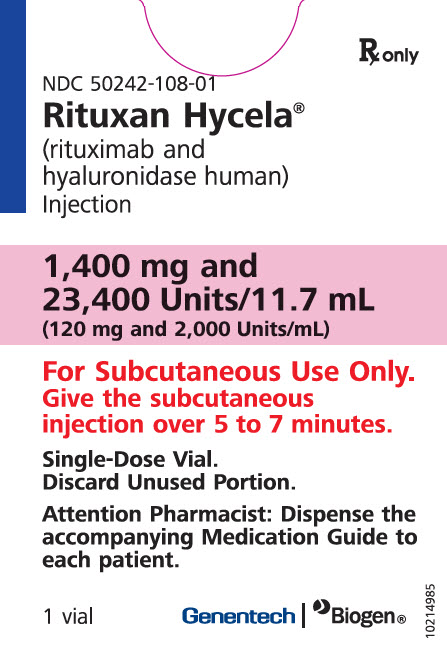
Principal Display Panel 11.7 Ml Vial Carton
Rx only
NDC 50242-108-01
Rituxan Hycela®
(rituximab and
hyaluronidase human)
Injection
1,400 mg and
23,400 Units/11.7 mL
(120 mg and 2,000 Units/mL)
For Subcutaneous Use Only.
Give the subcutaneous
injection over 5 to 7 minutes.
Single-Dose Vial.
Discard Unused Portion.
Attention Pharmacist: Dispense the
accompanying Medication Guide to
each patient.
1 vial
Genentech | Biogen®
10214985
Principal Display Panel 13.4 Ml Vial Carton
Rx only
NDC 50242-109-01
Rituxan Hycela®
(rituximab and
hyaluronidase human)
Injection
1,600 mg and
26,800 Units/13.4 mL
(120 mg and 2,000 Units/mL)
For Subcutaneous Use Only.
Give the subcutaneous
injection over 5 to 7 minutes.
Single-Dose Vial.
Discard Unused Portion.
Attention Pharmacist: Dispense the
accompanying Medication Guide to
each patient.
1 vial
Genentech | Biogen®
10214988
8.3 Females and Males of Reproductive Potential
Rituximab-containing products can cause fetal harm [see Use in Specific Populations (8.1)].
2.2 Recommended Dosage for Follicular Lymphoma (fl)
All patients must receive at least one full dose of a rituximab product by intravenous infusion before starting treatment with RITUXAN HYCELA [see Dosage and Administration (2.1) and Warnings and Precautions (5.4)]. Premedicate before each dose [see Dosage and Administration (2.5)].
The recommended dose is RITUXAN HYCELA 1,400 mg/23,400 Units (1,400 mg rituximab and 23,400 Units hyaluronidase human) subcutaneously at a fixed dose irrespective of patient's body surface area according to the following schedules:
-
Relapsed or Refractory, Follicular Lymphoma
Administer once weekly for 3 or 7 weeks following a full dose of a rituximab product by intravenous infusion at week 1 (i.e., 4 or 8 weeks in total). -
Retreatment for Relapsed or Refractory, Follicular Lymphoma
Administer once weekly for 3 weeks following a full dose of a rituximab product by intravenous infusion at week 1 (i.e., 4 weeks in total). -
Previously Untreated, Follicular Lymphoma
Administer on Day 1 of Cycles 2–8 of chemotherapy (every 21 days), for up to 7 cycles following a full dose of a rituximab product by intravenous infusion on Day 1 of Cycle 1 of chemotherapy (i.e., up to 8 cycles in total). In patients with complete or partial response, initiate RITUXAN HYCELA maintenance treatment 8 weeks following completion of RITUXAN HYCELA in combination with chemotherapy. Administer RITUXAN HYCELA as a single-agent every 8 weeks for 12 doses. -
Non-progressing, Follicular Lymphoma after first line CVP chemotherapy
Following completion of 6–8 cycles of CVP chemotherapy and a full dose of a rituximab product by intravenous infusion at week 1, administer once weekly for 3 weeks (i.e., 4 weeks in total) at 6 month intervals to a maximum of 16 doses.
5.3 Progressive Multifocal Leukoencephalopathy (pml)
JC virus infection resulting in PML and death has been observed in patients receiving rituximab-containing products, including RITUXAN HYCELA. Consider the diagnosis of PML in any patient presenting with new-onset neurologic manifestations. Evaluation of PML includes, but is not limited to, consultation with a neurologist, brain MRI, and lumbar puncture.
Discontinue RITUXAN HYCELA and consider discontinuation or reduction of any concomitant chemotherapy or immunosuppressive therapy in patients who develop PML [see Adverse Reactions (6.1)].
13.1 Carcinogenesis, Mutagenesis, Impairment of Fertility
No long term animal studies have been performed to establish the carcinogenic or mutagenic potential of RITUXAN HYCELA or rituximab, or to determine potential effects on fertility in males or females.
RITUXAN HYCELA contains hyaluronidase human. Hyaluronidases are found in most tissues of the body. Long-term animal studies have not been performed to assess the carcinogenic or mutagenic potential of hyaluronidase human. In addition, when hyaluronidase human was administered to cynomolgus monkeys for 39 weeks at dose levels up to 220,000 U/kg, which is > 90 times higher than the human dose, no evidence of toxicity to the male or female reproductive system was found through periodic monitoring of in-life parameters, e.g., semen analyses, hormone levels, menstrual cycles, and also from gross pathology, histopathology and organ weight data.
2.5 Recommended Premedication and Prophylactic Medications
Premedicate with acetaminophen and an antihistamine before each dose of RITUXAN HYCELA. Premedication with a glucocorticoid should also be considered [see Dosage and Administration (2.2, 2.3, 2.4)].
Provide prophylaxis for Pneumocystis jiroveci pneumonia (PCP) and herpes virus infections for patients with CLL during treatment and for up to 12 months following treatment as appropriate [see Warnings and Precautions (5.6)].
2.4 Recommended Dosage for Chronic Lymphocytic Leukemia (cll)
All patients must receive at least one full dose of a rituximab product by intravenous infusion in combination with FC chemotherapy before starting treatment with RITUXAN HYCELA [see Dosage and Administration (2.1) and Warnings and Precautions (5.4)]. Premedicate before each dose [see Dosage and Administration (2.5)].
The recommended dose for CLL is RITUXAN HYCELA 1,600 mg/26,800 Units (1,600 mg rituximab and 26,800 Units hyaluronidase human) in combination with FC chemotherapy, at a fixed dose, irrespective of patient's body surface area. Administer RITUXAN HYCELA 1,600 mg/26,800 Units on Day 1 of Cycles 2–6 (every 28 days) for a total of 5 cycles following a full intravenous dose at Day 1, Cycle 1 (i.e., 6 cycles in total).
2.3 Recommended Dosage for Diffuse Large B Cell Lymphoma (dlbcl)
All patients must receive at least one full dose of a rituximab product by intravenous infusion in combination with CHOP chemotherapy before starting treatment with RITUXAN HYCELA [see Dosage and Administration (2.1) and Warnings and Precautions (5.4)]. Premedicate before each dose [see Dosage and Administration (2.5)].
The recommended dose for DLBCL is RITUXAN HYCELA 1,400 mg/23,400 Units (1,400 mg rituximab and 23,400 Units hyaluronidase human) at a fixed dose irrespective of patient's body surface area in combination with CHOP chemotherapy. Administer RITUXAN HYCELA 1,400 mg/23,400 Units on Day 1 of Cycles 2–8 of CHOP chemotherapy for up to 7 cycles following a full dose of a rituximab product by intravenous infusion at Day 1, Cycle 1 of CHOP chemotherapy (i.e., up to 6–8 cycles in total).
Warning: Severe Mucocutaneous Reactions, Hepatitis B Virus Reactivation and Progressive Multifocal Leukoencephalopathy
WARNING: SEVERE MUCOCUTANEOUS REACTIONS, HEPATITIS B VIRUS REACTIVATION and PROGRESSIVE MULTIFOCAL LEUKOENCEPHALOPATHY
See full prescribing information for complete boxed warning.
Structured Label Content
Section 34073-7 (34073-7)
Renal toxicity when used in combination with cisplatin. (5.8)
Section 42229-5 (42229-5)
Severe Mucocutaneous Reactions
Severe, including fatal, mucocutaneous reactions can occur in patients receiving rituximab-containing products, including RITUXAN HYCELA [see Warnings and Precautions (5.1)].
Section 42231-1 (42231-1)
| This Medication Guide has been approved by the U.S. Food and Drug Administration | Revised: 6/2021 | |
|
MEDICATION GUIDE
RITUXAN HYCELA® [rih-TUKS-an hye-SELL-uh] (rituximab and hyaluronidase human) injection |
||
|
What is the most important information I should know about RITUXAN HYCELA? RITUXAN HYCELA can cause serious side effects that can lead to death, including:
|
||
|
|
|
| See "What are the possible side effects of RITUXAN HYCELA?" for more information about side effects. | ||
|
What is RITUXAN HYCELA?
RITUXAN HYCELA is a prescription medicine used to treat adults with:
RITUXAN HYCELA is not for use to treat medical conditions other than cancers. It is not known if RITUXAN HYCELA is safe and effective in children. |
||
Before you receive RITUXAN HYCELA, tell your healthcare provider about all of your medical conditions, including if you:
|
||
How will I receive RITUXAN HYCELA?
|
||
|
What are possible side effects of RITUXAN HYCELA? RITUXAN HYCELA can cause serious side effects, including:
|
||
|
|
|
The most common side effects of RITUXAN HYCELA in people with Follicular Lymphoma (FL) include: infections, low white blood cell count, nausea, constipation, cough, and tiredness. The most common side effects of RITUXAN HYCELA in people with Diffuse Large B-cell Lymphoma (DLBCL) include: infections, low white blood cell count, loss of hair, nausea, and low red blood cell count. The most common side effects of RITUXAN HYCELA in people with Chronic Lymphocytic Leukemia (CLL) include: infections, low white blood cell count, nausea, low platelet count, fever, vomiting, and injection site redness. These are not all of the possible side effects with RITUXAN HYCELA. Call your doctor for medical advice about side effects. You may report side effects to FDA at 1-800-FDA-1088. |
||
|
General information about the safe and effective use of RITUXAN HYCELA.
Medicines are sometimes prescribed for purposes other than those listed in a Medication Guide. You can ask your pharmacist or healthcare provider for information about RITUXAN HYCELA that is written for health professionals. |
||
|
What are the ingredients in RITUXAN HYCELA? Active ingredient: rituximab and hyaluronidase human. Inactive ingredients: L-histidine, L-histidine hydrochloride monohydrate, L-methionine, polysorbate 80, α,α-trehalose dihydrate, and Water for Injection. Manufactured by: Genentech, Inc., A Member of the Roche Group, 1 DNA Way, South San Francisco, CA 94080-4990 U.S. License No.: 1048 Jointly marketed by: Biogen and Genentech USA, Inc. RITUXAN HYCELA® is a registered trademark of Biogen. ©2021 Biogen and Genentech USA, Inc. For more information, go to www.RITUXANHYCELA.com or call 1-877-436-3683. |
Representative sample of labeling (see the HOW SUPPLIED section for complete listing):
Section 43683-2 (43683-2)
| Dosage and Administration, Preparation and Administration (2.6) | 06/2021 |
Section 44425-7 (44425-7)
Storage
Store RITUXAN HYCELA vials in the refrigerator at 2°C to 8°C (36°F to 46°F) in the original carton to protect from light. Do not freeze.
8.2 Lactation
There are no data on the presence of hyaluronidase human in human milk or the effect of rituximab on milk production, and there is limited data on the effect of rituximab on the breastfed child. However, rituximab is detected in the milk of lactating cynomolgus monkeys and maternal IgG is present in human breast milk. Rituximab has also been reported to be excreted at low concentrations in human breast milk. Given that the clinical significance of this finding for children is not known, advise women not to breastfeed during treatment with RITUXAN HYCELA and for 6 months after the last dose due to the potential for serious adverse reactions in breastfed children.
11 Description (11 DESCRIPTION)
RITUXAN HYCELA is a combination of rituximab and hyaluronidase human. Rituximab is a genetically engineered chimeric murine/human monoclonal IgG1 kappa antibody directed against the CD20 antigen. Rituximab has an approximate molecular weight of 145 kD. Rituximab has a binding affinity for the CD20 antigen of approximately 8.0 nM. Rituximab is produced by mammalian cell (Chinese Hamster Ovary) suspension.
Recombinant human hyaluronidase is an endoglycosidase used to increase the dispersion and absorption of co-administered drugs when administered subcutaneously. It is produced by mammalian (Chinese Hamster Ovary) cells containing a DNA plasmid encoding for a soluble fragment of human hyaluronidase (PH20). It is a glycosylated single-chain protein with an approximate molecular weight of 61 kD.
RITUXAN HYCELA (rituximab and hyaluronidase human) injection is a colorless to yellowish, clear to opalescent solution supplied in sterile, preservative-free, single-dose vials for subcutaneous use.
RITUXAN HYCELA is supplied as 1,400 mg rituximab and 23,400 Units hyaluronidase human per 11.7 mL in single-dose vials or 1,600 mg rituximab and 26,800 Units hyaluronidase human per 13.4 mL in single-dose vials. Each mL of solution contains rituximab (120 mg), hyaluronidase human (2,000 Units), L-histidine (0.53 mg), L-histidine hydrochloride monohydrate (3.47 mg), L-methionine (1.49 mg), polysorbate 80 (0.6 mg), α,α-trehalose dihydrate (79.45 mg), and Water for Injection.
5.6 Infections
Serious, including fatal, bacterial, fungal, and new or reactivated viral infections can occur during and following the completion of therapy with rituximab-containing products, including RITUXAN HYCELA. The incidence of infections with RITUXAN HYCELA vs rituximab was 56% and 49% respectively in patients with CLL, and 46% and 41% respectively in patients with FL/DLBCL in combination with chemotherapy. Infections have been reported in some patients with prolonged hypogammaglobulinemia (defined as hypogammaglobulinemia > 11 months after rituximab exposure). New or reactivated viral infections included cytomegalovirus, herpes simplex virus, parvovirus B19, varicella zoster virus, West Nile virus, and hepatitis B and C. Discontinue RITUXAN HYCELA for serious infections and institute appropriate anti-infective therapy [see Adverse Reactions (6.1)].
5.10 Immunization
The safety of immunization with live viral vaccines following rituximab-containing products, including RITUXAN HYCELA, therapy has not been studied and vaccination with live virus vaccines is not recommended before or during treatment.
8.4 Pediatric Use
The safety and effectiveness of RITUXAN HYCELA in pediatric patients have not been established.
8.5 Geriatric Use
Of the total number of subjects in the SABRINA, MabEase, and SAWYER studies, 37% were 65 and over, while 10% were 75 and over. No overall differences in safety or effectiveness were observed between these subjects and younger subjects, and other reported clinical experience has not identified differences in responses between the elderly and younger patients, but greater sensitivity of some older individuals cannot be ruled out.
5.8 Renal Toxicity
Severe, including fatal, renal toxicity can occur after administration of rituximab-containing products, including RITUXAN HYCELA. Renal toxicity has occurred in patients who experience tumor lysis syndrome and in patients with administered concomitant cisplatin therapy during clinical trials. The combination of cisplatin and RITUXAN HYCELA is not an approved treatment regimen. Monitor closely for signs of renal failure and discontinue RITUXAN HYCELA in patients with a rising serum creatinine or oliguria [see Warnings and Precautions (5.5)].
6.2 Immunogenicity
As with all therapeutic proteins, there is potential for immunogenicity. The detection of antibody formation is highly dependent on the sensitivity and specificity of the assay. Additionally, the observed incidence of antibody (including neutralizing antibody) positivity in an assay may be influenced by several factors including assay methodology, sample handling, timing of sample collection, concomitant medications, and underlying disease. For these reasons, comparison of the incidence of antibodies to RITUXAN HYCELA and rituximab in the studies described below with the incidence of antibodies in other studies or to other products may be misleading.
In the SABRINA study, where previously untreated patients with follicular lymphoma were treated with RITUXAN HYCELA or rituximab in combination with CVP or CHOP, the incidence of treatment-induced/enhanced anti-rituximab antibodies in the RITUXAN HYCELA group was similar to that observed in the rituximab group (2.0% RITUXAN HYCELA vs. 1.9% rituximab). The incidence of treatment-induced/enhanced anti-recombinant human hyaluronidase antibodies was 15% in the RITUXAN HYCELA group compared with 8% in the rituximab group, and the overall proportion of patients found to have anti-recombinant human hyaluronidase antibodies remained generally constant over the follow-up period in both cohorts. All patients who tested positive for anti-recombinant human hyaluronidase antibodies at any point during the study were negative for neutralizing antibodies.
In the SAWYER study, where previously untreated patients with CLL were treated with RITUXAN HYCELA or rituximab in combination with FC, the incidence of treatment-induced/enhanced anti-rituximab antibodies was 12% in the RITUXAN HYCELA group and 15% in the rituximab group. The incidence of treatment-induced/enhanced anti-recombinant human hyaluronidase antibodies was 11% in the RITUXAN HYCELA treatment arm. None of the patients who tested positive for anti-recombinant human hyaluronidase antibodies tested positive for neutralizing antibodies.
The clinical relevance of the development of anti-rituximab or anti-recombinant human hyaluronidase antibodies after treatment with RITUXAN HYCELA is not known.
4 Contraindications (4 CONTRAINDICATIONS)
None
6 Adverse Reactions (6 ADVERSE REACTIONS)
The following clinically significant adverse reactions are described elsewhere in the labeling:
- Mucocutaneous reactions [see Warnings and Precautions (5.1)]
- Hepatitis B reactivation including fulminant hepatitis [see Warnings and Precautions (5.2)]
- Progressive multifocal leukoencephalopathy [see Warnings and Precautions (5.3)]
- Hypersensitivity and other administration reactions [see Warnings and Precautions (5.4)]
- Tumor lysis syndrome [see Warnings and Precautions (5.5)]
- Infections [see Warnings and Precautions (5.6)]
- Cardiac arrhythmias [see Warnings and Precautions (5.7)]
- Renal toxicity [see Warnings and Precautions (5.8)]
- Bowel obstruction and perforation [see Warnings and Precautions (5.9)]
12.2 Pharmacodynamics
Peripheral B-cell counts declined to levels below normal following a dose of rituximab by intravenous infusion. In patients treated with rituximab for hematological malignancies, B cell recovery began within 6 months of treatment and generally returned to normal levels within 12 months after completion of therapy, although in some patients this may take longer.
12.3 Pharmacokinetics
The geometric mean rituximab exposures are provided in Table 4. The pharmacokinetic properties of rituximab following the administration of RITUXAN HYCELA in the approved indications are provided in Table 5. The elimination of rituximab was characterized by a time-dependent process that occurred early in therapy and a time-independent process.
| Study For study design information, see
Clinical Studies (14).
|
Cycle | Rituximab | ||
|---|---|---|---|---|
|
FL RITUXAN HYCELA 1,400 mg/23,400 Units (1,400 mg rituximab and 23,400 Units hyaluronidase human)
|
Cmax, mcg/mL (CV%) | SABRINA | 7 | 237 (29.4) |
| 18 | 156 (24.7) Based on predicted values
|
|||
| Ctrough, mcg/mL (CV%) | 7 | 122.2 (55.3) | ||
| 18 | 45.5 (53.6) | |||
| AUCTAU, mcg∙day/mL (CV%) | 7 | 3779 (33.7) | ||
| 18 | 5000 (34.3) | |||
|
CLL RITUXAN HYCELA 1,600 mg/26,800 Units (1,600 mg rituximab and 26,800 Units hyaluronidase human)
|
Cmax, mcg/mL (CV%) | SAWYER | 6 | 202 (36.1) |
| Ctrough, mcg/mL (CV%) | 5 | 97.5 (42.6) | ||
| AUCTAU, mcg∙day/mL (CV%) | 5 | 4088 (34.2) |
In the SABRINA study, the geometric mean Ctrough in the RITUXAN HYCELA arm was higher than in the rituximab arm with a geometric mean ratio (Ctrough, RITUXAN HYCELA/Ctrough, rituximab) of 1.52 (90% CI: 1.36, 1.70) at Cycle 7 [see Clinical Studies (14.1)].
In the SAWYER study, the geometric mean Ctrough in the RITUXAN HYCELA arm was higher than in the rituximab arm with an adjusted geometric mean ratio of 1.53 (90% CI: 1.27–1.85) at Cycle 5 [see Clinical Studies (14.3)].
| FL | CLL | |
|---|---|---|
| Absorption | ||
| Absolute Bioavailability Compared to a rituximab product administered intravenously
|
0.646 (0.634–0.659 95% CI ) |
0.634 (0.602–0.665) |
| Distribution | ||
| Volume of Central compartment (L) | 4.06 (26) | 4.80 (18) |
| Apparent Volume of Distribution at steady state Volume of central compartment and peripheral compartment (L) |
8.09 (19) | 8.52 (13) |
| Elimination | ||
| Terminal Half-life (days) | 34.1 (27) | 32 (24) |
| Clearance (L/day) | 0.18 (34) | 0.204 (31) |
1.4 Limitations of Use
- Initiate treatment with RITUXAN HYCELA only after patients have received at least one full dose of a rituximab product by intravenous infusion [see Dosage and Administration (2.1) and Warnings and Precautions (5.4)].
- RITUXAN HYCELA is not indicated for the treatment of non-malignant conditions.
1 Indications and Usage (1 INDICATIONS AND USAGE)
RITUXAN HYCELA is a combination of rituximab, a CD20-directed cytolytic antibody, and hyaluronidase human, an endoglycosidase, indicated for the treatment of adult patients with:
- Follicular Lymphoma (FL) (1.1)
- Relapsed or refractory, follicular lymphoma as a single agent
- Previously untreated follicular lymphoma in combination with first line chemotherapy and, in patients achieving a complete or partial response to rituximab in combination with chemotherapy, as single-agent maintenance therapy
- Non-progressing (including stable disease), follicular lymphoma as a single agent after first-line cyclophosphamide, vincristine, and prednisone (CVP) chemotherapy
- Diffuse Large B-cell Lymphoma (DLBCL) (1.2)
- Previously untreated diffuse large B-cell lymphoma in combination with cyclophosphamide, doxorubicin, vincristine, prednisone (CHOP) or other anthracycline-based chemotherapy regimens
- Chronic Lymphocytic Leukemia (CLL) (1.3)
- Previously untreated and previously treated CLL in combination with fludarabine and cyclophosphamide (FC)
Limitations of Use:
14.4 Patient Experience
Previously untreated adult patients outside of the United States with CD20+ diffuse large B-cell lymphoma (DLBCL) or CD20+ follicular non-Hodgkin's lymphoma (FL) Grades 1, 2, or 3a were randomized to receive a standard chemotherapy regimen (CHOP, CVP, or bendamustine) and either RITUXAN HYCELA 1,400 mg/23,400 Units at Cycles 2–4 (after the first cycle with intravenous rituximab) or a rituximab product by intravenous infusion at Cycles 1–4. After the fourth cycle, patients were crossed over to the alternative route of administration for the remaining 4 cycles. After Cycle 8, 477 of 620 patients (77%) reported preferring subcutaneous administration of RITUXAN HYCELA over intravenous rituximab and the most common reason was that administration required less time in the clinic. After Cycle 8, 66 of 620 patients (11%) preferred rituximab intravenous administration and the most common reason was that it felt more comfortable during administration. Forty eight of 620 patients (7.7%) had no preference for the route of administration. Twenty nine subjects of 620 (4.7%) received Cycle 8 but did not complete the preference questionnaire.
12.1 Mechanism of Action
Rituximab is a monoclonal antibody that targets the CD20 antigen expressed on the surface of pre-B and mature B-lymphocytes. Upon binding to CD20, rituximab mediates B-cell lysis. Possible mechanisms of cell lysis include complement dependent cytotoxicity (CDC) and antibody dependent cell mediated cytotoxicity (ADCC). Hyaluronan is a polysaccharide found in the extracellular matrix of the subcutaneous tissue. It is depolymerized by the naturally occurring enzyme hyaluronidase. Unlike the stable structural components of the interstitial matrix, hyaluronan has a half-life of approximately 0.5 days. Hyaluronidase human increases permeability of the subcutaneous tissue by temporarily depolymerizing hyaluronan. In the doses administered, hyaluronidase human in RITUXAN HYCELA acts locally.
The effects of hyaluronidase human are reversible and permeability of the subcutaneous tissue is restored within 24 to 48 hours.
Hyaluronidase human has been shown to increase the absorption rate of a rituximab product into the systemic circulation when given in the subcutis of Göttingen Minipigs.
14.1 Follicular Lymphoma
The SABRINA study [NCT01200758] was a randomized, two-stage, open-label, multicenter study that enrolled a total of 410 patients with previously untreated, CD20-positive follicular lymphoma of Grade 1, 2 or 3a requiring therapy. The study design is identical in stage 1 and 2. Patients were randomized (1:1) to receive either a rituximab product by intravenous infusion 375 mg/m2 for 8 cycles or 1 cycle of a rituximab product by intravenous infusion 375 mg/m2 followed by 7 cycles of RITUXAN HYCELA 1,400 mg/23,400 Units (1,400 mg rituximab and 23,400 Units hyaluronidase human) both every 3 weeks in combination with a total of 6–8 cycles of CHOP or 8 cycles of CVP chemotherapy. Patients underwent interim staging after 4 cycles. Patients who received R-CHOP and achieved a CR, CRu, PR or SD at the interim assessment could receive either 4 more cycles of R-CHOP or 2 cycles of R-CHOP followed by 2 cycles of monotherapy with rituximab product or RITUXAN HYCELA depending on randomization arm (i.e., a total of 8 cycles of rituximab product or RITUXAN HYCELA). Patients with at least a PR after combination treatment with chemotherapy continued with single agent maintenance treatment administered every 8 weeks for 24 months with rituximab product or RITUXAN HYCELA as per their randomization (i.e., total of 12 cycles of maintenance treatment).
Randomization was stratified by: underlying chemotherapy backbone (CHOP vs CVP), Follicular Lymphoma International Prognostic Index (FLIPI) (low-risk vs. intermediate-risk vs. high-risk), and region (Europe and North America vs. South and Central America vs Asia).
The main outcome measure for Stage 1 was the estimated ratio of observed rituximab serum Ctrough SC/Ctrough IV at Cycle 7 of combination treatment with chemotherapy every 3 weeks. The main outcome measure for Stage 2 was the investigator-assessed ORR consisting of CR, CRu, and PR at the completion of combination treatment with chemotherapy. Additional outcome measures were CRR (CR and CRu) at the end of completion of combination treatment with chemotherapy, ORR and CRR at the end of completion of maintenance treatment, and time-to-event endpoints (progression-free survival (PFS), and overall survival (OS)).
Of all randomized patients, the median age was 57 years (range: 28 to 86), 53% were female, and 86% were White. The median BSA was 1.83 m2. 45% had high risk or 34% had intermediate risk FLIPI score, and 54% had Ann Arbor Stage IV disease. Ninety percent of patients completed all 8 cycles of combination treatment with chemotherapy, and 70% of patients completed 20 cycles of both combination and maintenance treatment. Median treatment duration was 27.1 months in both groups. The median number of cycles received was 20 in both groups.
The pharmacokinetic results for the primary endpoint in Stage 1, rituximab Ctrough at Cycle 7 (i.e., 21 days after Cycle 7 rituximab administration), demonstrated that RITUXAN HYCELA 1,400 mg/23,400 Units was non-inferior compared with rituximab at 375 mg/m2 in patients receiving combination treatment with chemotherapy [see Clinical Pharmacology (12.3)]. The efficacy results are presented in Table 6.
| RITUXAN HYCELA N=205 |
Rituximab N=205 |
|
|---|---|---|
|
Overall Response Rate at End of combination treatment with chemotherapy Stage 2 main outcome measure was ORR at the end of combination treatment with chemotherapy; however pooled results which were preplanned are presented in this Table.
,
Response rates based on investigator assessment. Response rates at end of maintenance based on patients who received at least one cycle of maintenance treatment (n). Investigator-assessed ORR (comprising CR, CRu and PR).
|
||
| Number of responders (CR/CRu, PR) | 173 | 174 |
| Overall response (CR/CRu, PR) rate (%, [95% CI]) | 84% [79;89] | 85% [79;90] |
| Difference in overall response rates Difference in response rates (RITUXAN HYCELA minus rituximab). [95% CI] |
-0.5% [-7.7;6.8] | |
| Number of complete responders (CR/CRu) | 66 | 65 |
| Complete response (CR/CRu) rate (%, [95% CI]) | 32% [26;39] | 32% [25;39] |
| Difference in complete response rates [95% CI] | 0.0% [-9.3;9.3] | |
| Overall Response Rate at End of Maintenance | ||
| Number of patients treated in maintenance (n) | 172 | 178 |
| Number of responders (CR/CRu, PR) | 134 | 139 |
| Overall response (CR/CRu, PR) rate (%, [95% CI]) | 78% [71;84] | 78% [71;84] |
| Difference in overall response rates [95% CI] | -0.2 [-9.2;8.8] | |
| Number of complete responders (CR/CRu) | 87 | 103 |
| Complete response (CR/CRu) rate (%, [95% CI]) | 51% [43;58] | 58% [50;65] |
| Difference in complete response rates [95% CI] | -7.3 [-18.0;3.5] | |
|
Progression-free survival At time of final analysis (median follow-up 4.8 years).
|
||
| Number of patients with event | 65 (32%) | 71 (35%) |
| Hazard Ratio [95% CI] (unstratified Cox model) | 0.90 [0.64;1.26] | |
| Overall survival | ||
| Number of patients with event | 18 (8.8%) | 26 (12.7%) |
| Hazard Ratio [95% CI] (unstratified Cox model) | 0.70 [0.38;1.27] |
5 Warnings and Precautions (5 WARNINGS AND PRECAUTIONS)
- Hypersensitivity and other administration reactions: Local cutaneous reactions may occur more than 24 hours after administration. Interrupt injection if severe reaction develops. Premedicate before injection. (5.4)
- Tumor lysis syndrome: Administer aggressive intravenous hydration, anti hyperuricemic agents, monitor renal function. (5.5)
- Infections: Withhold and institute appropriate anti-infective therapy. (5.6)
- Cardiac adverse reactions: Discontinue in case of serious or life-threatening events. (5.7)
- Renal toxicity: Discontinue in patients with rising serum creatinine or oliguria. (5.8)
- Bowel obstruction and perforation: Consider and evaluate for abdominal pain, vomiting, or related symptoms. (5.9)
- Immunizations: Live virus vaccinations prior to or during treatment not recommended. (5.10)
- Embryo-Fetal toxicity: Can cause fetal harm. Advise females of reproductive potential of the potential risk to a fetus and use of effective contraception. (5.11)
5.11 Embryo Fetal Toxicity (5.11 Embryo-Fetal Toxicity)
Based on human data, rituximab-containing products can cause fetal harm due to B-cell lymphocytopenia in infants exposed to rituximab in-utero. Advise pregnant women of the potential risk to a fetus. Advise females of reproductive potential to use effective contraception during treatment with RITUXAN HYCELA and for 12 months after the last dose of rituximab-containing products, including RITUXAN HYCELA [see Use in Specific Populations (8.1, 8.3)].
2 Dosage and Administration (2 DOSAGE AND ADMINISTRATION)
- For subcutaneous use only (2.1)
- All patients must receive at least one full dose of a rituximab product by intravenous infusion before receiving RITUXAN HYCELA by subcutaneous injection (2.1).
- FL/DLBCL: Administer 1,400 mg/23,400 Units (1,400 mg rituximab and 23,400 Units hyaluronidase human) subcutaneously according to recommended schedule (2.2, 2.3).
- CLL: Administer 1,600 mg/26,800 Units (1,600 mg rituximab and 26,800 Units hyaluronidase human) subcutaneously according to recommended schedule (2.4).
- Premedicate with acetaminophen and antihistamine before each dose; in addition, consider premedication with glucocorticoids (2.5, 5.4)
- Administer specified volume into subcutaneous tissue of abdomen: (2.6)
- 11.7 mL from 1,400 mg/23,400 Units vial over approximately 5 minutes.
- 13.4 mL from 1,600 mg/26,800 Units vial over approximately 7 minutes.
- Observe 15 minutes following administration
1.1 Follicular Lymphoma (fl) (1.1 Follicular Lymphoma (FL))
RITUXAN HYCELA is indicated for the treatment of adult patients with:
- Relapsed or refractory, follicular lymphoma as a single agent.
- Previously untreated follicular lymphoma in combination with first line chemotherapy and, in patients achieving a complete or partial response to rituximab in combination with chemotherapy, as single-agent maintenance therapy.
- Non-progressing (including stable disease), follicular lymphoma as a single agent after first-line cyclophosphamide, vincristine, and prednisone (CVP) chemotherapy.
3 Dosage Forms and Strengths (3 DOSAGE FORMS AND STRENGTHS)
RITUXAN HYCELA is a colorless to yellowish, clear to opalescent solution for subcutaneous injection:
- Injection: 1,400 mg rituximab and 23,400 Units hyaluronidase human per 11.7 mL (120 mg/2,000 Units per mL) in a single-dose vial.
- Injection: 1,600 mg rituximab and 26,800 Units hyaluronidase human per 13.4 mL (120 mg/2,000 Units per mL) in a single-dose vial.
6.3 Postmarketing Experience
The following adverse reactions have been identified during post-approval use of rituximab-containing products. Because these reactions are reported voluntarily from a population of uncertain size, it is not always possible to reliably estimate their frequency or establish a causal relationship to drug exposure.
- Hematologic: prolonged pancytopenia, marrow hypoplasia, Grade 3–4 prolonged or late-onset neutropenia, hyperviscosity syndrome in Waldenstrom's macroglobulinemia, prolonged hypogammaglobulinemia
- Cardiac: fatal cardiac failure
- Immune/Autoimmune Events: uveitis, optic neuritis, systemic vasculitis, pleuritis, lupus-like syndrome, serum sickness, polyarticular arthritis, and vasculitis with rash.
- Infection: viral infections, including progressive multifocal leukoencephalopathy (PML), increase in fatal infections in HIV-associated lymphoma, and a reported increased incidence of Grade 3 and 4 infections
- Neoplasia: disease progression of Kaposi's sarcoma.
- Skin: severe mucocutaneous reactions, pyoderma gangrenosum (including genital presentation).
- Gastrointestinal: bowel obstruction and perforation.
- Pulmonary: fatal bronchiolitis obliterans and fatal interstitial lung disease.
8 Use in Specific Populations (8 USE IN SPECIFIC POPULATIONS)
- Lactation: Advise not to breastfeed. (8.2)
5.5 Tumor Lysis Syndrome (tls) (5.5 Tumor Lysis Syndrome (TLS))
TLS can occur within 12–24 hours after administration of a rituximab-containing product, including RITUXAN HYCELA. A high number of circulating malignant cells (≥ 25,000/mm3) or high tumor burden confers a greater risk of TLS. Administer aggressive intravenous hydration and anti-hyperuricemic therapy in patients at high risk for TLS. Correct electrolyte abnormalities, monitor renal function and fluid balance, and administer supportive care, including dialysis as indicated [see Warnings and Precautions (5.8)].
6.1 Clinical Trials Experience
Because clinical trials are conducted under widely varying conditions, adverse reaction rates observed in the clinical trials of a drug cannot be directly compared to rates in the clinical trials of another drug and may not reflect the rates observed in clinical practice.
The data described below reflect exposure to RITUXAN HYCELA in 892 patients in four controlled trials with exposures ranging from a single injection up to 27 months of treatment.
The population included 382 patients with follicular lymphoma (FL), 369 patients with diffuse large B-cell lymphoma (DLBCL), and 141 patients with chronic lymphocytic leukemia (CLL). The median age was 60 years (range: 18–85 years, 53% were male, and 84% were White. In the SABRINA study patients with FL received a full dose of a rituximab product by intravenous infusion, followed by RITUXAN HYCELA (1,400 mg rituximab/23,400 Units hyaluronidase human), in combination with chemotherapy for up to 7 doses (i.e., total of 8 doses in combination with chemotherapy), or as monotherapy for up to 12 doses (maintenance treatment). In the MabEase study patients with DLBCL received a full dose of a rituximab product by intravenous infusion, followed by RITUXAN HYCELA (1,400 mg rituximab/23,400 Units hyaluronidase human), given in combination with chemotherapy for up to 7 doses (i.e., up to a total of 8 doses). In the SAWYER study patients with CLL on part 2 received a full dose of a rituximab product by intravenous infusion, followed by RITUXAN HYCELA (1,600 mg rituximab/26,800 Units hyaluronidase human) for up to 5 doses, in combination with fludarabine and cyclophosphamide (i.e., total of 6 doses).
The most common adverse reactions (≥ 20%) of RITUXAN HYCELA observed in patients with FL on the SABRINA study were: infections, neutropenia, nausea, constipation, cough, and fatigue.
The most common adverse reactions (≥ 20%) of RITUXAN HYCELA observed in patients with DLBCL on the MabEase study were: infections, neutropenia, alopecia, nausea, and anemia.
The most common adverse reactions (≥ 20%) of RITUXAN HYCELA observed in patients with CLL on part 2 of the SAWYER study were: infections, neutropenia, nausea, thrombocytopenia, pyrexia, vomiting, and injection site erythema.
2.1 Important Dosing Information
RITUXAN HYCELA is for subcutaneous use only. RITUXAN HYCELA should only be administered by a healthcare professional with appropriate medical support to manage severe reactions that can be fatal if they occur.
All patients must first receive at least one full dose of a rituximab product by intravenous infusion without experiencing severe adverse reactions before starting treatment with RITUXAN HYCELA. If patients are not able to receive one full dose by intravenous infusion, they should continue subsequent cycles with a rituximab product by intravenous infusion and not switch to RITUXAN HYCELA until a full intravenous dose is successfully administered [see Warnings and Precautions (5.4)].
Refer to the prescribing information for a rituximab product for intravenous infusion for additional information.
Premedicate before each dose of RITUXAN HYCELA [see Dosage and Administration (2.5)].
Dose reductions of RITUXAN HYCELA are not recommended. When RITUXAN HYCELA is given in combination with chemotherapy dose, reduce the chemotherapeutic drugs to manage adverse reactions.
17 Patient Counseling Information (17 PATIENT COUNSELING INFORMATION)
Advise the patient to read the FDA-approved patient labeling (Medication Guide).
2.6 Preparation and Administration
To prevent medication errors, check the vial labels to ensure that the drug being prepared and administered is RITUXAN HYCELA for subcutaneous use. Do not administer RITUXAN HYCELA intravenously.
RITUXAN HYCELA is ready to use.
5.1 Severe Mucocutaneous Reactions
Mucocutaneous reactions, some with fatal outcome, can occur in patients treated with rituximab-containing products, including RITUXAN HYCELA. These reactions include paraneoplastic pemphigus, Stevens-Johnson syndrome, lichenoid dermatitis, vesiculobullous dermatitis, and toxic epidermal necrolysis. Discontinue RITUXAN HYCELA in patients who experience a severe mucocutaneous reaction. The safety of re-administration of a rituximab-containing product, including RITUXAN HYCELA, to patients with severe mucocutaneous reactions has not been determined.
5.2 Hepatitis B Virus Reactivation
Hepatitis B virus (HBV) reactivation, in some cases resulting in fulminant hepatitis, hepatic failure and death, can occur in patients treated with drugs classified as CD20-directed cytolytic antibodies, including rituximab-containing products. HBV reactivation is defined as an abrupt increase in HBV replication manifesting as a rapid increase in serum HBV DNA levels or detection of HBsAg in a person who was previously HBsAg negative and anti-HBc positive. Reactivation of HBV replication is often followed by hepatitis, i.e., increase in transaminase levels. In severe cases increase in bilirubin levels, liver failure, and death can occur.
Screen all patients for HBV infection by measuring HBsAg and anti-HBc before initiating treatment with a rituximab-containing product. For patients who show evidence of prior hepatitis B infection (HBsAg positive [regardless of antibody status] or HBsAg negative but anti-HBc positive), consult with physicians with expertise in managing hepatitis B regarding monitoring and consideration for HBV antiviral therapy before and/or during treatment with a rituximab-containing product. Monitor patients with evidence of current or prior HBV infection for clinical and laboratory signs of hepatitis or HBV reactivation during and for several months following RITUXAN HYCELA. HBV reactivation has been reported up to 24 months following completion of therapy containing rituximab.
In patients who develop reactivation of HBV while on RITUXAN HYCELA, immediately discontinue treatment and any concomitant chemotherapy, and institute appropriate treatment. Insufficient data exist regarding the safety of resuming RITUXAN HYCELA treatment in patients who develop HBV reactivation. Resumption of RITUXAN HYCELA treatment in patients whose HBV reactivation resolves should be discussed with physicians with expertise in managing HBV.
16 How Supplied/storage and Handling (16 HOW SUPPLIED/STORAGE AND HANDLING)
RITUXAN HYCELA (rituximab and hyaluronidase human) injection, for subcutaneous use is supplied as a sterile preservative-free liquid solution in a single-dose vial. The following configurations are available:
Individually packaged single-dose vials:
- RITUXAN HYCELA 1,400 mg/23,400 Units (NDC 50242-108-01) providing 1,400 mg rituximab and 23,400 Units hyaluronidase human per 11.7 mL
- RITUXAN HYCELA 1,600 mg/26,800 Units (NDC 50242-109-01) providing 1,600 mg rituximab and 26,800 Units hyaluronidase human per 13.4 mL
5.7 Cardiovascular Adverse Reactions
Cardiac adverse reactions, including ventricular fibrillation, myocardial infarction, and cardiogenic shock may occur with rituximab-containing products, including RITUXAN HYCELA.
Discontinue RITUXAN HYCELA for serious or life threatening cardiac arrhythmias. Perform cardiac monitoring during and after all administrations of RITUXAN HYCELA for patients who develop clinically significant arrhythmias, or who have a history of arrhythmia or angina [see Adverse Reactions (6.1)].
5.9 Bowel Obstruction and Perforation
Abdominal pain, bowel obstruction and perforation, in some cases leading to death, can occur in patients receiving rituximab-containing products, including RITUXAN HYCELA, in combination with chemotherapy. In postmarketing reports, the mean time to documented gastrointestinal perforation was 6 (range 1–77) days. Evaluate if symptoms of obstruction such as abdominal pain or repeated vomiting occur.
1.3 Chronic Lymphocytic Leukemia (cll) (1.3 Chronic Lymphocytic Leukemia (CLL))
RITUXAN HYCELA is indicated, in combination with fludarabine and cyclophosphamide (FC), for the treatment of adult patients with previously untreated and previously treated CLL.
14.3 Chronic Lymphocytic Leukemia (cll) (14.3 Chronic Lymphocytic Leukemia (CLL))
The SAWYER study [NCT01292603] was a randomized, two-part, open-label, multicenter study that enrolled a total of 176 patients with previously untreated CLL. Patients were randomized (1:1) to receive either a rituximab product by intravenous infusion, 375 mg/m2, in Cycle 1 followed by up to 5 cycles of rituximab, 500 mg/m2, or rituximab, 375 mg/m2, in Cycle 1 followed by subsequent cycles (2–6) of RITUXAN HYCELA 1,600 mg/26,800 Units (1,600 mg rituximab and 26,800 Units hyaluronidase human), both in combination with fludarabine and cyclophosphamide (FC) chemotherapy. The main outcome measure was the non-inferiority of the pharmacokinetic profile of RITUXAN HYCELA compared to rituximab. An additional outcome measure in Part 2 was investigator-assessed response rate.
The median age was 60 years (range: 25 to 78); 65% were males and 96% were White. The median BSA was 1.9 m2, 62% had Binet Stage B disease and 93% had typical CLL characterization.
The pharmacokinetic results demonstrated that RITUXAN HYCELA 1,600 mg/26,800 Units serum rituximab Ctrough level was non-inferior compared with rituximab at 500 mg/m2 in patients receiving combination treatment with chemotherapy [see Clinical Pharmacology (12.3)].
The efficacy results for Part 2 are presented in Table 8.
| Part 2 | |||
|---|---|---|---|
| RITUXAN HYCELA (N = 88) |
Rituximab (N = 88) |
||
| ORR – Overall Response Rate | |||
| CRR – Complete Response Rate | |||
| PFS – Progression-Free Survival | |||
|
ORR At 3 month follow-up visit (Part 2). Investigator-assessed.
|
Point estimate | 85.2% (n = 75) | 80.7% (n = 71) |
| 95% CI | [76.1%, 91.9%] | [70.9%, 88.3%] | |
| CRR | Point estimate | 27.3% (n = 24) | 31.8% (n = 28) |
| 95% CI | [18.3%, 37.8%] | [22.3%, 42.6%] | |
|
PFS At time of final analysis (median follow-up 4.4 years). Investigator-assessed.
|
Proportion with PFS event | 34.1% (n = 30) | 42.0% (n = 37) |
| HR 95% CI | 0.76 [0.47%, 1.23%] |
1.2 Diffuse Large B Cell Lymphoma (dlbcl) (1.2 Diffuse Large B-Cell Lymphoma (DLBCL))
RITUXAN HYCELA is indicated for the treatment of adult patients with previously untreated diffuse large B-cell lymphoma in combination with cyclophosphamide, doxorubicin, vincristine, prednisone (CHOP) or other anthracycline-based chemotherapy regimens.
14.2 Diffuse Large B Cell Lymphoma (dlbcl) (14.2 Diffuse Large B-Cell Lymphoma (DLBCL))
The MabEase study [NCT01649856] enrolled a total of 576 patients with previously untreated CD20-positive DLBCL. Patients were randomized (2:1) to receive either a rituximab product by intravenous infusion, 375 mg/m2 for 8 cycles or 1 cycle of a rituximab product by intravenous infusion 375 mg/m2 followed by 7 cycles of RITUXAN HYCELA 1,400 mg/23,400 Units (1,400 mg rituximab and 23,400 Units hyaluronidase human), both in combination with up to 6–8 cycles of CHOP chemotherapy, every 14 (CHOP-14) or 21 days (CHOP-21). Randomization was stratified by: age (< 60 years, ≥ 60 years), International Prognostic Index (IPI) risk category (low, low-intermediate, high-intermediate, high), and chemotherapy regimen (CHOP-21 or CHOP-14). The main outcome measure was investigator-assessed complete response rate (CR/CRu) at the end of combination treatment with chemotherapy. Additional outcome measures were time-to-event endpoints (PFS and OS).
Of all randomized patients, the median age was 64 years (range: 18 to 80 years); 54% were male; and 79% were White. The median BSA was 1.83 m2. 31% low risk or 30% low intermediate risk IPI score, 24% high intermediate risk, or 15% high risk IPI score and 42% of patients had Ann Arbor Stage IV disease. A total of 470 patients (82%) received 8 cycles of treatment. Median duration of exposure to treatment was 4.9 months in both treatment groups. The median number of administrations/cycles (RITUXAN HYCELA or rituximab) was 8 in both groups.
The efficacy results for are presented in Table 7. The median observation time was approximately 28 months.
| RITUXAN HYCELA N=381 |
Rituximab N=195 |
|
|---|---|---|
|
Complete Response Rate (CR/CRu) Investigator-assessed.
|
||
| Number achieving CR/CRu Four patients in the RITUXAN HYCELA group and 1 patient in the rituximab group had their response downgraded due to their bone marrow data.
|
179 | 82 |
| Cr/CRu rate (%, [95% CI]) | 47% [42;52] | 42% [35;49] |
| Difference in rates [95% CI] Difference in response rates (RITUXAN HYCELA minus rituximab).
|
4.9% [-3.6;13.5] | |
|
Progression-free survival Progression-free survival is defined as the time from randomization to the first occurrence of disease progression or relapse, or death from any cause.
|
||
| Number of patients with event | 104 (27%) | 44 (23%) |
| Hazard Ratio [95% CI] (unstratified Cox model) | 1.22 [0.85;1.73] | |
|
Overall survival Overall survival is defined as the time from randomization until death from any cause.
|
||
| Number of patients with event | 63 (17%) | 29 (15%) |
| Hazard Ratio [95% CI] (unstratified Cox model) | 1.08 [0.70;1.68] |
Principal Display Panel 11.7 Ml Vial Carton (PRINCIPAL DISPLAY PANEL - 11.7 mL Vial Carton)
Rx only
NDC 50242-108-01
Rituxan Hycela®
(rituximab and
hyaluronidase human)
Injection
1,400 mg and
23,400 Units/11.7 mL
(120 mg and 2,000 Units/mL)
For Subcutaneous Use Only.
Give the subcutaneous
injection over 5 to 7 minutes.
Single-Dose Vial.
Discard Unused Portion.
Attention Pharmacist: Dispense the
accompanying Medication Guide to
each patient.
1 vial
Genentech | Biogen®
10214985
Principal Display Panel 13.4 Ml Vial Carton (PRINCIPAL DISPLAY PANEL - 13.4 mL Vial Carton)
Rx only
NDC 50242-109-01
Rituxan Hycela®
(rituximab and
hyaluronidase human)
Injection
1,600 mg and
26,800 Units/13.4 mL
(120 mg and 2,000 Units/mL)
For Subcutaneous Use Only.
Give the subcutaneous
injection over 5 to 7 minutes.
Single-Dose Vial.
Discard Unused Portion.
Attention Pharmacist: Dispense the
accompanying Medication Guide to
each patient.
1 vial
Genentech | Biogen®
10214988
8.3 Females and Males of Reproductive Potential
Rituximab-containing products can cause fetal harm [see Use in Specific Populations (8.1)].
2.2 Recommended Dosage for Follicular Lymphoma (fl) (2.2 Recommended Dosage for Follicular Lymphoma (FL))
All patients must receive at least one full dose of a rituximab product by intravenous infusion before starting treatment with RITUXAN HYCELA [see Dosage and Administration (2.1) and Warnings and Precautions (5.4)]. Premedicate before each dose [see Dosage and Administration (2.5)].
The recommended dose is RITUXAN HYCELA 1,400 mg/23,400 Units (1,400 mg rituximab and 23,400 Units hyaluronidase human) subcutaneously at a fixed dose irrespective of patient's body surface area according to the following schedules:
-
Relapsed or Refractory, Follicular Lymphoma
Administer once weekly for 3 or 7 weeks following a full dose of a rituximab product by intravenous infusion at week 1 (i.e., 4 or 8 weeks in total). -
Retreatment for Relapsed or Refractory, Follicular Lymphoma
Administer once weekly for 3 weeks following a full dose of a rituximab product by intravenous infusion at week 1 (i.e., 4 weeks in total). -
Previously Untreated, Follicular Lymphoma
Administer on Day 1 of Cycles 2–8 of chemotherapy (every 21 days), for up to 7 cycles following a full dose of a rituximab product by intravenous infusion on Day 1 of Cycle 1 of chemotherapy (i.e., up to 8 cycles in total). In patients with complete or partial response, initiate RITUXAN HYCELA maintenance treatment 8 weeks following completion of RITUXAN HYCELA in combination with chemotherapy. Administer RITUXAN HYCELA as a single-agent every 8 weeks for 12 doses. -
Non-progressing, Follicular Lymphoma after first line CVP chemotherapy
Following completion of 6–8 cycles of CVP chemotherapy and a full dose of a rituximab product by intravenous infusion at week 1, administer once weekly for 3 weeks (i.e., 4 weeks in total) at 6 month intervals to a maximum of 16 doses.
5.3 Progressive Multifocal Leukoencephalopathy (pml) (5.3 Progressive Multifocal Leukoencephalopathy (PML))
JC virus infection resulting in PML and death has been observed in patients receiving rituximab-containing products, including RITUXAN HYCELA. Consider the diagnosis of PML in any patient presenting with new-onset neurologic manifestations. Evaluation of PML includes, but is not limited to, consultation with a neurologist, brain MRI, and lumbar puncture.
Discontinue RITUXAN HYCELA and consider discontinuation or reduction of any concomitant chemotherapy or immunosuppressive therapy in patients who develop PML [see Adverse Reactions (6.1)].
13.1 Carcinogenesis, Mutagenesis, Impairment of Fertility
No long term animal studies have been performed to establish the carcinogenic or mutagenic potential of RITUXAN HYCELA or rituximab, or to determine potential effects on fertility in males or females.
RITUXAN HYCELA contains hyaluronidase human. Hyaluronidases are found in most tissues of the body. Long-term animal studies have not been performed to assess the carcinogenic or mutagenic potential of hyaluronidase human. In addition, when hyaluronidase human was administered to cynomolgus monkeys for 39 weeks at dose levels up to 220,000 U/kg, which is > 90 times higher than the human dose, no evidence of toxicity to the male or female reproductive system was found through periodic monitoring of in-life parameters, e.g., semen analyses, hormone levels, menstrual cycles, and also from gross pathology, histopathology and organ weight data.
2.5 Recommended Premedication and Prophylactic Medications
Premedicate with acetaminophen and an antihistamine before each dose of RITUXAN HYCELA. Premedication with a glucocorticoid should also be considered [see Dosage and Administration (2.2, 2.3, 2.4)].
Provide prophylaxis for Pneumocystis jiroveci pneumonia (PCP) and herpes virus infections for patients with CLL during treatment and for up to 12 months following treatment as appropriate [see Warnings and Precautions (5.6)].
2.4 Recommended Dosage for Chronic Lymphocytic Leukemia (cll) (2.4 Recommended Dosage for Chronic Lymphocytic Leukemia (CLL))
All patients must receive at least one full dose of a rituximab product by intravenous infusion in combination with FC chemotherapy before starting treatment with RITUXAN HYCELA [see Dosage and Administration (2.1) and Warnings and Precautions (5.4)]. Premedicate before each dose [see Dosage and Administration (2.5)].
The recommended dose for CLL is RITUXAN HYCELA 1,600 mg/26,800 Units (1,600 mg rituximab and 26,800 Units hyaluronidase human) in combination with FC chemotherapy, at a fixed dose, irrespective of patient's body surface area. Administer RITUXAN HYCELA 1,600 mg/26,800 Units on Day 1 of Cycles 2–6 (every 28 days) for a total of 5 cycles following a full intravenous dose at Day 1, Cycle 1 (i.e., 6 cycles in total).
2.3 Recommended Dosage for Diffuse Large B Cell Lymphoma (dlbcl) (2.3 Recommended Dosage for Diffuse Large B-Cell Lymphoma (DLBCL))
All patients must receive at least one full dose of a rituximab product by intravenous infusion in combination with CHOP chemotherapy before starting treatment with RITUXAN HYCELA [see Dosage and Administration (2.1) and Warnings and Precautions (5.4)]. Premedicate before each dose [see Dosage and Administration (2.5)].
The recommended dose for DLBCL is RITUXAN HYCELA 1,400 mg/23,400 Units (1,400 mg rituximab and 23,400 Units hyaluronidase human) at a fixed dose irrespective of patient's body surface area in combination with CHOP chemotherapy. Administer RITUXAN HYCELA 1,400 mg/23,400 Units on Day 1 of Cycles 2–8 of CHOP chemotherapy for up to 7 cycles following a full dose of a rituximab product by intravenous infusion at Day 1, Cycle 1 of CHOP chemotherapy (i.e., up to 6–8 cycles in total).
Warning: Severe Mucocutaneous Reactions, Hepatitis B Virus Reactivation and Progressive Multifocal Leukoencephalopathy (WARNING: SEVERE MUCOCUTANEOUS REACTIONS, HEPATITIS B VIRUS REACTIVATION and PROGRESSIVE MULTIFOCAL LEUKOENCEPHALOPATHY)
WARNING: SEVERE MUCOCUTANEOUS REACTIONS, HEPATITIS B VIRUS REACTIVATION and PROGRESSIVE MULTIFOCAL LEUKOENCEPHALOPATHY
See full prescribing information for complete boxed warning.
Advanced Ingredient Data
Raw Label Data
All Sections (JSON)
Additional Information
Back to search View SPL set listing Open on DailyMed ↗
Source: dailymed · Ingested: 2026-02-15T11:51:19.750425 · Updated: 2026-03-14T22:40:03.259578