Anticoagulant Citrate Dextrose Solution Usp (acd) Solution A
395aec48-198a-4aed-8e38-7accfb3232f9
34391-3
HUMAN PRESCRIPTION DRUG LABEL
Drug Facts
Composition & Product
Identifiers & Packaging
Indications and Usage
ANTICOAGULANT CITRATE DEXTROSE SOLUTION USP (ACD) SOLUTION A is an anticoagulant for blood collection for use only with apheresis devices. [See Dosage and Administration (2) .]
Dosage and Administration
ANTICOAGULANT CITRATE DEXTROSE SOLUTION USP (ACD) SOLUTION A is added to tubing sets during apheresis procedures. ( 2 ) ANTICOAGULANT CITRATE DEXTROSE SOLUTION USP (ACD) SOLUTION A may only be used with apheresis devices. For instructions on the use of the solution see the apheresis device operator's manual. ( 2.1 ) Follow the directions for connecting the ANTICOAGULANT CITRATE DEXTROSE SOLUTION USP (ACD) SOLUTION A bag to the apheresis system. ( 2.2 )
Contraindications
DO NOT INFUSE ANTICOAGULANT CITRATE DEXTROSE SOLUTION USP (ACD) SOLUTION A DIRECTLY TO THE PATIENTS.
Warnings and Precautions
Verify that the ANTICOAGULANT CITRATE DEXTROSE SOLUTION USP (ACD) SOLUTION A has been securely attached to the Anticoagulant (AC) line on the system tubing set. Use aseptic technique throughout all procedures to ensure donor safety and quality. Do not reuse. Discard unused or partially used solution bags.
Adverse Reactions
Citrate reactions or toxicity may occur with the infusion and return of blood containing citrate anticoagulant. The recipient of the blood containing citrate should be monitored for the signs and symptoms of citrate toxicity. The signs and symptoms of citrate toxicity begin with paresthesia, a "tingling" sensation around the mouth or in the extremities, followed by severe reactions that are characterized by hypotension and possible cardiac arrhythmia. Citrate toxicity may occur more frequently in patients who are hypothermic, have impaired liver or renal function, or have low calcium levels because of an underlying disease.
How Supplied
ANTICOAGULANT CITRATE DEXTROSE SOLUTION USP (ACD) SOLUTION A is a clear solution supplied in sterile and non-pyrogenic polyolefin bags. The 750 mL bags are packaged 12 bags per case. The 500 mL bags are packaged 18 bags per case. SIZE CATALOG NUMBER NDC NUMBER 500 mL 40815 14537-815-50 750 mL 40817 14537-817-75
Storage and Handling
ANTICOAGULANT CITRATE DEXTROSE SOLUTION USP (ACD) SOLUTION A is a clear solution supplied in sterile and non-pyrogenic polyolefin bags. The 750 mL bags are packaged 12 bags per case. The 500 mL bags are packaged 18 bags per case. SIZE CATALOG NUMBER NDC NUMBER 500 mL 40815 14537-815-50 750 mL 40817 14537-817-75
Description
ANTICOAGULANT CITRATE DEXTROSE SOLUTION USP (ACD) SOLUTION A is an anticoagulant for blood collection for use only with apheresis devices. [See Dosage and Administration (2) .]
Medication Information
Warnings and Precautions
Verify that the ANTICOAGULANT CITRATE DEXTROSE SOLUTION USP (ACD) SOLUTION A has been securely attached to the Anticoagulant (AC) line on the system tubing set. Use aseptic technique throughout all procedures to ensure donor safety and quality. Do not reuse. Discard unused or partially used solution bags.
Indications and Usage
ANTICOAGULANT CITRATE DEXTROSE SOLUTION USP (ACD) SOLUTION A is an anticoagulant for blood collection for use only with apheresis devices. [See Dosage and Administration (2) .]
Dosage and Administration
ANTICOAGULANT CITRATE DEXTROSE SOLUTION USP (ACD) SOLUTION A is added to tubing sets during apheresis procedures. ( 2 ) ANTICOAGULANT CITRATE DEXTROSE SOLUTION USP (ACD) SOLUTION A may only be used with apheresis devices. For instructions on the use of the solution see the apheresis device operator's manual. ( 2.1 ) Follow the directions for connecting the ANTICOAGULANT CITRATE DEXTROSE SOLUTION USP (ACD) SOLUTION A bag to the apheresis system. ( 2.2 )
Contraindications
DO NOT INFUSE ANTICOAGULANT CITRATE DEXTROSE SOLUTION USP (ACD) SOLUTION A DIRECTLY TO THE PATIENTS.
Adverse Reactions
Citrate reactions or toxicity may occur with the infusion and return of blood containing citrate anticoagulant. The recipient of the blood containing citrate should be monitored for the signs and symptoms of citrate toxicity. The signs and symptoms of citrate toxicity begin with paresthesia, a "tingling" sensation around the mouth or in the extremities, followed by severe reactions that are characterized by hypotension and possible cardiac arrhythmia. Citrate toxicity may occur more frequently in patients who are hypothermic, have impaired liver or renal function, or have low calcium levels because of an underlying disease.
Storage and Handling
ANTICOAGULANT CITRATE DEXTROSE SOLUTION USP (ACD) SOLUTION A is a clear solution supplied in sterile and non-pyrogenic polyolefin bags. The 750 mL bags are packaged 12 bags per case. The 500 mL bags are packaged 18 bags per case. SIZE CATALOG NUMBER NDC NUMBER 500 mL 40815 14537-815-50 750 mL 40817 14537-817-75
How Supplied
ANTICOAGULANT CITRATE DEXTROSE SOLUTION USP (ACD) SOLUTION A is a clear solution supplied in sterile and non-pyrogenic polyolefin bags. The 750 mL bags are packaged 12 bags per case. The 500 mL bags are packaged 18 bags per case. SIZE CATALOG NUMBER NDC NUMBER 500 mL 40815 14537-815-50 750 mL 40817 14537-817-75
Description
ANTICOAGULANT CITRATE DEXTROSE SOLUTION USP (ACD) SOLUTION A is an anticoagulant for blood collection for use only with apheresis devices. [See Dosage and Administration (2) .]
Section 42229-5
Directions for Connecting the ANTICOAGULANT CITRATE DEXTROSE SOLUTION USP (ACD) SOLUTION A bag to the apheresis device.
At the prompt to connect anticoagulant to the apheresis device tubing set:
- Remove the overwrap by pulling down at notch, and remove the ANTICOAGULANT CITRATE DEXTROSE SOLUTION USP (ACD) SOLUTION A bag.
- Before use, perform the following checks [See Warnings and Precautions (5).]:
- Check for leaks by gently squeezing the bag. If leaks are found, discard the bag.
- Ensure that the solution is the ANTICOAGULANT CITRATE DEXTROSE SOLUTION USP (ACD) SOLUTION A and is within the expiration date.
- Inspect the solution in adequate light. Bags showing cloudiness, haze, or particulate matter should not be used.
- Remove the protective cap from the port on the bag.
- Connect the bag to the apheresis device tubing set using aseptic technique and hang the solution.
- Break the frangible connector. When you break frangible connectors, bend them in both directions to ensure that you break them completely. Failure to do so may result in restricted flow.
- Proceed according to the apheresis device operator's manual.
Parenteral drug products should be inspected visually for particulate matter and discoloration prior to administration, whenever solution and container permit.
Section 44425-7
STORAGE
Store up to 25 °C [See USP Controlled Room Temperature].
Avoid excessive heat. Protect from freezing.
11 Description
ANTICOAGULANT CITRATE DEXTROSE SOLUTION USP (ACD) SOLUTION A is designed to be metered by an apheresis device in apheresis procedures, to prevent platelet activation and coagulation as blood moves throughout the extracorporeal unit (tubing set) in an apheresis procedure.
The solution is sterile and non-pyrogenic, and it contains no bacteriostatic or antimicrobial agents.
The formulas of the active ingredients are provided in Table 1.
| Ingredients | Molecular Formula | Molecular Weight |
|---|---|---|
| (%w/v) Citric Acid, Monohydrate | C6H8O7 | 192.12 |
| Dextrose Monohydrate | C6H12O6 ∙ H2O | 198.17 |
| Sodium Citrate Dihydrate | C6H9Na3O9 | 294.10 |
| Water for Injection | H2O | 18.00 |
Each 100 mL of ANTICOAGULANT CITRATE DEXTROSE SOLUTION USP (ACD) SOLUTION A contains: (%w/v) Citric Acid, Monohydrate 0.8 g; Dextrose Monohydrate 2.45 g; Sodium Citrate Dihydrate 2.2 g; and Water for Injection.
The polyolefin bag is not made with natural rubber latex or PVC.
The bag is made from a multilayered film. It contains materials that have been tested to demonstrate the suitability of the container for storing pharmaceutical solutions. The solution contact layer is an elasticized polyolefin. The bag is nontoxic and biologically inert. The bag-solution unit is a closed system and is not dependent upon entry of external air during administration. The bag is overwrapped to provide protection from the physical environment and to provide an additional moisture barrier when necessary.
2.2 Administration
- Ensure solution is the ANTICOAGULANT CITRATE DEXTROSE SOLUTION USP (ACD) SOLUTION A and is within the expiration date.
- Inspect the bag. Do not use if the container is damaged, leaking or if there is any visible sign of deterioration.
- Use only if solution is clear and free of particulate matter.
- Protect from sharp objects.
4 Contraindications
DO NOT INFUSE ANTICOAGULANT CITRATE DEXTROSE SOLUTION USP (ACD) SOLUTION A DIRECTLY TO THE PATIENTS.
6 Adverse Reactions
Citrate reactions or toxicity may occur with the infusion and return of blood containing citrate anticoagulant. The recipient of the blood containing citrate should be monitored for the signs and symptoms of citrate toxicity. The signs and symptoms of citrate toxicity begin with paresthesia, a "tingling" sensation around the mouth or in the extremities, followed by severe reactions that are characterized by hypotension and possible cardiac arrhythmia. Citrate toxicity may occur more frequently in patients who are hypothermic, have impaired liver or renal function, or have low calcium levels because of an underlying disease.
1 Indications and Usage
ANTICOAGULANT CITRATE DEXTROSE SOLUTION USP (ACD) SOLUTION A is an anticoagulant for blood collection for use only with apheresis devices. [See Dosage and Administration (2).]
12.1 Mechanism of Action
ANTICOAGULANT CITRATE DEXTROSE SOLUTION USP (ACD) SOLUTION A acts as an extracorporeal anticoagulant by binding the free calcium in the blood. Calcium is a necessary co-factor to several steps in the clotting cascade. The following ingredients are key components of the solution:
- Citric acid for pH regulation
- Sodium Citrate anticoagulates
- Dextrose for isotonicity
This solution has no pharmacological effect.
5 Warnings and Precautions
- Verify that the ANTICOAGULANT CITRATE DEXTROSE SOLUTION USP (ACD) SOLUTION A has been securely attached to the Anticoagulant (AC) line on the system tubing set. Use aseptic technique throughout all procedures to ensure donor safety and quality.
- Do not reuse. Discard unused or partially used solution bags.
2 Dosage and Administration
- ANTICOAGULANT CITRATE DEXTROSE SOLUTION USP (ACD) SOLUTION A is added to tubing sets during apheresis procedures. (2)
- ANTICOAGULANT CITRATE DEXTROSE SOLUTION USP (ACD) SOLUTION A may only be used with apheresis devices. For instructions on the use of the solution see the apheresis device operator's manual. (2.1)
- Follow the directions for connecting the ANTICOAGULANT CITRATE DEXTROSE SOLUTION USP (ACD) SOLUTION A bag to the apheresis system. (2.2)
3 Dosage Forms and Strengths
500 mL or 750 mL ANTICOAGULANT CITRATE DEXTROSE SOLUTION USP (ACD) SOLUTION A is a sterile solution in a polyolefin bag. Each 100 mL contains: (%w/v) Citric Acid, Monohydrate 0.8 g; Dextrose Monohydrate 2.45 g; Sodium Citrate Dihydrate 2.2 g; and Water for Injection.
8 Use in Specific Populations
ANTICOAGULANT CITRATE DEXTROSE SOLUTION USP (ACD) SOLUTION A has not been adequately studied in controlled clinical trials with specific populations.
2.1 General Dosing Information
ANTICOAGULANT CITRATE DEXTROSE SOLUTION USP (ACD) SOLUTION A is added to tubing sets during apheresis procedures. The solution is connected to the tubing set in an apheresis collection. The recommended dose is determined by the apheresis device and metered into the tubing set by the apheresis device. It is not intended for direct intravenous infusion.
For instructions on the use of the solution with the apheresis device and tubing set, see the device operator's manual.
16 How Supplied/storage and Handling
ANTICOAGULANT CITRATE DEXTROSE SOLUTION USP (ACD) SOLUTION A is a clear solution supplied in sterile and non-pyrogenic polyolefin bags. The 750 mL bags are packaged 12 bags per case. The 500 mL bags are packaged 18 bags per case.
| SIZE | CATALOG NUMBER | NDC NUMBER |
|---|---|---|
| 500 mL | 40815 | 14537-815-50 |
| 750 mL | 40817 | 14537-817-75 |
Principal Display Panel 500 Ml Bag Label
Anticoagulant Citrate Dextrose
Solution USP (ACD) Solution A
Catalog # 40815
Polyolefin Bag
500 mL
NDC 14537-815-50
Sterile. Non-pyrogenic. Sterilized with Steam.
Do not use unless the solution is clear and the
container is intact.
Rx Only.
Single use container.
Read the package insert before application.
For use only with apheresis devices. See apheresis
device operator's manual for complete instructions.
Caution: Not for direct intravenous infusion.
Recommended storage:
Store up to 25 °C. (See USP Controlled Room
Temperature).
Avoid excessive heat.
Protect from freezing.
Each 100 mL contains:
Dextrose Monohydrate USP
2.45 g
Sodium Citrate Dihydrate USP
2.20 g
Citric Acid Monohydrate USP
0.80 g
In Water for Injection USP
Manufactured by Terumo BCT, Inc.
10811 W. Collins Ave., Lakewood CO 80215, USA
777967-540
TERUMOBCT
Lot
Expiry Date
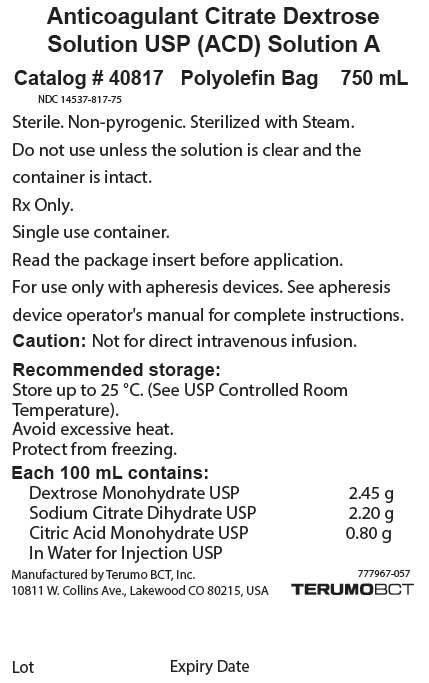
Principal Display Panel 750 Ml Bag Label
Anticoagulant Citrate Dextrose
Solution USP (ACD) Solution A
Catalog # 40817
Polyolefin Bag
750 mL
NDC 14537-817-75
Sterile. Non-pyrogenic. Sterilized with Steam.
Do not use unless the solution is clear and the
container is intact.
Rx Only.
Single use container.
Read the package insert before application.
For use only with apheresis devices. See apheresis
device operator's manual for complete instructions.
Caution: Not for direct intravenous infusion.
Recommended storage:
Store up to 25 °C. (See USP Controlled Room
Temperature).
Avoid excessive heat.
Protect from freezing.
Each 100 mL contains:
Dextrose Monohydrate USP
2.45 g
Sodium Citrate Dihydrate USP
2.20 g
Citric Acid Monohydrate USP
0.80 g
In Water for Injection USP
Manufactured by Terumo BCT, Inc.
10811 W. Collins Ave., Lakewood CO 80215, USA
777967-057
TERUMOBCT
Lot
Expiry Date
Structured Label Content
Section 42229-5 (42229-5)
Directions for Connecting the ANTICOAGULANT CITRATE DEXTROSE SOLUTION USP (ACD) SOLUTION A bag to the apheresis device.
At the prompt to connect anticoagulant to the apheresis device tubing set:
- Remove the overwrap by pulling down at notch, and remove the ANTICOAGULANT CITRATE DEXTROSE SOLUTION USP (ACD) SOLUTION A bag.
- Before use, perform the following checks [See Warnings and Precautions (5).]:
- Check for leaks by gently squeezing the bag. If leaks are found, discard the bag.
- Ensure that the solution is the ANTICOAGULANT CITRATE DEXTROSE SOLUTION USP (ACD) SOLUTION A and is within the expiration date.
- Inspect the solution in adequate light. Bags showing cloudiness, haze, or particulate matter should not be used.
- Remove the protective cap from the port on the bag.
- Connect the bag to the apheresis device tubing set using aseptic technique and hang the solution.
- Break the frangible connector. When you break frangible connectors, bend them in both directions to ensure that you break them completely. Failure to do so may result in restricted flow.
- Proceed according to the apheresis device operator's manual.
Parenteral drug products should be inspected visually for particulate matter and discoloration prior to administration, whenever solution and container permit.
Section 44425-7 (44425-7)
STORAGE
Store up to 25 °C [See USP Controlled Room Temperature].
Avoid excessive heat. Protect from freezing.
11 Description (11 DESCRIPTION)
ANTICOAGULANT CITRATE DEXTROSE SOLUTION USP (ACD) SOLUTION A is designed to be metered by an apheresis device in apheresis procedures, to prevent platelet activation and coagulation as blood moves throughout the extracorporeal unit (tubing set) in an apheresis procedure.
The solution is sterile and non-pyrogenic, and it contains no bacteriostatic or antimicrobial agents.
The formulas of the active ingredients are provided in Table 1.
| Ingredients | Molecular Formula | Molecular Weight |
|---|---|---|
| (%w/v) Citric Acid, Monohydrate | C6H8O7 | 192.12 |
| Dextrose Monohydrate | C6H12O6 ∙ H2O | 198.17 |
| Sodium Citrate Dihydrate | C6H9Na3O9 | 294.10 |
| Water for Injection | H2O | 18.00 |
Each 100 mL of ANTICOAGULANT CITRATE DEXTROSE SOLUTION USP (ACD) SOLUTION A contains: (%w/v) Citric Acid, Monohydrate 0.8 g; Dextrose Monohydrate 2.45 g; Sodium Citrate Dihydrate 2.2 g; and Water for Injection.
The polyolefin bag is not made with natural rubber latex or PVC.
The bag is made from a multilayered film. It contains materials that have been tested to demonstrate the suitability of the container for storing pharmaceutical solutions. The solution contact layer is an elasticized polyolefin. The bag is nontoxic and biologically inert. The bag-solution unit is a closed system and is not dependent upon entry of external air during administration. The bag is overwrapped to provide protection from the physical environment and to provide an additional moisture barrier when necessary.
2.2 Administration
- Ensure solution is the ANTICOAGULANT CITRATE DEXTROSE SOLUTION USP (ACD) SOLUTION A and is within the expiration date.
- Inspect the bag. Do not use if the container is damaged, leaking or if there is any visible sign of deterioration.
- Use only if solution is clear and free of particulate matter.
- Protect from sharp objects.
4 Contraindications (4 CONTRAINDICATIONS)
DO NOT INFUSE ANTICOAGULANT CITRATE DEXTROSE SOLUTION USP (ACD) SOLUTION A DIRECTLY TO THE PATIENTS.
6 Adverse Reactions (6 ADVERSE REACTIONS)
Citrate reactions or toxicity may occur with the infusion and return of blood containing citrate anticoagulant. The recipient of the blood containing citrate should be monitored for the signs and symptoms of citrate toxicity. The signs and symptoms of citrate toxicity begin with paresthesia, a "tingling" sensation around the mouth or in the extremities, followed by severe reactions that are characterized by hypotension and possible cardiac arrhythmia. Citrate toxicity may occur more frequently in patients who are hypothermic, have impaired liver or renal function, or have low calcium levels because of an underlying disease.
1 Indications and Usage (1 INDICATIONS AND USAGE)
ANTICOAGULANT CITRATE DEXTROSE SOLUTION USP (ACD) SOLUTION A is an anticoagulant for blood collection for use only with apheresis devices. [See Dosage and Administration (2).]
12.1 Mechanism of Action
ANTICOAGULANT CITRATE DEXTROSE SOLUTION USP (ACD) SOLUTION A acts as an extracorporeal anticoagulant by binding the free calcium in the blood. Calcium is a necessary co-factor to several steps in the clotting cascade. The following ingredients are key components of the solution:
- Citric acid for pH regulation
- Sodium Citrate anticoagulates
- Dextrose for isotonicity
This solution has no pharmacological effect.
5 Warnings and Precautions (5 WARNINGS AND PRECAUTIONS)
- Verify that the ANTICOAGULANT CITRATE DEXTROSE SOLUTION USP (ACD) SOLUTION A has been securely attached to the Anticoagulant (AC) line on the system tubing set. Use aseptic technique throughout all procedures to ensure donor safety and quality.
- Do not reuse. Discard unused or partially used solution bags.
2 Dosage and Administration (2 DOSAGE AND ADMINISTRATION)
- ANTICOAGULANT CITRATE DEXTROSE SOLUTION USP (ACD) SOLUTION A is added to tubing sets during apheresis procedures. (2)
- ANTICOAGULANT CITRATE DEXTROSE SOLUTION USP (ACD) SOLUTION A may only be used with apheresis devices. For instructions on the use of the solution see the apheresis device operator's manual. (2.1)
- Follow the directions for connecting the ANTICOAGULANT CITRATE DEXTROSE SOLUTION USP (ACD) SOLUTION A bag to the apheresis system. (2.2)
3 Dosage Forms and Strengths (3 DOSAGE FORMS AND STRENGTHS)
500 mL or 750 mL ANTICOAGULANT CITRATE DEXTROSE SOLUTION USP (ACD) SOLUTION A is a sterile solution in a polyolefin bag. Each 100 mL contains: (%w/v) Citric Acid, Monohydrate 0.8 g; Dextrose Monohydrate 2.45 g; Sodium Citrate Dihydrate 2.2 g; and Water for Injection.
8 Use in Specific Populations (8 USE IN SPECIFIC POPULATIONS)
ANTICOAGULANT CITRATE DEXTROSE SOLUTION USP (ACD) SOLUTION A has not been adequately studied in controlled clinical trials with specific populations.
2.1 General Dosing Information
ANTICOAGULANT CITRATE DEXTROSE SOLUTION USP (ACD) SOLUTION A is added to tubing sets during apheresis procedures. The solution is connected to the tubing set in an apheresis collection. The recommended dose is determined by the apheresis device and metered into the tubing set by the apheresis device. It is not intended for direct intravenous infusion.
For instructions on the use of the solution with the apheresis device and tubing set, see the device operator's manual.
16 How Supplied/storage and Handling (16 HOW SUPPLIED/STORAGE AND HANDLING)
ANTICOAGULANT CITRATE DEXTROSE SOLUTION USP (ACD) SOLUTION A is a clear solution supplied in sterile and non-pyrogenic polyolefin bags. The 750 mL bags are packaged 12 bags per case. The 500 mL bags are packaged 18 bags per case.
| SIZE | CATALOG NUMBER | NDC NUMBER |
|---|---|---|
| 500 mL | 40815 | 14537-815-50 |
| 750 mL | 40817 | 14537-817-75 |
Principal Display Panel 500 Ml Bag Label (PRINCIPAL DISPLAY PANEL - 500 mL Bag Label)
Anticoagulant Citrate Dextrose
Solution USP (ACD) Solution A
Catalog # 40815
Polyolefin Bag
500 mL
NDC 14537-815-50
Sterile. Non-pyrogenic. Sterilized with Steam.
Do not use unless the solution is clear and the
container is intact.
Rx Only.
Single use container.
Read the package insert before application.
For use only with apheresis devices. See apheresis
device operator's manual for complete instructions.
Caution: Not for direct intravenous infusion.
Recommended storage:
Store up to 25 °C. (See USP Controlled Room
Temperature).
Avoid excessive heat.
Protect from freezing.
Each 100 mL contains:
Dextrose Monohydrate USP
2.45 g
Sodium Citrate Dihydrate USP
2.20 g
Citric Acid Monohydrate USP
0.80 g
In Water for Injection USP
Manufactured by Terumo BCT, Inc.
10811 W. Collins Ave., Lakewood CO 80215, USA
777967-540
TERUMOBCT
Lot
Expiry Date
Principal Display Panel 750 Ml Bag Label (PRINCIPAL DISPLAY PANEL - 750 mL Bag Label)
Anticoagulant Citrate Dextrose
Solution USP (ACD) Solution A
Catalog # 40817
Polyolefin Bag
750 mL
NDC 14537-817-75
Sterile. Non-pyrogenic. Sterilized with Steam.
Do not use unless the solution is clear and the
container is intact.
Rx Only.
Single use container.
Read the package insert before application.
For use only with apheresis devices. See apheresis
device operator's manual for complete instructions.
Caution: Not for direct intravenous infusion.
Recommended storage:
Store up to 25 °C. (See USP Controlled Room
Temperature).
Avoid excessive heat.
Protect from freezing.
Each 100 mL contains:
Dextrose Monohydrate USP
2.45 g
Sodium Citrate Dihydrate USP
2.20 g
Citric Acid Monohydrate USP
0.80 g
In Water for Injection USP
Manufactured by Terumo BCT, Inc.
10811 W. Collins Ave., Lakewood CO 80215, USA
777967-057
TERUMOBCT
Lot
Expiry Date
Advanced Ingredient Data
Raw Label Data
All Sections (JSON)
Additional Information
Back to search View SPL set listing Open on DailyMed ↗
Source: dailymed · Ingested: 2026-02-15T11:45:16.028575 · Updated: 2026-03-14T22:22:01.587267