tricitrates sf oral solution
2ecb42a2-82f1-456b-8f1e-02c2d0a7b5ad
34391-3
HUMAN PRESCRIPTION DRUG LABEL
Drug Facts
Composition & Product
Identifiers & Packaging
Dosage and Administration
Tricitrates SF Oral Solution should be taken diluted in water, followed by additional water, if desired. Palatability is enhanced if chilled before taking.
Contraindications
Severe renal impairment with oliguria or azotemia, untreated Addison's disease, or severe myocardial damage. In certain situations, when patients are on a sodium-restricted diet, the use of potassium citrate may be preferable; or, when patients are on a potassium-restricted diet, the use of sodium citrate may be preferable.
Adverse Reactions
Tricitrates SF Oral Solution is generally well tolerated without any unpleasant side effects when given in recommended doses to patients with normal renal function and urinary output. However, as with any alkalinizing agent, caution must be used in certain patients with abnormal renal mechanisms to avoid development of hyperkalemia or alkalosis, especially in the presence of hypocalcemia. Potassium intoxication causes listlessness, weakness, mental confusion, and tingling of extremities.
How Supplied
Tricitrates SF Oral Solution (orange colored, raspberry flavored) is supplied in the following oral dosage form: NDC 0121-0677-16: 16 fl oz (473 mL) bottles
Description
Rx ONLY
Medication Information
Dosage and Administration
Tricitrates SF Oral Solution should be taken diluted in water, followed by additional water, if desired. Palatability is enhanced if chilled before taking.
Contraindications
Severe renal impairment with oliguria or azotemia, untreated Addison's disease, or severe myocardial damage. In certain situations, when patients are on a sodium-restricted diet, the use of potassium citrate may be preferable; or, when patients are on a potassium-restricted diet, the use of sodium citrate may be preferable.
Adverse Reactions
Tricitrates SF Oral Solution is generally well tolerated without any unpleasant side effects when given in recommended doses to patients with normal renal function and urinary output. However, as with any alkalinizing agent, caution must be used in certain patients with abnormal renal mechanisms to avoid development of hyperkalemia or alkalosis, especially in the presence of hypocalcemia. Potassium intoxication causes listlessness, weakness, mental confusion, and tingling of extremities.
How Supplied
Tricitrates SF Oral Solution (orange colored, raspberry flavored) is supplied in the following oral dosage form:
NDC 0121-0677-16: 16 fl oz (473 mL) bottles
Description
Tricitrates SF Oral Solution is a stable and pleasant-tasting oral systemic alkalizer containing potassium citrate, sodium citrate, and citric acid in a sugar-free, non-alcoholic base.
Tricitrates SF Oral Solution contains in each teaspoonful (5 mL):
| POTASSIUM CITRATE
Monohydrate |
550 mg |
| SODIUM CITRATE
Dihydrate |
500 mg |
| CITRIC ACID
Monohydrate |
334 mg |
Each mL contains 1 mEq potassium ion and 1 mEq sodium ion and is equivalent to 2 mEq bicarbonate (HCO 3).
Inactive Ingredients: FD&C Yellow No. 6, flavoring, polyethylene glycol, propylene glycol, purified water, sodium benzoate, and sorbitol solution.
Section 42229-5
Rx ONLY
Section 42232-9
Should be used with caution by patients with low urinary output or reduced glomerular filtration rates unless under the supervision of a physician. Aluminum-based antacids should be avoided in these patients. Patients should be directed to dilute adequately with water and, preferably, to take each dose after meals, to minimize the possibility of gastrointestinal injury associated with oral ingestion of potassium salt preparations and to avoid saline laxative effect. Sodium salts should be used cautiously in patients with cardiac failure, hypertension, peripheral and pulmonary edema, and toxemia of pregnancy.
Concurrent administration of potassium-containing medication, potassium-sparing diuretics, angiotensin-converting enzyme (ACE) inhibitors, or cardiac glycosides may lead to toxicity. Periodic examination and determinations of serum electrolytes, particularly serum bicarbonate level, should be carried out in those patients with renal disease in order to avoid these complications.
Actions
Potassium citrate and sodium citrate are absorbed and metabolized to potassium bicarbonate and sodium bicarbonate, thus acting as systemic alkalizers. The effects are essentially those of chlorides before absorption and those of bicarbonates subsequently. Oxidation is virtually complete so that less than 5% of the citrates are excreted in the urine unchanged.
Storage
Keep tightly closed. Store at controlled room temperature, 20°-25°C (68°-77°F). Protect from excessive heat and freezing.
SHAKE WELL BEFORE USING.
Overdosage
Overdosage with sodium salts may cause diarrhea, nausea and vomiting, hypernoia, and convulsions. Overdosage with potassium salts may cause hyperkalemia and alkalosis, especially in the presence of renal disease.
Usual Adult Dose
3 to 6 teaspoonfuls (15 to 30 mL), diluted in water, four times a day, after meals and at bedtime, or as directed by a physician.
Usual Dosage Range
2 to 3 teaspoonfuls (10 to 15 mL), diluted with water, taken four times a day, will usually maintain a urinary pH of 6.5-7.4. 3 to 4 teaspoonfuls (15 to 20 mL), diluted with water, taken four times a day, will usually maintain a urinary pH of 7.0-7.6 throughout most of the 24 hours without unpleasant side effects. To check urine pH, HYDRION Paper (pH 6.0-8.0) or NITRAZINE Paper (pH 4.5-7.5) are available and easy to use.
Usual Pediatric Dose
1 to 3 teaspoonfuls (5 to 15 mL), diluted in water, four times a day, after meals and at bedtime, or as directed by a physician.
Indications and Advantages
Tricitrates SF Oral Solution is an effective alkalinizing agent useful in those conditions where long-term maintenance of an alkaline urine is desirable, such as in patients with uric acid and cystine calculi of the urinary tract. In addition, it is a valuable adjuvant when administered with uricosuric agents in gout therapy, since urates tend to crystallize out of an acid urine. It is also effective in correcting the acidosis of certain renal tubular disorders. This product is highly concentrated, and when administered after meals and before bedtime, allows one to maintain an alkaline urine pH around the clock, usually without the necessity of a 2 A.M. dose. This product alkalinizes the urine without producing a systemic alkalosis in recommended dosage. It is highly palatable, pleasant tasting, and tolerable, even when administered for long periods. Potassium citrate and sodium citrate do not neutralize the gastric juice or disturb digestion.
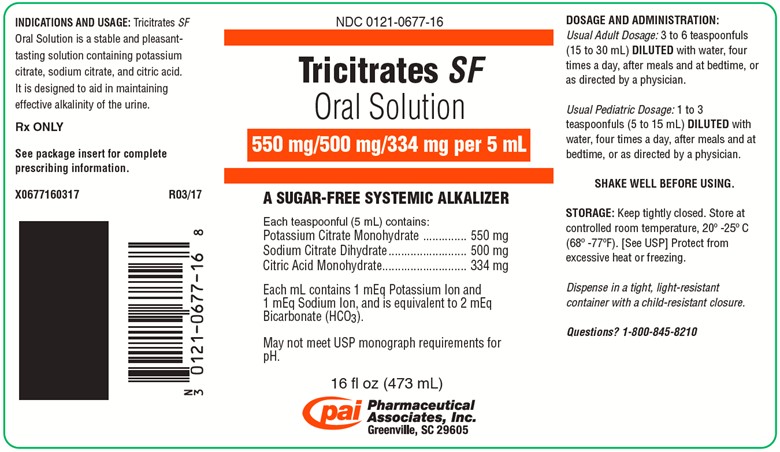
Principal Display Panel 473 Ml Bottle Label
NDC 0121-0677-16
Tricitrates SF
Oral Solution
550 mg/500 mg/334 mg per 5 mL
A SUGAR-FREE SYSTEMIC ALKALIZER
Each teaspoonful (5 mL) contains:
Potassium Citrate Monohydrate 550 mg
Sodium Citrate Dihydrate 500 mg
Citric Acid Monohydrate 334 mg
Each mL contains 1 mEq Potassium Ion and
1 mEq Sodium Ion, and is equivalent to 2 mEq
Bicarbonate (HCO
3).
May not meet USP monograph requirements for
pH.
16 fl oz (473 mL)
Pharmaceutical
Associates, Inc.
Greenville, SC 29605
Structured Label Content
Dosage and Administration (DOSAGE AND ADMINISTRATION)
Tricitrates SF Oral Solution should be taken diluted in water, followed by additional water, if desired. Palatability is enhanced if chilled before taking.
Contraindications (CONTRAINDICATIONS)
Severe renal impairment with oliguria or azotemia, untreated Addison's disease, or severe myocardial damage. In certain situations, when patients are on a sodium-restricted diet, the use of potassium citrate may be preferable; or, when patients are on a potassium-restricted diet, the use of sodium citrate may be preferable.
Adverse Reactions (ADVERSE REACTIONS)
Tricitrates SF Oral Solution is generally well tolerated without any unpleasant side effects when given in recommended doses to patients with normal renal function and urinary output. However, as with any alkalinizing agent, caution must be used in certain patients with abnormal renal mechanisms to avoid development of hyperkalemia or alkalosis, especially in the presence of hypocalcemia. Potassium intoxication causes listlessness, weakness, mental confusion, and tingling of extremities.
How Supplied (HOW SUPPLIED)
Tricitrates SF Oral Solution (orange colored, raspberry flavored) is supplied in the following oral dosage form:
NDC 0121-0677-16: 16 fl oz (473 mL) bottles
Description (DESCRIPTION)
Tricitrates SF Oral Solution is a stable and pleasant-tasting oral systemic alkalizer containing potassium citrate, sodium citrate, and citric acid in a sugar-free, non-alcoholic base.
Tricitrates SF Oral Solution contains in each teaspoonful (5 mL):
| POTASSIUM CITRATE
Monohydrate |
550 mg |
| SODIUM CITRATE
Dihydrate |
500 mg |
| CITRIC ACID
Monohydrate |
334 mg |
Each mL contains 1 mEq potassium ion and 1 mEq sodium ion and is equivalent to 2 mEq bicarbonate (HCO 3).
Inactive Ingredients: FD&C Yellow No. 6, flavoring, polyethylene glycol, propylene glycol, purified water, sodium benzoate, and sorbitol solution.
Section 42229-5 (42229-5)
Rx ONLY
Section 42232-9 (42232-9)
Should be used with caution by patients with low urinary output or reduced glomerular filtration rates unless under the supervision of a physician. Aluminum-based antacids should be avoided in these patients. Patients should be directed to dilute adequately with water and, preferably, to take each dose after meals, to minimize the possibility of gastrointestinal injury associated with oral ingestion of potassium salt preparations and to avoid saline laxative effect. Sodium salts should be used cautiously in patients with cardiac failure, hypertension, peripheral and pulmonary edema, and toxemia of pregnancy.
Concurrent administration of potassium-containing medication, potassium-sparing diuretics, angiotensin-converting enzyme (ACE) inhibitors, or cardiac glycosides may lead to toxicity. Periodic examination and determinations of serum electrolytes, particularly serum bicarbonate level, should be carried out in those patients with renal disease in order to avoid these complications.
Actions (ACTIONS)
Potassium citrate and sodium citrate are absorbed and metabolized to potassium bicarbonate and sodium bicarbonate, thus acting as systemic alkalizers. The effects are essentially those of chlorides before absorption and those of bicarbonates subsequently. Oxidation is virtually complete so that less than 5% of the citrates are excreted in the urine unchanged.
Storage (STORAGE)
Keep tightly closed. Store at controlled room temperature, 20°-25°C (68°-77°F). Protect from excessive heat and freezing.
SHAKE WELL BEFORE USING.
Overdosage (OVERDOSAGE)
Overdosage with sodium salts may cause diarrhea, nausea and vomiting, hypernoia, and convulsions. Overdosage with potassium salts may cause hyperkalemia and alkalosis, especially in the presence of renal disease.
Usual Adult Dose
3 to 6 teaspoonfuls (15 to 30 mL), diluted in water, four times a day, after meals and at bedtime, or as directed by a physician.
Usual Dosage Range
2 to 3 teaspoonfuls (10 to 15 mL), diluted with water, taken four times a day, will usually maintain a urinary pH of 6.5-7.4. 3 to 4 teaspoonfuls (15 to 20 mL), diluted with water, taken four times a day, will usually maintain a urinary pH of 7.0-7.6 throughout most of the 24 hours without unpleasant side effects. To check urine pH, HYDRION Paper (pH 6.0-8.0) or NITRAZINE Paper (pH 4.5-7.5) are available and easy to use.
Usual Pediatric Dose
1 to 3 teaspoonfuls (5 to 15 mL), diluted in water, four times a day, after meals and at bedtime, or as directed by a physician.
Indications and Advantages (INDICATIONS AND ADVANTAGES)
Tricitrates SF Oral Solution is an effective alkalinizing agent useful in those conditions where long-term maintenance of an alkaline urine is desirable, such as in patients with uric acid and cystine calculi of the urinary tract. In addition, it is a valuable adjuvant when administered with uricosuric agents in gout therapy, since urates tend to crystallize out of an acid urine. It is also effective in correcting the acidosis of certain renal tubular disorders. This product is highly concentrated, and when administered after meals and before bedtime, allows one to maintain an alkaline urine pH around the clock, usually without the necessity of a 2 A.M. dose. This product alkalinizes the urine without producing a systemic alkalosis in recommended dosage. It is highly palatable, pleasant tasting, and tolerable, even when administered for long periods. Potassium citrate and sodium citrate do not neutralize the gastric juice or disturb digestion.
Principal Display Panel 473 Ml Bottle Label (PRINCIPAL DISPLAY PANEL - 473 mL Bottle Label)
NDC 0121-0677-16
Tricitrates SF
Oral Solution
550 mg/500 mg/334 mg per 5 mL
A SUGAR-FREE SYSTEMIC ALKALIZER
Each teaspoonful (5 mL) contains:
Potassium Citrate Monohydrate 550 mg
Sodium Citrate Dihydrate 500 mg
Citric Acid Monohydrate 334 mg
Each mL contains 1 mEq Potassium Ion and
1 mEq Sodium Ion, and is equivalent to 2 mEq
Bicarbonate (HCO
3).
May not meet USP monograph requirements for
pH.
16 fl oz (473 mL)
Pharmaceutical
Associates, Inc.
Greenville, SC 29605
Advanced Ingredient Data
Raw Label Data
All Sections (JSON)
Additional Information
Back to search View SPL set listing Open on DailyMed ↗
Source: dailymed · Ingested: 2026-02-15T11:43:48.701323 · Updated: 2026-03-14T22:17:29.241377