trimethoprim sulfate and polymyxin b sulfate ophthalmic solution
2c5579eb-ad81-415e-8dcb-9f1c94c897ae
34391-3
HUMAN PRESCRIPTION DRUG LABEL
Drug Facts
Composition & Product
Identifiers & Packaging
Indications and Usage
Trimethoprim Sulfate and Polymyxin B Sulfate Ophthalmic Solution is indicated in the treatment of surface ocular bacterial infections, including acute bacterial conjunctivitis, and blepharoconjunctivitis, caused by susceptible strains of the following microorganisms: Staphylococcus aureus, Staphylococcus epidermidis, Streptococcus pneumoniae, Streptococcus viridans, Haemophilus influenza and Pseudomonas aeruginosa. * *Efficacy for this organism in this organ system was studied in fewer than 10 infections.
Contraindications
Trimethoprim Sulfate and Polymyxin B Sulfate Ophthalmic Solution is contraindicated in patients with known hypersensitivity to any of its components.
Adverse Reactions
The most frequent adverse reaction to Trimethoprim Sulfate and Polymxin B Sulfate Ophthalmic Solution is local irritation consisting of increased redness, burning, stinging, and/or itching. This may occur on instillation, within 48 hours, or at any time with extended use. There are also multiple reports of hypersensitivity reactions consisting of lid edema, itching, increased redness, tearing, and/or circumocular rash. Photosensitivity has been reported in patients taking oral trimethoprim.
How Supplied
Trimethoprim Sulfate and Polymyxin B Sulfate Ophthalmic Solution is supplied as a sterile solution in plastic dropper bottles in the following size: 10 mL in a 10 mL bottle NDC 63187-193-10
Description
Rx only
Medication Information
Warnings
NOT FOR INJECTION INTO THE EYE. If a sensitivity reaction to Trimethoprim and Polymyxin B Sulfate Ophthalmic Solution occurs, discontinue use. Trimethoprim Sulfate and Polymyxin B Sulfate Ophthalmic Solution is not indicated for the prophylaxis or treatment of ophthalmic neonatorum.
Indications and Usage
Trimethoprim Sulfate and Polymyxin B Sulfate Ophthalmic Solution is indicated in the treatment of surface ocular bacterial infections, including acute bacterial conjunctivitis, and blepharoconjunctivitis, caused by susceptible strains of the following microorganisms:
Staphylococcus aureus, Staphylococcus epidermidis, Streptococcus pneumoniae, Streptococcus viridans, Haemophilus influenza and Pseudomonas aeruginosa.*
*Efficacy for this organism in this organ system was studied in fewer than 10 infections.
Contraindications
Trimethoprim Sulfate and Polymyxin B Sulfate Ophthalmic Solution is contraindicated in patients with known hypersensitivity to any of its components.
Adverse Reactions
The most frequent adverse reaction to Trimethoprim Sulfate and Polymxin B Sulfate Ophthalmic Solution is local irritation consisting of increased redness, burning, stinging, and/or itching. This may occur on instillation, within 48 hours, or at any time with extended use. There are also multiple reports of hypersensitivity reactions consisting of lid edema, itching, increased redness, tearing, and/or circumocular rash.
Photosensitivity has been reported in patients taking oral trimethoprim.
How Supplied
Trimethoprim Sulfate and Polymyxin B Sulfate Ophthalmic Solution is supplied as a sterile solution in plastic dropper bottles in the following size: 10 mL in a 10 mL bottle NDC 63187-193-10
Description
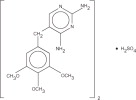
Trimethoprim Sulfate and Polymyxin B Sulfate Ophthalmic Solution is a sterile antimicrobial solution for topical ophthalmic use. Trimethoprim sulfate, 2,4-diamino-5-(3,4,5-trimethoxybenzyl)pyrimidine sulfate (2:1), occurs as a white, odorless, crystalline powder with a molecular weight of 678.72. The structural formula is as follows:
Polymyxin B sulfate is the sulfate salt of polymyxin B1 and B2 which are produced by the growth of Bacillus polymyxa (Prazmowski) Migula (Fam. Bacillaceae). It has a potency of not less than 6,000 polymyxin B units per mg, calculated on an anhydrous basis. The structural formula is as follows:
Each mL contains:
Actives: Trimethoprim Sulfate equivalent to Trimethoprim 1 mg (0.1%) and Polymyxin B Sulfate 10,000 units. Preservative: Benzalkonium Chloride 0.04 mg (0.004%). Inactives: Sodium Chloride, Sulfuric Acid and Sodium Hydroxide may be added to adjust pH (3.0 to 5.5), and Purified Water USP.
Section 34072-9
General: As with other antimicrobial preparations, prolonged use may result in overgrowth of nonsusceptible organisms, including fungi. If superinfection occurs, appropriate therapy should be initiated.
Section 34076-0
Information for Patients: Avoid contaminating the applicator tip with material from the eye, fingers, or other source. This precaution is necessary if the sterility of the drops is to be maintained.
If redness, irritation, swelling or pain persists or increases, discontinue use immediately and contact your physician.
Section 34078-6
Nonteratogenic Effects: The oral administration of trimethoprim to rats at a dose of 70 mg/kg/day commencing with the last third of gestation and continuing through parturition and lactation caused no deleterious effects on gestation or pup growth and survival.
Section 34080-2
Nursing mothers: It is not known whether this drug is excreted in human milk. Because many drugs are excreted in human milk, caution should be exercised when Trimethoprim Sulfate and Polymyxin B Sulfate Ophthalmic Solution is administered to a nursing woman.
Section 34081-0
Pediatric Use: Safety and effectiveness in pediatric patients below the age of 2 months have not been established (see WARNINGS).
Section 42228-7
Pregnancy: Teratogenic Effects
Pregnancy Category C. Animal reproduction studies have not been conducted with polymyxin B sulfate. It is not known whether polymyxin B sulfate can cause fetal harm when administered to a pregnant woman or can affect reproduction capacity.
Trimethoprim has been shown to be teratogenic in the rat when given in oral doses 40 times the human dose. In some rabbit studies, the overall increase in fetal loss (dead and resorbed and malformed conceptuses) was associated with oral doses 6 times the human therapeutic dose.
While there are no large well-controlled studies on the use of trimethoprim in pregnant women, Brumfitt and Pursell, in a retrospective study, reported the outcome of 186 pregnancies during which the mother received either placebo or oral trimethoprim in combination with sulfamethoxazole. The incidence of congenital abnormalities was 4.5% (3 of 66) in those who received placebo and 3.3% (4 of 120) in those receiving trimethoprim and sulfamethoxazole. There were no abnormalities in the 10 children whose mothers received the drug during the first trimester. In a separate survey, Brumfitt and Pursell also found no congenital abnormalities in 35 children whose mothers had received oral trimethoprim and sulfamethoxazole at the time of conception or shortly thereafter. Because trimethoprim may interfere with folic acid metabolism, trimethoprim should be used during pregnancy only if the potential benefit justifies the potential risk to the fetus.
Section 42229-5
Rx only
Section 44425-7
STORAGE: Store at 20° to 25°C (68° to 77°F) [see USP Controlled Room Temperature]. Protect from light.
WARNING – KEEP THIS AND ALL DRUGS OUT OF THE REACH OF CHILDREN.
Akorn
Manufactured by: Akorn, Inc.
Lake Forest, IL 60045
ATP00N
Rev. 10/08
Relabeled by: Proficient Rx LP
Thousand Oaks, CA 91320
Section 49489-8
Microbiology: In vitro studies have demonstrated that the anti-infective components of Trimethoprim and Polymyxin B Sulfate Ophthalmic Solution are active against the following bacterial pathogens that are capable of causing external infections of the eye:
Section 51945-4
Principal Display Panel Text for Container Label:
NDC 63187-193-10
Trimethoprim Sulfate
and Polymyxin B
Sulfate Ophthalmic
Solution
10 mL
For the eye
Sterile
Rx only [Akorn Logo]
Clinical Pharmacology
Trimethoprim is a synthetic antibacterial drug active against a wide variety of aerobic gram-positive and gram-negative ophthalmic pathogens. Trimethoprim blocks the production of tetrahydrofolic acid from dihydrofolic acid by binding to and reversibly inhibiting the enzyme dihydrofolate reductase. This binding is very much stronger for the bacterial enzyme than for the corresponding mammalian enzyme. For that reason, trimethoprim selectively interferes with bacterial biosynthesis of nucleic acids and proteins.
Polymyxin B, a cyclic lipopeptide antibiotic, is rapidly bactericidal for a variety of gram-negative organisms, especially Pseudomonas aeruginosa. It increases the permeability of the bacterial cell membrane by interacting with the phospholipid components of the membrane.
When used topically, trimethoprim and polymyxin B absorption through intact skin and mucous membranes is insignificant.
Blood samples were obtained from 11 human volunteers at 20 minutes, 1 hour and 3 hours following instillation in the eye of 2 drops of ophthalmic solution containing 1 mg trimethoprim and 10,000 units polymyxin B per mL. Peak serum concentrations were approximately 0.03 mcg/mL trimethoprim and 1 unit/mL polymyxin B.
Structured Label Content
Warnings (WARNINGS)
NOT FOR INJECTION INTO THE EYE. If a sensitivity reaction to Trimethoprim and Polymyxin B Sulfate Ophthalmic Solution occurs, discontinue use. Trimethoprim Sulfate and Polymyxin B Sulfate Ophthalmic Solution is not indicated for the prophylaxis or treatment of ophthalmic neonatorum.
Indications and Usage (INDICATIONS AND USAGE)
Trimethoprim Sulfate and Polymyxin B Sulfate Ophthalmic Solution is indicated in the treatment of surface ocular bacterial infections, including acute bacterial conjunctivitis, and blepharoconjunctivitis, caused by susceptible strains of the following microorganisms:
Staphylococcus aureus, Staphylococcus epidermidis, Streptococcus pneumoniae, Streptococcus viridans, Haemophilus influenza and Pseudomonas aeruginosa.*
*Efficacy for this organism in this organ system was studied in fewer than 10 infections.
Contraindications (CONTRAINDICATIONS)
Trimethoprim Sulfate and Polymyxin B Sulfate Ophthalmic Solution is contraindicated in patients with known hypersensitivity to any of its components.
Adverse Reactions (ADVERSE REACTIONS)
The most frequent adverse reaction to Trimethoprim Sulfate and Polymxin B Sulfate Ophthalmic Solution is local irritation consisting of increased redness, burning, stinging, and/or itching. This may occur on instillation, within 48 hours, or at any time with extended use. There are also multiple reports of hypersensitivity reactions consisting of lid edema, itching, increased redness, tearing, and/or circumocular rash.
Photosensitivity has been reported in patients taking oral trimethoprim.
How Supplied (HOW SUPPLIED)
Trimethoprim Sulfate and Polymyxin B Sulfate Ophthalmic Solution is supplied as a sterile solution in plastic dropper bottles in the following size: 10 mL in a 10 mL bottle NDC 63187-193-10
Description (DESCRIPTION)
Trimethoprim Sulfate and Polymyxin B Sulfate Ophthalmic Solution is a sterile antimicrobial solution for topical ophthalmic use. Trimethoprim sulfate, 2,4-diamino-5-(3,4,5-trimethoxybenzyl)pyrimidine sulfate (2:1), occurs as a white, odorless, crystalline powder with a molecular weight of 678.72. The structural formula is as follows:
Polymyxin B sulfate is the sulfate salt of polymyxin B1 and B2 which are produced by the growth of Bacillus polymyxa (Prazmowski) Migula (Fam. Bacillaceae). It has a potency of not less than 6,000 polymyxin B units per mg, calculated on an anhydrous basis. The structural formula is as follows:
Each mL contains:
Actives: Trimethoprim Sulfate equivalent to Trimethoprim 1 mg (0.1%) and Polymyxin B Sulfate 10,000 units. Preservative: Benzalkonium Chloride 0.04 mg (0.004%). Inactives: Sodium Chloride, Sulfuric Acid and Sodium Hydroxide may be added to adjust pH (3.0 to 5.5), and Purified Water USP.
Section 34072-9 (34072-9)
General: As with other antimicrobial preparations, prolonged use may result in overgrowth of nonsusceptible organisms, including fungi. If superinfection occurs, appropriate therapy should be initiated.
Section 34076-0 (34076-0)
Information for Patients: Avoid contaminating the applicator tip with material from the eye, fingers, or other source. This precaution is necessary if the sterility of the drops is to be maintained.
If redness, irritation, swelling or pain persists or increases, discontinue use immediately and contact your physician.
Section 34078-6 (34078-6)
Nonteratogenic Effects: The oral administration of trimethoprim to rats at a dose of 70 mg/kg/day commencing with the last third of gestation and continuing through parturition and lactation caused no deleterious effects on gestation or pup growth and survival.
Section 34080-2 (34080-2)
Nursing mothers: It is not known whether this drug is excreted in human milk. Because many drugs are excreted in human milk, caution should be exercised when Trimethoprim Sulfate and Polymyxin B Sulfate Ophthalmic Solution is administered to a nursing woman.
Section 34081-0 (34081-0)
Pediatric Use: Safety and effectiveness in pediatric patients below the age of 2 months have not been established (see WARNINGS).
Section 42228-7 (42228-7)
Pregnancy: Teratogenic Effects
Pregnancy Category C. Animal reproduction studies have not been conducted with polymyxin B sulfate. It is not known whether polymyxin B sulfate can cause fetal harm when administered to a pregnant woman or can affect reproduction capacity.
Trimethoprim has been shown to be teratogenic in the rat when given in oral doses 40 times the human dose. In some rabbit studies, the overall increase in fetal loss (dead and resorbed and malformed conceptuses) was associated with oral doses 6 times the human therapeutic dose.
While there are no large well-controlled studies on the use of trimethoprim in pregnant women, Brumfitt and Pursell, in a retrospective study, reported the outcome of 186 pregnancies during which the mother received either placebo or oral trimethoprim in combination with sulfamethoxazole. The incidence of congenital abnormalities was 4.5% (3 of 66) in those who received placebo and 3.3% (4 of 120) in those receiving trimethoprim and sulfamethoxazole. There were no abnormalities in the 10 children whose mothers received the drug during the first trimester. In a separate survey, Brumfitt and Pursell also found no congenital abnormalities in 35 children whose mothers had received oral trimethoprim and sulfamethoxazole at the time of conception or shortly thereafter. Because trimethoprim may interfere with folic acid metabolism, trimethoprim should be used during pregnancy only if the potential benefit justifies the potential risk to the fetus.
Section 42229-5 (42229-5)
Rx only
Section 44425-7 (44425-7)
STORAGE: Store at 20° to 25°C (68° to 77°F) [see USP Controlled Room Temperature]. Protect from light.
WARNING – KEEP THIS AND ALL DRUGS OUT OF THE REACH OF CHILDREN.
Akorn
Manufactured by: Akorn, Inc.
Lake Forest, IL 60045
ATP00N
Rev. 10/08
Relabeled by: Proficient Rx LP
Thousand Oaks, CA 91320
Section 49489-8 (49489-8)
Microbiology: In vitro studies have demonstrated that the anti-infective components of Trimethoprim and Polymyxin B Sulfate Ophthalmic Solution are active against the following bacterial pathogens that are capable of causing external infections of the eye:
Section 51945-4 (51945-4)
Principal Display Panel Text for Container Label:
NDC 63187-193-10
Trimethoprim Sulfate
and Polymyxin B
Sulfate Ophthalmic
Solution
10 mL
For the eye
Sterile
Rx only [Akorn Logo]
Clinical Pharmacology (CLINICAL PHARMACOLOGY)
Trimethoprim is a synthetic antibacterial drug active against a wide variety of aerobic gram-positive and gram-negative ophthalmic pathogens. Trimethoprim blocks the production of tetrahydrofolic acid from dihydrofolic acid by binding to and reversibly inhibiting the enzyme dihydrofolate reductase. This binding is very much stronger for the bacterial enzyme than for the corresponding mammalian enzyme. For that reason, trimethoprim selectively interferes with bacterial biosynthesis of nucleic acids and proteins.
Polymyxin B, a cyclic lipopeptide antibiotic, is rapidly bactericidal for a variety of gram-negative organisms, especially Pseudomonas aeruginosa. It increases the permeability of the bacterial cell membrane by interacting with the phospholipid components of the membrane.
When used topically, trimethoprim and polymyxin B absorption through intact skin and mucous membranes is insignificant.
Blood samples were obtained from 11 human volunteers at 20 minutes, 1 hour and 3 hours following instillation in the eye of 2 drops of ophthalmic solution containing 1 mg trimethoprim and 10,000 units polymyxin B per mL. Peak serum concentrations were approximately 0.03 mcg/mL trimethoprim and 1 unit/mL polymyxin B.
Advanced Ingredient Data
Raw Label Data
All Sections (JSON)
Additional Information
Back to search View SPL set listing Open on DailyMed ↗
Source: dailymed · Ingested: 2026-02-15T11:35:48.285251 · Updated: 2026-03-14T21:44:26.969907