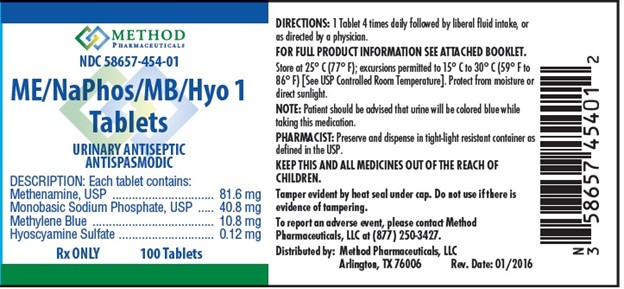
me-naphos-mb-hyo 1 tablets
2ae628e7-3b33-6a9a-e054-00144ff8d46c
34391-3
HUMAN PRESCRIPTION DRUG LABEL
Drug Facts
Composition & Product
Identifiers & Packaging
Dosage and Administration
Adults One tablet orally 4 times per day followed by liberal fluid intake. Older Children Dosage must be individualized by physician. Not recommended for use in children up to 6 years of age.
Adverse Reactions
Cardiovascula r – rapid pulse, flushing Central Nervous System – blurred vision, dizziness Respiratory – shortness of breath or troubled breathing Genitourinary – difficulty micturition, acute urinary retention Gastrointestinal – dry mouth, nausea/vomiting
Drug Interactions
because of this product's effect on gastrointestinal motility and gastric emptying, it may decrease the absorption of other oral medications during concurrent use such as: urinary alkalizers; thiazide diuretics (may cause the urine to become alkaline reducing the effectiveness of methenamine by inhibiting its conversion to formaldehyde); antimuscarinics (concurrent use may intensify antimuscarinic effects of hyoscyamine because of secondary antimuscarinic activities of these medications); antacids/antidiarrheals (may reduce absorption of hyoscyamine, concurrent use with antacids may cause urine to become alkaline reducing effectiveness of methenamine by inhibiting its conversion to formaldehyde) doses of these medications should be spaced 1 hour apart from doses of hyoscyamine; antimyasthenics (concurrent use with hyoscyamine may further reduce intestinal motility); ketoconazole (patients should be advised to take this combination at least 2 hours after ketoconazole); monoamine oxidase (MAO) Inhibitors (concurrent use may intensify antimuscarinic side effects, opioid (narcotic) analgesics may result in increased risk of severe constipation); sulfonamides (these drugs may precipitate with formaldehyde in the urine, increasing the danger of crystalluria). Patients should be advised that the urine may become blue to blue green and the feces may be discolored as a result of the excretion of methylene blue.
How Supplied
ME/NaPhos/MB/Hyo 1 Tablets are light blue to blue, oval, biconvex tablets debossed with "M455" with scoreline on one side and plain on the other side. Supplied in bottles of 100 tablets (NDC 58657-454-01).
Description
Each tablet contains: Methenamine, USP ................................. 81.6 mg Monobasic Sodium Phosphate, USP ......... 40.8 mg Methylene Blue ....................................... 10.8 mg Hyoscyamine Sulfate ............................... 0.12 mg
Medication Information
Warnings
Do not exceed recommended dosage. If rapid pulse,
dizziness, or blurring of vision occurs
discontinue use
immediately.
Dosage and Administration
Adults
One tablet orally 4 times per day followed by liberal
fluid intake.
Older Children
Dosage must be individualized by physician. Not
recommended for use in children up to 6 years of age.
Adverse Reactions
Cardiovascular – rapid pulse, flushing
Central Nervous System – blurred vision, dizziness
Respiratory – shortness of breath or troubled
breathing
Genitourinary – difficulty micturition, acute urinary
retention
Gastrointestinal – dry mouth, nausea/vomiting
Drug Interactions
because of this product's effect on gastrointestinal
motility and gastric emptying, it may decrease the
absorption of other oral medications during concurrent
use such as: urinary alkalizers; thiazide diuretics (may
cause the urine to become alkaline reducing the
effectiveness of methenamine by inhibiting its
conversion to formaldehyde); antimuscarinics
(concurrent use may intensify antimuscarinic effects of
hyoscyamine because of secondary antimuscarinic
activities of these medications); antacids/antidiarrheals
(may reduce absorption of hyoscyamine, concurrent use
with antacids may cause urine to become alkaline
reducing effectiveness of methenamine by inhibiting its
conversion to formaldehyde) doses of these medications
should be spaced 1 hour apart from doses of
hyoscyamine; antimyasthenics (concurrent use with
hyoscyamine may further reduce intestinal motility);
ketoconazole (patients should be advised to take this
combination at least 2 hours after ketoconazole);
monoamine oxidase (MAO) Inhibitors (concurrent use
may intensify antimuscarinic side effects, opioid
(narcotic) analgesics may result in increased risk of
severe constipation); sulfonamides (these drugs may
precipitate with formaldehyde in the urine, increasing
the danger of crystalluria).
Patients should be advised that the urine may become
blue to blue green and the feces may be discolored as a
result of the excretion of methylene blue.
How Supplied
ME/NaPhos/MB/Hyo 1 Tablets are light blue to
blue, oval, biconvex tablets debossed with
"M455" with scoreline on one side and plain on
the other side. Supplied in bottles of 100 tablets
(NDC 58657-454-01).
Description
Each tablet contains:
Methenamine, USP ................................. 81.6 mg
Monobasic Sodium Phosphate, USP ......... 40.8 mg
Methylene Blue ....................................... 10.8 mg
Hyoscyamine Sulfate ............................... 0.12 mg
Section 34072-9
DIRECTIONS: 1 Tablet 4 times daily followed by liberal fluid intake, or
as directed by a physician.
FOR FULL PRODUCT INFORMATION SEE ATTACHED BOOKLET.
Store at 25° C (77° F); excursions permitted to 15° C to 30° C (59° F to
86° F) [See USP Controlled Room Temperature]. Protect from moisture or
direct sunlight.
NOTE: Patient should be advised that urine will be colored blue while
taking this medication.
PHARMACIST: Preserve and dispense in tight-light resistant container as
defined in the USP.
KEEP THIS AND ALL MEDICINES OUT OF THE REACH OF
CHILDREN.
Tamper evident by heat seal under cap. Do not use if there is
evidence of tampering.
To report an adverse event, please contact Method
Pharmaceuticals, LLC at (877) 250-3427.
Section 51945-4
Distributed by: Method Pharmaceuticals, LLC
Arlington, TX 76006 Rev. Date: 01/2016
Pinciple Display Panel
Booklet
Section 60561-8
CAUTION
RX ONLY
STORAGE
Store at 25° C (77° F); excursions permitted to 15° C to
30° C (59° F to 86° F) [See USP Controlled
Room Temperature]. Keep container tightly closed.
Distributed By: Method Pharmaceuticals, LLC
Arlington, TX 76006
Rev. Date: 01/2016
Geriatric
use with caution in elderly patients as they may respond
to usual doses of hyoscyamine with excitement,
agitation, drowsiness, or confusion.
Pediatric
infants and young children are especially susceptible to
the toxic effect of the belladonna alkaloids.
Overdosage
Emesis or gastric lavage. Slow intravenous
administration of physostigmine in doses of 1 mg to
4 mg (0.5 mg to 1 mg in children), repeated as needed
in one to two hours to reverse severe antimuscarinic
symptoms. Administration of small doses of diazepam to
control excitement and seizures. Artificial respiration
with oxygen if needed for respiratory depression.
Adequate hydration. Symptomatic treatment as
necessary.
Precautions
(Pregnancy Category C)
hyoscyamine and methenamine cross the placenta.
Studies have not been done in animals or humans. It is
not known whether
ME/NaPhos/MB/Hyo 1
Tablets cause fetal harm when administered to a
pregnant woman or can affect reproduction capacity.
ME/NaPhos/MB/Hyo 1 Tablets should be given to
a pregnant woman only if clearly needed.
Prolonged Use
there have been no studies to establish the safety of
prolonged use in humans. No known long-term animal
studies have been performed to evaluate carcinogenic
potential.
Breast Feeding
problems in humans have not been documented;
however, methenamine and traces of hyoscyamine are
excreted in breast milk.
Indication and Usage
ME/NaPhos/MB/Hyo 1 Tablets is indicated for the
treatment of symptoms of irritative voiding. Indicated
for the relief of local symptoms, such as hypermotility
which accompany lower urinary tract infections and as
antispasmodic. Indicated for the relief of urinary tract
symptoms caused by diagnostic procedures.
Clinical Pharmacology
HYOSCYAMINE is a parasympatholytic which relaxes
smooth muscles and thus produces an antispasmodic
effect. It is well absorbed from the gastrointestinal tract
and is rapidly distributed throughout body tissues. Most
is excreted in the urine within 12 hours, 13% to 50%
being unchanged.
Its biotransformation is hepatic. Its protein binding is
moderate.
METHENAMINE degrades in an acidic urine environment
releasing formaldehyde which provides bactericidal or
bacteriostatic action. It is well absorbed from the
gastrointestinal tract. 70% to 90% reaches the urine
unchanged at which point it is hydrolyzed if the urine is
acidic. Within 24 hours it is almost completely (90%)
excreted; of this amount at pH 5, approximately 20% is
formaldehyde. Protein binding: some formaldehyde is
bound to substances in the urine and surrounding
tissues. Methenamine is freely distributed to body tissue
and fluids but is not clinically significant as it does not
hydrolyze at pH greater than 6.8.
METHYLENE BLUE possesses weak antiseptic properties.
It is well absorbed in the gastrointestinal tract and is
rapidly reduced to leukomethylene blue which is
stabilized in some combination form in the urine. 75%
is excreted unchanged.
MONOBASIC SODIUM PHOSPHATE helps to maintain an
acid pH in the urine necessary for the degradation of
methenamine.
Drug Abuse and Dependence
A dependence on the use of
ME/NaPhos/MB/Hyo 1
Tablets has not been reported and due to the nature of
its ingredients, abuse of
ME/NaPhos/MB/Hyo 1
Tablets
is not expected.
Inactive Ingredients Include:
Microcrystalline
Cellulose, Mannitol, Croscarmellose Sodium, Magnesium
Stearate, FD&C Blue #1
HYOSCYAMINE SULFATE is an alkaloid of belladonna.
Exists as a white crystalline powder. Affected by light It
is very soluble in water; freely soluble in alcohol;
practically insoluble in ether.
METHENAMINE exists as colorless, lustrous crystals or
white crystalline powder. Its solutions are alkaline to
litmus. Freely soluble in water; soluble in alcohol and in
chloroform.
METHYLENE BLUE exists as dark green crystals. It is
soluble in water and in chloroform; sparingly soluble in
alcohol.
MONOBASIC SODIUM PHOSPHATE exists as a white
crystalline powder. Its solutions are acidic to litmus. It is
freely soluble in water and practically insoluble in
alcohol.
This product is not an Orange Book (OB) rated
product, therefore all prescriptions using this
product shall be pursuant to state statutes as
applicable. There are no claims of bioequivalence
or therapeutic equivalence.
Structured Label Content
Warnings (WARNINGS)
Do not exceed recommended dosage. If rapid pulse,
dizziness, or blurring of vision occurs
discontinue use
immediately.
Dosage and Administration (DOSAGE AND ADMINISTRATION)
Adults
One tablet orally 4 times per day followed by liberal
fluid intake.
Older Children
Dosage must be individualized by physician. Not
recommended for use in children up to 6 years of age.
Adverse Reactions (ADVERSE REACTIONS)
Cardiovascular – rapid pulse, flushing
Central Nervous System – blurred vision, dizziness
Respiratory – shortness of breath or troubled
breathing
Genitourinary – difficulty micturition, acute urinary
retention
Gastrointestinal – dry mouth, nausea/vomiting
Drug Interactions
because of this product's effect on gastrointestinal
motility and gastric emptying, it may decrease the
absorption of other oral medications during concurrent
use such as: urinary alkalizers; thiazide diuretics (may
cause the urine to become alkaline reducing the
effectiveness of methenamine by inhibiting its
conversion to formaldehyde); antimuscarinics
(concurrent use may intensify antimuscarinic effects of
hyoscyamine because of secondary antimuscarinic
activities of these medications); antacids/antidiarrheals
(may reduce absorption of hyoscyamine, concurrent use
with antacids may cause urine to become alkaline
reducing effectiveness of methenamine by inhibiting its
conversion to formaldehyde) doses of these medications
should be spaced 1 hour apart from doses of
hyoscyamine; antimyasthenics (concurrent use with
hyoscyamine may further reduce intestinal motility);
ketoconazole (patients should be advised to take this
combination at least 2 hours after ketoconazole);
monoamine oxidase (MAO) Inhibitors (concurrent use
may intensify antimuscarinic side effects, opioid
(narcotic) analgesics may result in increased risk of
severe constipation); sulfonamides (these drugs may
precipitate with formaldehyde in the urine, increasing
the danger of crystalluria).
Patients should be advised that the urine may become
blue to blue green and the feces may be discolored as a
result of the excretion of methylene blue.
How Supplied (HOW SUPPLIED)
ME/NaPhos/MB/Hyo 1 Tablets are light blue to
blue, oval, biconvex tablets debossed with
"M455" with scoreline on one side and plain on
the other side. Supplied in bottles of 100 tablets
(NDC 58657-454-01).
Description
Each tablet contains:
Methenamine, USP ................................. 81.6 mg
Monobasic Sodium Phosphate, USP ......... 40.8 mg
Methylene Blue ....................................... 10.8 mg
Hyoscyamine Sulfate ............................... 0.12 mg
Section 34072-9 (34072-9)
DIRECTIONS: 1 Tablet 4 times daily followed by liberal fluid intake, or
as directed by a physician.
FOR FULL PRODUCT INFORMATION SEE ATTACHED BOOKLET.
Store at 25° C (77° F); excursions permitted to 15° C to 30° C (59° F to
86° F) [See USP Controlled Room Temperature]. Protect from moisture or
direct sunlight.
NOTE: Patient should be advised that urine will be colored blue while
taking this medication.
PHARMACIST: Preserve and dispense in tight-light resistant container as
defined in the USP.
KEEP THIS AND ALL MEDICINES OUT OF THE REACH OF
CHILDREN.
Tamper evident by heat seal under cap. Do not use if there is
evidence of tampering.
To report an adverse event, please contact Method
Pharmaceuticals, LLC at (877) 250-3427.
Section 51945-4 (51945-4)
Distributed by: Method Pharmaceuticals, LLC
Arlington, TX 76006 Rev. Date: 01/2016
Pinciple Display Panel
Booklet
Section 60561-8 (60561-8)
CAUTION
RX ONLY
STORAGE
Store at 25° C (77° F); excursions permitted to 15° C to
30° C (59° F to 86° F) [See USP Controlled
Room Temperature]. Keep container tightly closed.
Distributed By: Method Pharmaceuticals, LLC
Arlington, TX 76006
Rev. Date: 01/2016
Geriatric
use with caution in elderly patients as they may respond
to usual doses of hyoscyamine with excitement,
agitation, drowsiness, or confusion.
Pediatric
infants and young children are especially susceptible to
the toxic effect of the belladonna alkaloids.
Overdosage (OVERDOSAGE)
Emesis or gastric lavage. Slow intravenous
administration of physostigmine in doses of 1 mg to
4 mg (0.5 mg to 1 mg in children), repeated as needed
in one to two hours to reverse severe antimuscarinic
symptoms. Administration of small doses of diazepam to
control excitement and seizures. Artificial respiration
with oxygen if needed for respiratory depression.
Adequate hydration. Symptomatic treatment as
necessary.
Precautions (PRECAUTIONS)
(Pregnancy Category C)
hyoscyamine and methenamine cross the placenta.
Studies have not been done in animals or humans. It is
not known whether
ME/NaPhos/MB/Hyo 1
Tablets cause fetal harm when administered to a
pregnant woman or can affect reproduction capacity.
ME/NaPhos/MB/Hyo 1 Tablets should be given to
a pregnant woman only if clearly needed.
Prolonged Use (Prolonged use)
there have been no studies to establish the safety of
prolonged use in humans. No known long-term animal
studies have been performed to evaluate carcinogenic
potential.
Breast Feeding (Breast-feeding)
problems in humans have not been documented;
however, methenamine and traces of hyoscyamine are
excreted in breast milk.
Indication and Usage (INDICATION AND USAGE)
ME/NaPhos/MB/Hyo 1 Tablets is indicated for the
treatment of symptoms of irritative voiding. Indicated
for the relief of local symptoms, such as hypermotility
which accompany lower urinary tract infections and as
antispasmodic. Indicated for the relief of urinary tract
symptoms caused by diagnostic procedures.
Clinical Pharmacology (CLINICAL PHARMACOLOGY)
HYOSCYAMINE is a parasympatholytic which relaxes
smooth muscles and thus produces an antispasmodic
effect. It is well absorbed from the gastrointestinal tract
and is rapidly distributed throughout body tissues. Most
is excreted in the urine within 12 hours, 13% to 50%
being unchanged.
Its biotransformation is hepatic. Its protein binding is
moderate.
METHENAMINE degrades in an acidic urine environment
releasing formaldehyde which provides bactericidal or
bacteriostatic action. It is well absorbed from the
gastrointestinal tract. 70% to 90% reaches the urine
unchanged at which point it is hydrolyzed if the urine is
acidic. Within 24 hours it is almost completely (90%)
excreted; of this amount at pH 5, approximately 20% is
formaldehyde. Protein binding: some formaldehyde is
bound to substances in the urine and surrounding
tissues. Methenamine is freely distributed to body tissue
and fluids but is not clinically significant as it does not
hydrolyze at pH greater than 6.8.
METHYLENE BLUE possesses weak antiseptic properties.
It is well absorbed in the gastrointestinal tract and is
rapidly reduced to leukomethylene blue which is
stabilized in some combination form in the urine. 75%
is excreted unchanged.
MONOBASIC SODIUM PHOSPHATE helps to maintain an
acid pH in the urine necessary for the degradation of
methenamine.
Drug Abuse and Dependence (DRUG ABUSE AND DEPENDENCE)
A dependence on the use of
ME/NaPhos/MB/Hyo 1
Tablets has not been reported and due to the nature of
its ingredients, abuse of
ME/NaPhos/MB/Hyo 1
Tablets
is not expected.
Inactive Ingredients Include: (Inactive Ingredients include:)
Microcrystalline
Cellulose, Mannitol, Croscarmellose Sodium, Magnesium
Stearate, FD&C Blue #1
HYOSCYAMINE SULFATE is an alkaloid of belladonna.
Exists as a white crystalline powder. Affected by light It
is very soluble in water; freely soluble in alcohol;
practically insoluble in ether.
METHENAMINE exists as colorless, lustrous crystals or
white crystalline powder. Its solutions are alkaline to
litmus. Freely soluble in water; soluble in alcohol and in
chloroform.
METHYLENE BLUE exists as dark green crystals. It is
soluble in water and in chloroform; sparingly soluble in
alcohol.
MONOBASIC SODIUM PHOSPHATE exists as a white
crystalline powder. Its solutions are acidic to litmus. It is
freely soluble in water and practically insoluble in
alcohol.
This product is not an Orange Book (OB) rated
product, therefore all prescriptions using this
product shall be pursuant to state statutes as
applicable. There are no claims of bioequivalence
or therapeutic equivalence.
Advanced Ingredient Data
Raw Label Data
All Sections (JSON)
Additional Information
Back to search View SPL set listing Open on DailyMed ↗
Source: dailymed · Ingested: 2026-02-15T11:43:55.877078 · Updated: 2026-03-14T22:48:33.210061