gentamicin sulfate ophthalmic solution usp, 0.3%
2098faaa-7f60-4640-8c37-19456ebba653
34391-3
HUMAN PRESCRIPTION DRUG LABEL
Drug Facts
Composition & Product
Identifiers & Packaging
Indications and Usage
Gentamicin Sulfate Sterile Ophthalmic Solution is indicated in the topical treatment of ocular bacterial infections, including conjunctivitis, keratitis, keratoconjunctivitis, corneal ulcers, blepharitis, blepharoconjunctivitis, acute meibomianitis, and dacryocystitis caused by susceptible strains of the following microorganisms: Staphylococcus aureus, Staphylococcus epidermidis, Streptococcus pyogenes, Streptococcus pneumoniae, Enterobacter aerogenes, Escherichia coli, Haemophilus influenzae, Klebsiella pneumoniae, Neisseria gonorrhoeae, Pseudomonas aeruginosa, and Serratia marcescens.
Dosage and Administration
Gentamicin Sulfate sterile ophthalmic solution; Instill one or two drops into the affected eye(s) every four hours. In severe infections, dosage may be increased to as much as two drops once every hour.
Contraindications
Gentamicin Sulfate Sterile Ophthalmic Solution is contraindicated in patients with known hypersensitivity to any of the components.
Adverse Reactions
Bacterial and fungal corneal ulcers have developed during treatment with gentamicin ophthalmic preparations. The most frequently reported adverse reactions are ocular burning and irritation upon drug instillation, non-specific conjunctivitis, conjunctival epithelial defects and conjunctival hyperemia. Other adverse reactions which have occurred rarely are allergic reactions, thrombocytopenic purpura and hallucinations.
How Supplied
Gentamicin Sulfate ophthalmic solution - Sterile, 5-mL plastic dropper bottle, box of one. (NDC 63187-764-05)
Description
Sterile Rx only
Medication Information
Warnings
NOT FOR INJECTION INTO THE EYE. Gentamicin Sulfate Ophthalmic Solution is not for injection. It should never be injected subconjunctivally, nor should it be directly introduced into the anterior chamber of the eye.
Indications and Usage
Gentamicin Sulfate Sterile Ophthalmic Solution is indicated in the topical treatment of ocular bacterial infections, including conjunctivitis, keratitis, keratoconjunctivitis, corneal ulcers, blepharitis, blepharoconjunctivitis, acute meibomianitis, and dacryocystitis caused by susceptible strains of the following microorganisms:
-
Staphylococcus aureus, Staphylococcus epidermidis, Streptococcus pyogenes, Streptococcus pneumoniae, Enterobacter aerogenes, Escherichia coli, Haemophilus influenzae, Klebsiella pneumoniae, Neisseria gonorrhoeae, Pseudomonas aeruginosa, and Serratia marcescens.
Dosage and Administration
Gentamicin Sulfate sterile ophthalmic solution; Instill one or two drops into the affected eye(s) every four hours. In severe infections, dosage may be increased to as much as two drops once every hour.
Contraindications
Gentamicin Sulfate Sterile Ophthalmic Solution is contraindicated in patients with known hypersensitivity to any of the components.
Adverse Reactions
Bacterial and fungal corneal ulcers have developed during treatment with gentamicin ophthalmic preparations.
The most frequently reported adverse reactions are ocular burning and irritation upon drug instillation, non-specific conjunctivitis, conjunctival epithelial defects and conjunctival hyperemia.
Other adverse reactions which have occurred rarely are allergic reactions, thrombocytopenic purpura and hallucinations.
How Supplied
Gentamicin Sulfate ophthalmic solution - Sterile, 5-mL plastic dropper bottle, box of one. (NDC 63187-764-05)
Description
Gentamicin sulfate is a water-soluble antibiotic of the aminoglycoside group.
Gentamicin Sulfate Ophthalmic Solution is a sterile, aqueous solution for ophthalmic use.
-
Each mL contains:
Active: Gentamicin Sulfate USP (equivalent to 3 mg gentamicin base)
Preservative: Benzalkonium Chloride
Inactives: Disodium Phosphate, Monosodium Phosphate, and Sodium Chloride. The pH range is from 6.8 to 7.3.
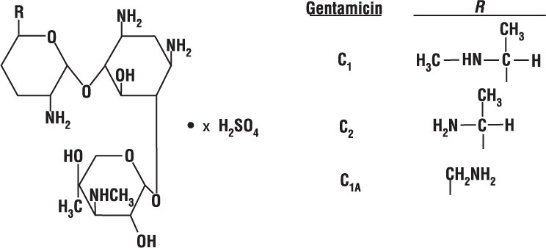
Gentamicin is obtained from cultures of Micromonospora purpurea. It is a mixture of the sulfate salts of gentamicin C1, C2, and C1A. All three components appear to have similar antimicrobial activities. Gentamicin sulfate occurs as a white powder and is soluble in water and insoluble in alcohol. The structural formula is as follows:
Section 42229-5
Sterile
Rx only
Section 44425-7
STORAGE: Store at 20° to 25°C (68° to 77°F) [see USP Controlled Room Temperature].
Avoid exposure to excessive heat.
Section 51945-4
Principal Display Panel Text for Container Label:
NDC 63187-764-05
Gentamicin
Sulfate Ophthalmic
Solution, USP
0.3%
(equivalent to 3 mg
gentamicin per mL)
Sterile
Rx only 5 mL
General
Prolonged use of topical antibiotics may give rise to overgrowth of nonsusceptible organisms including fungi. Bacterial resistance to gentamicin may also develop. If purulent discharge, inflammation or pain becomes aggravated, the patient should discontinue use of the medication and consult a physician.
If irritation or hypersensitivity to any component of the drug develops, the patient should discontinue use of this preparation and appropriate therapy should be instituted.
Microbiology
Gentamicin sulfate is active in vitro against many strains of the following microorganisms:
-
Staphylococcus aureus, Staphylococcus epidermidis, Streptococcus pyogenes, Streptococcus pneumoniae, Enterobacter aerogenes, Escherichia coli, Haemophilus influenzae, Klebsiella pneumoniae, Neisseria gonorrhoeae, Pseudomonas aeruginosa, and Serratia marcescens.
Pediatric Use
Safety and effectiveness in neonates have not been established.
Pregnancy Category C
Gentamicin has been shown to depress body weights, kidney weights and median glomerular counts in newborn rats when administered systemically to pregnant rats in daily doses approximately 500 times the maximum recommended ophthalmic human dose. There are no adequate and well-controlled studies in pregnant women. Gentamicin should be used during pregnancy only if the potential benefit justifies the potential risk to the fetus.
Information for Patients
To avoid contamination, do not touch tip of container to the eye, eyelid or any surface.
Carcinogenesis, Mutagenesis, Impairment of Fertility
There are no published carcinogenicity or impairment of fertility studies on gentamicin. Aminoglycoside antibiotics have been found to be non mutagenic.
Structured Label Content
Warnings (WARNINGS)
NOT FOR INJECTION INTO THE EYE. Gentamicin Sulfate Ophthalmic Solution is not for injection. It should never be injected subconjunctivally, nor should it be directly introduced into the anterior chamber of the eye.
Indications and Usage (INDICATIONS AND USAGE)
Gentamicin Sulfate Sterile Ophthalmic Solution is indicated in the topical treatment of ocular bacterial infections, including conjunctivitis, keratitis, keratoconjunctivitis, corneal ulcers, blepharitis, blepharoconjunctivitis, acute meibomianitis, and dacryocystitis caused by susceptible strains of the following microorganisms:
-
Staphylococcus aureus, Staphylococcus epidermidis, Streptococcus pyogenes, Streptococcus pneumoniae, Enterobacter aerogenes, Escherichia coli, Haemophilus influenzae, Klebsiella pneumoniae, Neisseria gonorrhoeae, Pseudomonas aeruginosa, and Serratia marcescens.
Dosage and Administration (DOSAGE AND ADMINISTRATION)
Gentamicin Sulfate sterile ophthalmic solution; Instill one or two drops into the affected eye(s) every four hours. In severe infections, dosage may be increased to as much as two drops once every hour.
Contraindications (CONTRAINDICATIONS)
Gentamicin Sulfate Sterile Ophthalmic Solution is contraindicated in patients with known hypersensitivity to any of the components.
Adverse Reactions (ADVERSE REACTIONS)
Bacterial and fungal corneal ulcers have developed during treatment with gentamicin ophthalmic preparations.
The most frequently reported adverse reactions are ocular burning and irritation upon drug instillation, non-specific conjunctivitis, conjunctival epithelial defects and conjunctival hyperemia.
Other adverse reactions which have occurred rarely are allergic reactions, thrombocytopenic purpura and hallucinations.
How Supplied (HOW SUPPLIED)
Gentamicin Sulfate ophthalmic solution - Sterile, 5-mL plastic dropper bottle, box of one. (NDC 63187-764-05)
Description (DESCRIPTION)
Gentamicin sulfate is a water-soluble antibiotic of the aminoglycoside group.
Gentamicin Sulfate Ophthalmic Solution is a sterile, aqueous solution for ophthalmic use.
-
Each mL contains:
Active: Gentamicin Sulfate USP (equivalent to 3 mg gentamicin base)
Preservative: Benzalkonium Chloride
Inactives: Disodium Phosphate, Monosodium Phosphate, and Sodium Chloride. The pH range is from 6.8 to 7.3.
Gentamicin is obtained from cultures of Micromonospora purpurea. It is a mixture of the sulfate salts of gentamicin C1, C2, and C1A. All three components appear to have similar antimicrobial activities. Gentamicin sulfate occurs as a white powder and is soluble in water and insoluble in alcohol. The structural formula is as follows:
Section 42229-5 (42229-5)
Sterile
Rx only
Section 44425-7 (44425-7)
STORAGE: Store at 20° to 25°C (68° to 77°F) [see USP Controlled Room Temperature].
Avoid exposure to excessive heat.
Section 51945-4 (51945-4)
Principal Display Panel Text for Container Label:
NDC 63187-764-05
Gentamicin
Sulfate Ophthalmic
Solution, USP
0.3%
(equivalent to 3 mg
gentamicin per mL)
Sterile
Rx only 5 mL
General
Prolonged use of topical antibiotics may give rise to overgrowth of nonsusceptible organisms including fungi. Bacterial resistance to gentamicin may also develop. If purulent discharge, inflammation or pain becomes aggravated, the patient should discontinue use of the medication and consult a physician.
If irritation or hypersensitivity to any component of the drug develops, the patient should discontinue use of this preparation and appropriate therapy should be instituted.
Microbiology
Gentamicin sulfate is active in vitro against many strains of the following microorganisms:
-
Staphylococcus aureus, Staphylococcus epidermidis, Streptococcus pyogenes, Streptococcus pneumoniae, Enterobacter aerogenes, Escherichia coli, Haemophilus influenzae, Klebsiella pneumoniae, Neisseria gonorrhoeae, Pseudomonas aeruginosa, and Serratia marcescens.
Pediatric Use
Safety and effectiveness in neonates have not been established.
Pregnancy Category C
Gentamicin has been shown to depress body weights, kidney weights and median glomerular counts in newborn rats when administered systemically to pregnant rats in daily doses approximately 500 times the maximum recommended ophthalmic human dose. There are no adequate and well-controlled studies in pregnant women. Gentamicin should be used during pregnancy only if the potential benefit justifies the potential risk to the fetus.
Information for Patients (Information for patients)
To avoid contamination, do not touch tip of container to the eye, eyelid or any surface.
Carcinogenesis, Mutagenesis, Impairment of Fertility
There are no published carcinogenicity or impairment of fertility studies on gentamicin. Aminoglycoside antibiotics have been found to be non mutagenic.
Advanced Ingredient Data
Raw Label Data
All Sections (JSON)
Additional Information
Back to search View SPL set listing Open on DailyMed ↗
Source: dailymed · Ingested: 2026-02-15T11:34:57.384268 · Updated: 2026-03-14T21:41:56.665367