3% and 5% sodium chloride injection, usp
181705c7-40e4-4d7d-b9ea-ada99380e7a9
34391-3
HUMAN PRESCRIPTION DRUG LABEL
Drug Facts
Composition & Product
Identifiers & Packaging
Indications and Usage
3% and 5% Sodium Chloride Injection, USP is indicated as a source of water and electrolytes.
Dosage and Administration
As directed by a physician. Dosage, rate, and duration of administration are to be individualized and depend upon the indication for use, the patient’s age, weight, clinical condition, concomitant treatment, and on the patient’s clinical and laboratory response to treatment. Parenteral drug products should be inspected visually for particulate matter and discoloration prior to administration whenever solution and container permit. Use of a final filter is recommended during administration of all parenteral solutions, where possible. Do not administer unless solution is clear and seal is intact. All injections in VIAFLEX plastic containers are intended for intravenous administration using sterile and nonpyrogenic equipment. Additives may be incompatible. Complete information is not available. Those additives known to be incompatible should not be used. Consult with pharmacist, if available. If, in the informed judgment of the physician, it is deemed advisable to introduce additives, use aseptic technique. Mix thoroughly when additives have been introduced. Do not store solutions containing additives. After opening the container, the contents should be used immediately and should not be stored for a subsequent infusion. Do not reconnect any partially used containers. Discard any unused portion.
Contraindications
None known.
Adverse Reactions
The following adverse reactions have not been reported with 3% and 5% Sodium Chloride Injection, USP but may occur: • hyperchloremia • hyperchloremic metabolic acidosis, • hypersensitivity/infusion reactions, including hypotension, pyrexia, tremor, chills, urticaria, rash, and pruritus, • Infusion site reactions, such as thrombosis, phlebitis, irritation, infusion site erythema, injection site streaking, burning sensation, infusion site urticaria. If an adverse reaction does occur, discontinue the infusion, evaluate the patient, institute appropriate therapeutic countermeasures, and save the remainder of the fluid for examination if deemed necessary.
Drug Interactions
Caution must be exercised in the administration of 3% and 5% Sodium Chloride Injection, USP to patients treated with drugs that may increase the risk of sodium and fluid retention, such as corticosteroids. Caution is advised in patients treated with lithium. Renal sodium and lithium clearance may be increased during the administration of 3% and 5% Sodium Chloride Injection, USP. Administration of 3% and 5% Sodium Chloride Injection, USP may, therefore, result in decreased lithium levels.
How Supplied
3% and 5% Sodium Chloride Injection, USP in VIAFLEX plastic container is available as follows: Code Size (mL) NDC Product Name 2B1353 500 0338-0054-03 3% Sodium Chloride Injection, USP 2B1373 500 0338-0056-03 5% Sodium Chloride Injection, USP Exposure of pharmaceutical products to heat should be minimized. Avoid excessive heat. It is recommended the product be stored at room temperature (25°C/77°F); brief exposure up to 40°C /104°F does not adversely affect the product.
Description
3% and 5% Sodium Chloride Injection, USP is a sterile, nonpyrogenic, hypertonic solution for fluid and electrolyte replenishment in single dose containers for intravenous administration. The pH may have been adjusted with hydrochloric acid. It contains no antimicrobial agents. Composition, ionic concentration, osmolarity, and pH are shown in Table 1 . Table 1 size (mL) Composition (g/L) Ionic Concentration (mEq/L) Normal physiological osmolarity range is approximately 280 to 310 mOsmol/L. Osmolarity (mOsmol/L) (calc) pH Sodium Chloride USP (NaCl) Sodium Chloride 3% Sodium Chloride Injection, USP 500 30 513 513 1027 5.0 (4.5 to 7.0) 5% Sodium Chloride Injection, USP 500 30 856 856 1711 5.0 (4.5 to 7.0) The VIAFLEX plastic container is fabricated from a specially formulated polyvinyl chloride (PL 146 Plastic). The amount of water that can permeate from inside the container into the overwrap is insufficient to affect the solution significantly. Solutions in contact with the plastic container can leach out certain of its chemical components in very small amounts within the expiration period, e.g., di-2-ethylhexyl phthalate (DEHP), up to 5 parts per million. However, the safety of the plastic has been confirmed in tests in animals according to USP biological tests for plastic containers as well as by tissue culture toxicity studies.
Medication Information
Warnings
Hypersensitivity/infusion reactions, including hypotension, pyrexia, tremor, chills, urticaria, rash, and pruritus may occur with 3% and 5% Sodium Chloride Injection, USP.
Stop the infusion immediately if signs or symptoms of a hypersensitivity reaction develop, such as tachycardia, chest pain, dyspnea and flushing. Appropriate therapeutic countermeasures must be instituted as clinically indicated.
Depending on the volume and rate of infusion, the intravenous administration of 3% and 5% Sodium Chloride Injection, USP can cause fluid and/or solute overloading resulting in dilution of serum electrolyte concentrations, overhydration/hypervolemia, congested states, pulmonary edema, or acid-base imbalance. The risk of dilutive states is inversely proportional to the electrolyte concentration of the injection. The risk of solute overload causing congested states with peripheral and pulmonary edema is directly proportional to the electrolyte concentrations of the injection.
Monitor changes in fluid balance, electrolyte concentrations, and acid base balance during prolonged parenteral therapy or whenever the condition of the patient or the rate of administration warrants such evaluation.
Administer 3% and 5% Sodium Chloride Injection, USP with particular caution to patients with or at risk for hypernatremia, hyperchloremia, hypervolemia or with conditions that may cause sodium retention, fluid overload and edema; such as patients with primary hyperaldosteronism, or secondary hyperaldosteronism (for example, associated with hypertension, congestive heart failure, liver disease (including cirrhosis), renal disease (including renal artery stenosis, nephrosclerosis) or pre-eclampsia). Certain medications may increase risk of sodium and fluid retention, see DRUG INTERACTIONS.
Administer 3% and 5% Sodium Chloride Injection, USP with particular caution to patients with severe renal impairment. In such patients administration of Sodium Chloride Injection, USP may result in sodium retention.
Indications and Usage
3% and 5% Sodium Chloride Injection, USP is indicated as a source of water and electrolytes.
Dosage and Administration
As directed by a physician. Dosage, rate, and duration of administration are to be individualized and depend upon the indication for use, the patient’s age, weight, clinical condition, concomitant treatment, and on the patient’s clinical and laboratory response to treatment.
Parenteral drug products should be inspected visually for particulate matter and discoloration prior to administration whenever solution and container permit. Use of a final filter is recommended during administration of all parenteral solutions, where possible.
Do not administer unless solution is clear and seal is intact.
All injections in VIAFLEX plastic containers are intended for intravenous administration using sterile and nonpyrogenic equipment.
Additives may be incompatible. Complete information is not available. Those additives known to be incompatible should not be used. Consult with pharmacist, if available. If, in the informed judgment of the physician, it is deemed advisable to introduce additives, use aseptic technique. Mix thoroughly when additives have been introduced. Do not store solutions containing additives.
After opening the container, the contents should be used immediately and should not be stored for a subsequent infusion. Do not reconnect any partially used containers. Discard any unused portion.
Contraindications
None known.
Adverse Reactions
The following adverse reactions have not been reported with 3% and 5% Sodium Chloride Injection, USP but may occur: • hyperchloremia • hyperchloremic metabolic acidosis, • hypersensitivity/infusion reactions, including hypotension, pyrexia, tremor, chills, urticaria, rash, and pruritus, • Infusion site reactions, such as thrombosis, phlebitis, irritation, infusion site erythema, injection site streaking, burning sensation, infusion site urticaria. If an adverse reaction does occur, discontinue the infusion, evaluate the patient, institute appropriate therapeutic countermeasures, and save the remainder of the fluid for examination if deemed necessary.
Drug Interactions
Caution must be exercised in the administration of 3% and 5% Sodium Chloride Injection, USP to patients treated with drugs that may increase the risk of sodium and fluid retention, such as corticosteroids.
Caution is advised in patients treated with lithium. Renal sodium and lithium clearance may be increased during the administration of 3% and 5% Sodium Chloride Injection, USP. Administration of 3% and 5% Sodium Chloride Injection, USP may, therefore, result in decreased lithium levels.
How Supplied
3% and 5% Sodium Chloride Injection, USP in VIAFLEX plastic container is available as follows:
| Code | Size (mL) | NDC | Product Name |
|---|---|---|---|
|
2B1353 |
500 |
0338-0054-03 |
3% Sodium Chloride |
|
2B1373 |
500 |
0338-0056-03 |
5% Sodium Chloride |
Exposure of pharmaceutical products to heat should be minimized. Avoid excessive heat. It is recommended the product be stored at room temperature (25°C/77°F); brief exposure up to 40°C /104°F does not adversely affect the product.
Description
3% and 5% Sodium Chloride Injection, USP is a sterile, nonpyrogenic, hypertonic solution for fluid and electrolyte replenishment in single dose containers for intravenous administration. The pH may have been adjusted with hydrochloric acid. It contains no antimicrobial agents. Composition, ionic concentration, osmolarity, and pH are shown in Table 1.
|
size (mL) |
Composition |
Ionic Concentration |
Normal physiological osmolarity range is approximately 280 to 310 mOsmol/L. Osmolarity (mOsmol/L) (calc) |
pH |
||
|
Sodium |
Sodium |
Chloride |
||||
|
3% Sodium Chloride |
500 |
30 |
513 |
513 |
1027 |
5.0 |
|
5% Sodium Chloride |
500 |
30 |
856 |
856 |
1711 |
5.0 |
The VIAFLEX plastic container is fabricated from a specially formulated polyvinyl chloride (PL 146 Plastic). The amount of water that can permeate from inside the container into the overwrap is insufficient to affect the solution significantly. Solutions in contact with the plastic container can leach out certain of its chemical components in very small amounts within the expiration period, e.g., di-2-ethylhexyl phthalate (DEHP), up to 5 parts per million. However, the safety of the plastic has been confirmed in tests in animals according to USP biological tests for plastic containers as well as by tissue culture toxicity studies.
Section 42229-5
Baxter Healthcare Corporation
Deerfield, IL 60015 USA
Printed in USA
07-19-00-0269
Rev. May 2018
Baxter and Viaflex are trademarks of Baxter International Inc.
General
Do not connect flexible plastic containers in series in order to avoid air embolism due to possible residual air contained in the primary container. Such use could result in air embolism due to residual air being drawn from the primary container before administration of the fluid from the secondary container is completed.
Pressurizing intravenous solutions contained in flexible plastic containers to increase flow rates can result in air embolism if the residual air in the container is not fully evacuated prior to administration.
Use of a vented intravenous administration set with the vent in the open position could result in air embolism. Vented intravenous administration sets with the vent in the open position should not be used with flexible plastic containers.
3% and 5% Sodium Chloride Injection, USP is hypertonic with an osmolarity of 1027 mOsmol/L and 1711 mOsmol/L, respectively. Administration of hypertonic solutions may cause venous damage and thus should be administered through a large vein, for rapid dilution.
Do not mix or administer 3% and 5% Sodium Chloride Injection, USP solutions through the same administration set with whole blood or cellular blood components.
Rapid correction of hypo- and hypernatremia is potentially dangerous (risk of serious neurologic complications). Dosage, rate, and duration of administration should be determined by a physician experienced in intravenous fluid therapy.
To Open
Tear overwrap down side at slit and remove solution container. Visually inspect the container. If the outlet port protector is damaged, detached, or not present, discard container as solution path sterility may be impaired. Some opacity of the plastic due to moisture absorption during the sterilization process may be observed. This is normal and does not affect the solution quality or safety. The opacity will diminish gradually. Check for minute leaks by squeezing inner bag firmly. If leaks are found, discard solution as sterility may be impaired. If supplemental medication is desired, follow directions below.
Pregnancy
There are no adequate and well controlled studies with 3% and 5% Sodium Chloride Injection, USP in pregnant women and animal reproduction studies have not been conducted with this drug. Therefore, it is not known whether 3% and 5% Sodium Chloride Injection, USP can cause fetal harm when administered to a pregnant woman. 3% and 5% Sodium Chloride Injection, USP should be given during pregnancy only if the potential benefit justifies the potential risks to the fetus.
Overdosage
Excessive administration of 3% and 5% Sodium Chloride Injection, USP may lead to hypernatremia (which can lead to CNS manifestations, including seizures, coma, cerebral edema and death) and sodium overload (which can lead to central and/or peripheral edema).
When assessing an overdose, any additives in the solution must also be considered. The effects of an overdose may require immediate medical attention and treatment.
Geriatric Use
Clinical studies of 3% and 5% Sodium Chloride Injection, USP, did not include sufficient numbers of subjects aged 65 and over to determine whether they respond differently from younger subjects. Other reported clinical experience has not identified differences in responses between the elderly and younger patients. In general, dose selection for an elderly patient should be cautious, usually starting at the low end of the dosing range, reflecting the greater frequency of decreased hepatic, renal, or cardiac function, and of concomitant disease or other drug therapy.
This drug is known to be substantially excreted by the kidney, and the risk of toxic reactions to this drug may be greater in patients with impaired renal function. Because elderly patients are more likely to have decreased renal function, care should be taken in dose selection, and it may be useful to monitor renal function.
Pediatric Use
The use of 3% and 5% Sodium Chloride Injection, USP in pediatric patients is based on clinical practice. (See DOSAGE AND ADMINISTRATION)
Plasma electrolyte concentrations should be closely monitored in the pediatric population as this population may have impaired ability to regulate fluids and electrolytes.
Nursing Mothers
It is not known whether this drug is excreted present in human milk. Because many drugs are excreted present in human milk, caution should be exercised when 3% and 5% Sodium Chloride Injection, USP is administered to a nursing woman.
To Add Medication
Warning: Additives may be incompatible - see DOSAGE AND ADMINISTRATION.
Clinical Pharmacology
3% and 5% Sodium Chloride Injection, USP has value as a source of water and electrolytes. It is capable of inducing diuresis depending on the clinical condition of the patient.
Preparation for Administration
-
1.Suspend container from eyelet support.
-
2.Remove protector from outlet port at bottom of container.
-
3.Attach administration set. Refer to complete directions accompanying set.
Post Marketing Adverse Reactions
The following adverse reactions have not been reported with 3% and 5% Sodium Chloride Injection, USP but may occur:
-
•hyperchloremia
-
•hyperchloremic metabolic acidosis,
-
•hypersensitivity/infusion reactions, including hypotension, pyrexia, tremor, chills, urticaria, rash, and pruritus,
-
•Infusion site reactions, such as thrombosis, phlebitis, irritation, infusion site erythema, injection site streaking, burning sensation, infusion site urticaria.
If an adverse reaction does occur, discontinue the infusion, evaluate the patient, institute appropriate therapeutic countermeasures, and save the remainder of the fluid for examination if deemed necessary.
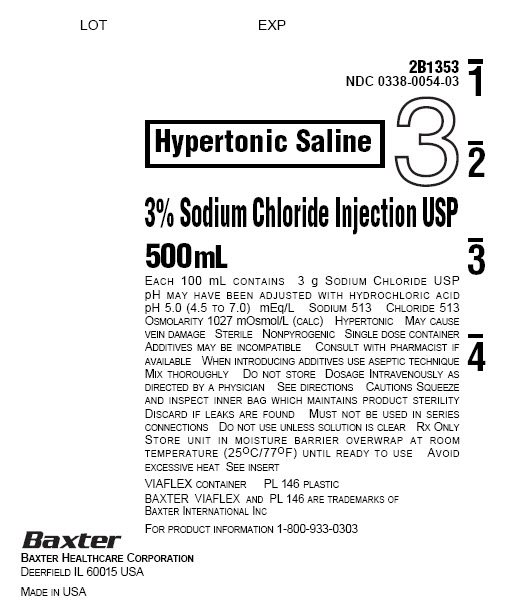
Package Label Principal Display Panel
LOT
EXP
2B1353
NDC 0338-0054-03
Hypertonic Saline
3% Sodium Chloride Injection USP
500mL
EACH 100 mL CONTAINS 3 g SODIUM CHLORIDE USP
pH MAY HAVE BEEN ADJUSTED WITH HYDROCHLORIC ACID
pH 5.0 (4.5 TO 7.0) mEq/L SODIUM 513 CHLORIDE 513
OSMOLARITY 1027 mOsmol/L (CALC) HYPERTONIC MAY CAUSE
VEIN DAMAGE STERILE NONPYROGENIC SINGLE DOSE CONTAINER
ADDITIVES MAY BE INCOMPATIBLE CONSULT WITH PHARMACIST IF
AVAILABLE WHEN INTRODUCING ADDITIVES USE ASEPTIC TECHNIQUE
MIX THOROUGHLY DO NOT STORE DOSAGE INTRAVENOUSLY AS
DIRECTED BY A PHYSICIAN SEE DIRECTIONS CAUTIONS SQUEEZE
AND INSPECT INNER BAG WHICH MAINTAINS PRODUCT STERILITY
DISCARD IF LEAKS ARE FOUND MUST NOT BE USED IN SERIES
CONNECTIONS DO NOT USE UNLESS SOLUTION IS CLEAR RX ONLY
STORE UNIT IN MOISTURE BARRIER OVERWRAP AT ROOM
TEMPERATURE (25°C/77°F) UNTIL READY TO USE AVOID
EXCESSIVE HEAT SEE INSERT
VIAFLEX CONTAINER
PL 146 PLASTIC
BAXTER VIAFLEX AND PL 146 ARE TRADEMARKS OF
BAXTER INTERNATIONAL INC
FOR PRODUCT INFORMATION 1-800-933-0303
Baxter Logo
BAXTER HEALTHCARE CORPORATION
DEERFIELD IL 60015 USA
MADE IN USA
LOT
EXP
2B1373
NDC 0338-0056-03
Hypertonic Saline
5% Sodium Chloride Injection USP
500mL
EACH 100 mL CONTAINS 5 g SODIUM CHLORIDE USP
pH MAY HAVE BEEN ADJUSTED WITH HYDROCHLORIC ACID
pH 5.0 (4.5 TO 7.0) mEq/L SODIUM 856 CHLORIDE 856
OSMOLARITY 1711 mOsmol/L (CALC) HYPERTONIC
MAY CAUSE VEIN DAMAGE STERILE NONPYROGENIC
SINGLE DOSE CONTAINER ADDITIVES MAY BE INCOMPATIBLE
CONSULT WITH PHARMACIST IF AVAILABLE WHEN
INTRODUCING ADDITIVES USE ASEPTIC TECHNIQUE
MIX THOROUGHLY DO NOT STORE DOSAGE INTRAVENOUSLY
AS DIRECTED BY A PHYSICIAN SEE DIRECTIONS CAUTIONS
SQUEEZE AND INSPECT INNER BAG WHICH MAINTAINS PRODUCT
STERILITY DISCARD IF LEAKS ARE FOUND MUST NOT BE USED
IN SERIES CONNECTIONS DO NOT USE UNLESS SOLUTION IS
CLEAR RX ONLY STORE UNIT IN MOISTURE BARRIER
OVERWRAP AT ROOM TEMPERATURE (25°C/77°F) UNTIL
READY TO USE AVOID EXCESSIVE HEAT SEE INSERT
VIAFLEX CONTAINER
PL 146 PLASTIC
BAXTER VIAFLEX AND PL 146 ARE TRADEMARKS OF
BAXTER INTERNATIONAL INC
FOR PRODUCT INFORMATION 1-800-933-0303
Baxter Logo
BAXTER HEALTHCARE CORPORATION
DEERFIELD IL 60015 USA
MADE IN USA
Directions for Use of Viaflex Plastic Container
For Information on Risk of Air Embolism – see PRECAUTIONS.
To Add Medication Before Solution Administration
-
1.Prepare medication site.
-
2.Using syringe with 19 to 22 gauge needle, puncture resealable medication port and inject.
-
3.Mix solution and medication thoroughly. For high density medication such as potassium chloride, squeeze ports while ports are upright and mix thoroughly.
To Add Medication During Solution Administration
-
1.Close clamp on the set.
-
2.Prepare medication site.
-
3.Using syringe with 19 to 22 gauge needle, puncture resealable medication port and inject.
-
4.Remove container from IV pole and/or turn to an upright position.
-
5.Evacuate both ports by squeezing them while container is in the upright position.
-
6.Mix solution and medication thoroughly.
-
7.Return container to in use position and continue administration.
Structured Label Content
Warnings (WARNINGS)
Hypersensitivity/infusion reactions, including hypotension, pyrexia, tremor, chills, urticaria, rash, and pruritus may occur with 3% and 5% Sodium Chloride Injection, USP.
Stop the infusion immediately if signs or symptoms of a hypersensitivity reaction develop, such as tachycardia, chest pain, dyspnea and flushing. Appropriate therapeutic countermeasures must be instituted as clinically indicated.
Depending on the volume and rate of infusion, the intravenous administration of 3% and 5% Sodium Chloride Injection, USP can cause fluid and/or solute overloading resulting in dilution of serum electrolyte concentrations, overhydration/hypervolemia, congested states, pulmonary edema, or acid-base imbalance. The risk of dilutive states is inversely proportional to the electrolyte concentration of the injection. The risk of solute overload causing congested states with peripheral and pulmonary edema is directly proportional to the electrolyte concentrations of the injection.
Monitor changes in fluid balance, electrolyte concentrations, and acid base balance during prolonged parenteral therapy or whenever the condition of the patient or the rate of administration warrants such evaluation.
Administer 3% and 5% Sodium Chloride Injection, USP with particular caution to patients with or at risk for hypernatremia, hyperchloremia, hypervolemia or with conditions that may cause sodium retention, fluid overload and edema; such as patients with primary hyperaldosteronism, or secondary hyperaldosteronism (for example, associated with hypertension, congestive heart failure, liver disease (including cirrhosis), renal disease (including renal artery stenosis, nephrosclerosis) or pre-eclampsia). Certain medications may increase risk of sodium and fluid retention, see DRUG INTERACTIONS.
Administer 3% and 5% Sodium Chloride Injection, USP with particular caution to patients with severe renal impairment. In such patients administration of Sodium Chloride Injection, USP may result in sodium retention.
Indications and Usage (INDICATIONS AND USAGE)
3% and 5% Sodium Chloride Injection, USP is indicated as a source of water and electrolytes.
Dosage and Administration (DOSAGE AND ADMINISTRATION)
As directed by a physician. Dosage, rate, and duration of administration are to be individualized and depend upon the indication for use, the patient’s age, weight, clinical condition, concomitant treatment, and on the patient’s clinical and laboratory response to treatment.
Parenteral drug products should be inspected visually for particulate matter and discoloration prior to administration whenever solution and container permit. Use of a final filter is recommended during administration of all parenteral solutions, where possible.
Do not administer unless solution is clear and seal is intact.
All injections in VIAFLEX plastic containers are intended for intravenous administration using sterile and nonpyrogenic equipment.
Additives may be incompatible. Complete information is not available. Those additives known to be incompatible should not be used. Consult with pharmacist, if available. If, in the informed judgment of the physician, it is deemed advisable to introduce additives, use aseptic technique. Mix thoroughly when additives have been introduced. Do not store solutions containing additives.
After opening the container, the contents should be used immediately and should not be stored for a subsequent infusion. Do not reconnect any partially used containers. Discard any unused portion.
Contraindications (CONTRAINDICATIONS)
None known.
Drug Interactions
Caution must be exercised in the administration of 3% and 5% Sodium Chloride Injection, USP to patients treated with drugs that may increase the risk of sodium and fluid retention, such as corticosteroids.
Caution is advised in patients treated with lithium. Renal sodium and lithium clearance may be increased during the administration of 3% and 5% Sodium Chloride Injection, USP. Administration of 3% and 5% Sodium Chloride Injection, USP may, therefore, result in decreased lithium levels.
How Supplied (HOW SUPPLIED)
3% and 5% Sodium Chloride Injection, USP in VIAFLEX plastic container is available as follows:
| Code | Size (mL) | NDC | Product Name |
|---|---|---|---|
|
2B1353 |
500 |
0338-0054-03 |
3% Sodium Chloride |
|
2B1373 |
500 |
0338-0056-03 |
5% Sodium Chloride |
Exposure of pharmaceutical products to heat should be minimized. Avoid excessive heat. It is recommended the product be stored at room temperature (25°C/77°F); brief exposure up to 40°C /104°F does not adversely affect the product.
Description (DESCRIPTION)
3% and 5% Sodium Chloride Injection, USP is a sterile, nonpyrogenic, hypertonic solution for fluid and electrolyte replenishment in single dose containers for intravenous administration. The pH may have been adjusted with hydrochloric acid. It contains no antimicrobial agents. Composition, ionic concentration, osmolarity, and pH are shown in Table 1.
|
size (mL) |
Composition |
Ionic Concentration |
Normal physiological osmolarity range is approximately 280 to 310 mOsmol/L. Osmolarity (mOsmol/L) (calc) |
pH |
||
|
Sodium |
Sodium |
Chloride |
||||
|
3% Sodium Chloride |
500 |
30 |
513 |
513 |
1027 |
5.0 |
|
5% Sodium Chloride |
500 |
30 |
856 |
856 |
1711 |
5.0 |
The VIAFLEX plastic container is fabricated from a specially formulated polyvinyl chloride (PL 146 Plastic). The amount of water that can permeate from inside the container into the overwrap is insufficient to affect the solution significantly. Solutions in contact with the plastic container can leach out certain of its chemical components in very small amounts within the expiration period, e.g., di-2-ethylhexyl phthalate (DEHP), up to 5 parts per million. However, the safety of the plastic has been confirmed in tests in animals according to USP biological tests for plastic containers as well as by tissue culture toxicity studies.
Section 42229-5 (42229-5)
Baxter Healthcare Corporation
Deerfield, IL 60015 USA
Printed in USA
07-19-00-0269
Rev. May 2018
Baxter and Viaflex are trademarks of Baxter International Inc.
General
Do not connect flexible plastic containers in series in order to avoid air embolism due to possible residual air contained in the primary container. Such use could result in air embolism due to residual air being drawn from the primary container before administration of the fluid from the secondary container is completed.
Pressurizing intravenous solutions contained in flexible plastic containers to increase flow rates can result in air embolism if the residual air in the container is not fully evacuated prior to administration.
Use of a vented intravenous administration set with the vent in the open position could result in air embolism. Vented intravenous administration sets with the vent in the open position should not be used with flexible plastic containers.
3% and 5% Sodium Chloride Injection, USP is hypertonic with an osmolarity of 1027 mOsmol/L and 1711 mOsmol/L, respectively. Administration of hypertonic solutions may cause venous damage and thus should be administered through a large vein, for rapid dilution.
Do not mix or administer 3% and 5% Sodium Chloride Injection, USP solutions through the same administration set with whole blood or cellular blood components.
Rapid correction of hypo- and hypernatremia is potentially dangerous (risk of serious neurologic complications). Dosage, rate, and duration of administration should be determined by a physician experienced in intravenous fluid therapy.
To Open
Tear overwrap down side at slit and remove solution container. Visually inspect the container. If the outlet port protector is damaged, detached, or not present, discard container as solution path sterility may be impaired. Some opacity of the plastic due to moisture absorption during the sterilization process may be observed. This is normal and does not affect the solution quality or safety. The opacity will diminish gradually. Check for minute leaks by squeezing inner bag firmly. If leaks are found, discard solution as sterility may be impaired. If supplemental medication is desired, follow directions below.
Pregnancy
There are no adequate and well controlled studies with 3% and 5% Sodium Chloride Injection, USP in pregnant women and animal reproduction studies have not been conducted with this drug. Therefore, it is not known whether 3% and 5% Sodium Chloride Injection, USP can cause fetal harm when administered to a pregnant woman. 3% and 5% Sodium Chloride Injection, USP should be given during pregnancy only if the potential benefit justifies the potential risks to the fetus.
Overdosage (OVERDOSAGE)
Excessive administration of 3% and 5% Sodium Chloride Injection, USP may lead to hypernatremia (which can lead to CNS manifestations, including seizures, coma, cerebral edema and death) and sodium overload (which can lead to central and/or peripheral edema).
When assessing an overdose, any additives in the solution must also be considered. The effects of an overdose may require immediate medical attention and treatment.
Geriatric Use
Clinical studies of 3% and 5% Sodium Chloride Injection, USP, did not include sufficient numbers of subjects aged 65 and over to determine whether they respond differently from younger subjects. Other reported clinical experience has not identified differences in responses between the elderly and younger patients. In general, dose selection for an elderly patient should be cautious, usually starting at the low end of the dosing range, reflecting the greater frequency of decreased hepatic, renal, or cardiac function, and of concomitant disease or other drug therapy.
This drug is known to be substantially excreted by the kidney, and the risk of toxic reactions to this drug may be greater in patients with impaired renal function. Because elderly patients are more likely to have decreased renal function, care should be taken in dose selection, and it may be useful to monitor renal function.
Pediatric Use
The use of 3% and 5% Sodium Chloride Injection, USP in pediatric patients is based on clinical practice. (See DOSAGE AND ADMINISTRATION)
Plasma electrolyte concentrations should be closely monitored in the pediatric population as this population may have impaired ability to regulate fluids and electrolytes.
Nursing Mothers
It is not known whether this drug is excreted present in human milk. Because many drugs are excreted present in human milk, caution should be exercised when 3% and 5% Sodium Chloride Injection, USP is administered to a nursing woman.
To Add Medication
Warning: Additives may be incompatible - see DOSAGE AND ADMINISTRATION.
Clinical Pharmacology (CLINICAL PHARMACOLOGY)
3% and 5% Sodium Chloride Injection, USP has value as a source of water and electrolytes. It is capable of inducing diuresis depending on the clinical condition of the patient.
Preparation for Administration
-
1.Suspend container from eyelet support.
-
2.Remove protector from outlet port at bottom of container.
-
3.Attach administration set. Refer to complete directions accompanying set.
Post Marketing Adverse Reactions (Post-Marketing Adverse Reactions)
The following adverse reactions have not been reported with 3% and 5% Sodium Chloride Injection, USP but may occur:
-
•hyperchloremia
-
•hyperchloremic metabolic acidosis,
-
•hypersensitivity/infusion reactions, including hypotension, pyrexia, tremor, chills, urticaria, rash, and pruritus,
-
•Infusion site reactions, such as thrombosis, phlebitis, irritation, infusion site erythema, injection site streaking, burning sensation, infusion site urticaria.
If an adverse reaction does occur, discontinue the infusion, evaluate the patient, institute appropriate therapeutic countermeasures, and save the remainder of the fluid for examination if deemed necessary.
Package Label Principal Display Panel (PACKAGE LABEL - PRINCIPAL DISPLAY PANEL)
LOT
EXP
2B1353
NDC 0338-0054-03
Hypertonic Saline
3% Sodium Chloride Injection USP
500mL
EACH 100 mL CONTAINS 3 g SODIUM CHLORIDE USP
pH MAY HAVE BEEN ADJUSTED WITH HYDROCHLORIC ACID
pH 5.0 (4.5 TO 7.0) mEq/L SODIUM 513 CHLORIDE 513
OSMOLARITY 1027 mOsmol/L (CALC) HYPERTONIC MAY CAUSE
VEIN DAMAGE STERILE NONPYROGENIC SINGLE DOSE CONTAINER
ADDITIVES MAY BE INCOMPATIBLE CONSULT WITH PHARMACIST IF
AVAILABLE WHEN INTRODUCING ADDITIVES USE ASEPTIC TECHNIQUE
MIX THOROUGHLY DO NOT STORE DOSAGE INTRAVENOUSLY AS
DIRECTED BY A PHYSICIAN SEE DIRECTIONS CAUTIONS SQUEEZE
AND INSPECT INNER BAG WHICH MAINTAINS PRODUCT STERILITY
DISCARD IF LEAKS ARE FOUND MUST NOT BE USED IN SERIES
CONNECTIONS DO NOT USE UNLESS SOLUTION IS CLEAR RX ONLY
STORE UNIT IN MOISTURE BARRIER OVERWRAP AT ROOM
TEMPERATURE (25°C/77°F) UNTIL READY TO USE AVOID
EXCESSIVE HEAT SEE INSERT
VIAFLEX CONTAINER
PL 146 PLASTIC
BAXTER VIAFLEX AND PL 146 ARE TRADEMARKS OF
BAXTER INTERNATIONAL INC
FOR PRODUCT INFORMATION 1-800-933-0303
Baxter Logo
BAXTER HEALTHCARE CORPORATION
DEERFIELD IL 60015 USA
MADE IN USA
LOT
EXP
2B1373
NDC 0338-0056-03
Hypertonic Saline
5% Sodium Chloride Injection USP
500mL
EACH 100 mL CONTAINS 5 g SODIUM CHLORIDE USP
pH MAY HAVE BEEN ADJUSTED WITH HYDROCHLORIC ACID
pH 5.0 (4.5 TO 7.0) mEq/L SODIUM 856 CHLORIDE 856
OSMOLARITY 1711 mOsmol/L (CALC) HYPERTONIC
MAY CAUSE VEIN DAMAGE STERILE NONPYROGENIC
SINGLE DOSE CONTAINER ADDITIVES MAY BE INCOMPATIBLE
CONSULT WITH PHARMACIST IF AVAILABLE WHEN
INTRODUCING ADDITIVES USE ASEPTIC TECHNIQUE
MIX THOROUGHLY DO NOT STORE DOSAGE INTRAVENOUSLY
AS DIRECTED BY A PHYSICIAN SEE DIRECTIONS CAUTIONS
SQUEEZE AND INSPECT INNER BAG WHICH MAINTAINS PRODUCT
STERILITY DISCARD IF LEAKS ARE FOUND MUST NOT BE USED
IN SERIES CONNECTIONS DO NOT USE UNLESS SOLUTION IS
CLEAR RX ONLY STORE UNIT IN MOISTURE BARRIER
OVERWRAP AT ROOM TEMPERATURE (25°C/77°F) UNTIL
READY TO USE AVOID EXCESSIVE HEAT SEE INSERT
VIAFLEX CONTAINER
PL 146 PLASTIC
BAXTER VIAFLEX AND PL 146 ARE TRADEMARKS OF
BAXTER INTERNATIONAL INC
FOR PRODUCT INFORMATION 1-800-933-0303
Baxter Logo
BAXTER HEALTHCARE CORPORATION
DEERFIELD IL 60015 USA
MADE IN USA
Directions for Use of Viaflex Plastic Container (DIRECTIONS FOR USE OF VIAFLEX PLASTIC CONTAINER)
For Information on Risk of Air Embolism – see PRECAUTIONS.
To Add Medication Before Solution Administration (To add medication before solution administration)
-
1.Prepare medication site.
-
2.Using syringe with 19 to 22 gauge needle, puncture resealable medication port and inject.
-
3.Mix solution and medication thoroughly. For high density medication such as potassium chloride, squeeze ports while ports are upright and mix thoroughly.
To Add Medication During Solution Administration (To add medication during solution administration)
-
1.Close clamp on the set.
-
2.Prepare medication site.
-
3.Using syringe with 19 to 22 gauge needle, puncture resealable medication port and inject.
-
4.Remove container from IV pole and/or turn to an upright position.
-
5.Evacuate both ports by squeezing them while container is in the upright position.
-
6.Mix solution and medication thoroughly.
-
7.Return container to in use position and continue administration.
Advanced Ingredient Data
Raw Label Data
All Sections (JSON)
Additional Information
Back to search View SPL set listing Open on DailyMed ↗
Source: dailymed · Ingested: 2026-02-15T11:47:07.805340 · Updated: 2026-03-14T22:26:24.564180