k-phos® original
04557ab3-6d21-49b4-b849-744c75b8a630
34391-3
HUMAN PRESCRIPTION DRUG LABEL
Drug Facts
Composition & Product
Identifiers & Packaging
Dosage and Administration
Two tablets dissolved in 6-8 oz. of water 4 times daily with meals and at bedtime. For best results, let the tablets soak in water for 2 to 5 minutes, or more if necessary, and stir. If any tablet particles remain undissolved, they may be crushed and stirred vigorously to speed dissolution.
Contraindications
This product is contraindicated in patients with infected phosphate stones; in patients with severely impaired renal function (less than 30% of normal) and in the presence of hyperphosphatemia and hyperkalemia.
Adverse Reactions
Gastrointestinal upset (diarrhea, nausea, stomach pain, and vomiting) may occur with the use of potassium phosphate. Also, bone and joint pain (possible phosphate-induced osteomalacia) could occur. The following adverse effects may be observed with potassium administration: irregular heartbeat; dizziness; mental confusion; weakness or heaviness of legs; unusual tiredness; muscle cramps; numbness, tingling, pain, or weakness in hands or feet; numbness or tingling around lips; shortness of breath or troubled breathing.
Drug Interactions
The use of antacids containing magnesium, calcium, or aluminum in conjunction with phosphate preparations may bind the phosphate and prevent its absorption. Potassium-containing medications or potassium-sparing diuretics may cause hyperkalemia when used concurrently with potassium salts. Patients should have serum potassium level determinations at periodic intervals. Concurrent use of salicylates may lead to increased serum salicylate levels since excretion of salicylates is reduced in acidified urine. Serum salicylate levels should be closely monitored to avoid toxicity.
How Supplied
White, scored tablet with the name BEACH and the number 1111 imprinted on each tablet. Bottles of 100 (NDC 0486-1111-01) and bottles of 500 (NDC 0486-1111-05) tablets.
Description
Rx ONLY
Medication Information
Dosage and Administration
Two tablets dissolved in 6-8 oz. of water 4 times daily with meals and at bedtime. For best results, let the tablets soak in water for 2 to 5 minutes, or more if necessary, and stir. If any tablet particles remain undissolved, they may be crushed and stirred vigorously to speed dissolution.
Contraindications
This product is contraindicated in patients with infected phosphate stones; in patients with severely impaired renal function (less than 30% of normal) and in the presence of hyperphosphatemia and hyperkalemia.
Adverse Reactions
Gastrointestinal upset (diarrhea, nausea, stomach pain, and vomiting) may occur with the use of potassium phosphate. Also, bone and joint pain (possible phosphate-induced osteomalacia) could occur. The following adverse effects may be observed with potassium administration: irregular heartbeat; dizziness; mental confusion; weakness or heaviness of legs; unusual tiredness; muscle cramps; numbness, tingling, pain, or weakness in hands or feet; numbness or tingling around lips; shortness of breath or troubled breathing.
Drug Interactions
The use of antacids containing magnesium, calcium, or aluminum in conjunction with phosphate preparations may bind the phosphate and prevent its absorption. Potassium-containing medications or potassium-sparing diuretics may cause hyperkalemia when used concurrently with potassium salts. Patients should have serum potassium level determinations at periodic intervals. Concurrent use of salicylates may lead to increased serum salicylate levels since excretion of salicylates is reduced in acidified urine. Serum salicylate levels should be closely monitored to avoid toxicity.
How Supplied
White, scored tablet with the name BEACH and the number 1111 imprinted on each tablet. Bottles of 100 (NDC 0486-1111-01) and bottles of 500 (NDC 0486-1111-05) tablets.
Description
Each tablet contains potassium acid phosphate 500 mg. Each tablet yields approximately 114 mg of phosphorus and 144 mg of potassium or 3.7 mEq.
Inactive ingredients: Magnesium stearate, microcrystalline cellulose, silicon dioxide, starch, stearic acid.
Section 42229-5
Rx ONLY
Actions
K-PHOS® ORIGINAL is a highly effective sodium-free urinary acidifier.
General
This product contains potassium and should be used with caution if regulation of this element is desired. Occasionally, some individuals may experience a mild laxative effect during the first few days of phosphate therapy. If laxation persists to an unpleasant degree, reduce the daily dosage until this effect subsides or, if necessary, discontinue the use of this product.
Caution should be exercised when prescribing this product in the following conditions: Cardiac disease (particularly in digitalized patients); severe adrenal insufficiency (Addison's disease); acute dehydration; severe renal insufficiency or chronic renal disease; extensive tissue breakdown (such as severe burns); myotonia congenita; hypoparathyroidism; and acute pancreatitis. Rickets may benefit from phosphate therapy, but caution should be exercised. High serum phosphate levels may increase the incidence of extra-skeletal calcification.
Storage
Keep tightly closed. Store at controlled room temperature, 20°-25°C (68°-77°F).
Dispense in tight, light-resistant containers with child-resistant closures.
Nursing Mothers
It is not known whether this drug is excreted in human milk. Because many drugs are excreted in human milk, caution should be exercised when this product is administered to a nursing woman.
Laboratory Tests
Careful monitoring of renal function and serum calcium, phosphorus and potassium may be required at periodic intervals during potassium phosphate therapy. Other tests may be warranted in some patients, depending on conditions.
Indicatons and Usage
For use in patients with elevated urinary pH. K-PHOS® ORIGINAL helps keep calcium soluble and reduces odor and rash caused by ammoniacal urine. Also, by acidifying the urine, it increases the antibacterial activity of methenamine mandelate and methenamine hippurate.
Pregnancy Category C
Animal reproduction studies have not been conducted with K-PHOS® ORIGINAL. It is also not known whether this product can cause fetal harm when administered to a pregnant woman or can affect reproductive capacity. This product should be given to a pregnant woman only if clearly needed.
Information for Patients
Patients with kidney stones may pass old stones when phosphate therapy is started and should be warned of this possibility. Patients should be advised to avoid the use of antacids containing aluminum, calcium, or magnesium, which may prevent the absorption of phosphate. To assure against gastrointestinal injury associated with oral ingestion of concentrated potassium salt preparations, patients should be instructed to dissolve tablets completely in an appropriate amount of water before taking.
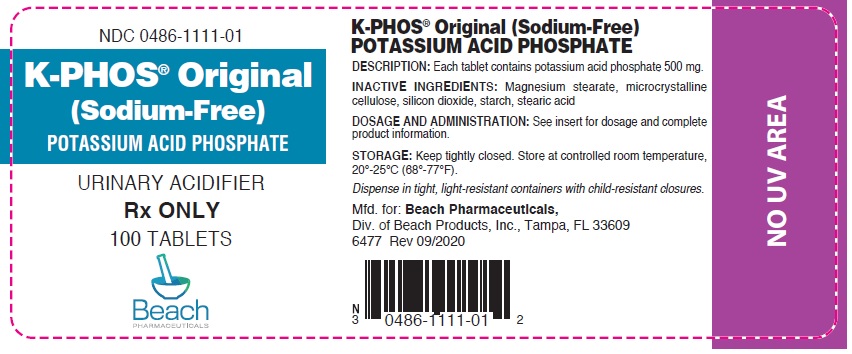
Principal Display Panel 100 Tablet Bottle Label
NDC 0486-1111-01
K-PHOS® Original
(Sodium-Free)
POTASSIUM ACID PHOSPHATE
URINARY ACIDIFIER
Rx ONLY
100 TABLETS
Beach
PHARMACEUTICALS
PRINCIPAL DISPLAY PANEL - 500 Tablet Bottle Label
NDC 0486-1111-05
K-PHOS® Original
(Sodium-Free)
POTASSIUM ACID PHOSPHATE
URINARY ACIDIFIER
Rx ONLY
500 TABLETS
Beach
PHARMACEUTICALS
Carcinogenesis, Mutagenesis, Impairment of Fertility
No long-term or reproduction studies in animals or humans have been performed with K-PHOS® ORIGINAL to evaluate its carcinogenic, mutagenic, or impairment of fertility potential.
Structured Label Content
Dosage and Administration (DOSAGE AND ADMINISTRATION)
Two tablets dissolved in 6-8 oz. of water 4 times daily with meals and at bedtime. For best results, let the tablets soak in water for 2 to 5 minutes, or more if necessary, and stir. If any tablet particles remain undissolved, they may be crushed and stirred vigorously to speed dissolution.
Contraindications (CONTRAINDICATIONS)
This product is contraindicated in patients with infected phosphate stones; in patients with severely impaired renal function (less than 30% of normal) and in the presence of hyperphosphatemia and hyperkalemia.
Adverse Reactions (ADVERSE REACTIONS)
Gastrointestinal upset (diarrhea, nausea, stomach pain, and vomiting) may occur with the use of potassium phosphate. Also, bone and joint pain (possible phosphate-induced osteomalacia) could occur. The following adverse effects may be observed with potassium administration: irregular heartbeat; dizziness; mental confusion; weakness or heaviness of legs; unusual tiredness; muscle cramps; numbness, tingling, pain, or weakness in hands or feet; numbness or tingling around lips; shortness of breath or troubled breathing.
Drug Interactions
The use of antacids containing magnesium, calcium, or aluminum in conjunction with phosphate preparations may bind the phosphate and prevent its absorption. Potassium-containing medications or potassium-sparing diuretics may cause hyperkalemia when used concurrently with potassium salts. Patients should have serum potassium level determinations at periodic intervals. Concurrent use of salicylates may lead to increased serum salicylate levels since excretion of salicylates is reduced in acidified urine. Serum salicylate levels should be closely monitored to avoid toxicity.
How Supplied (HOW SUPPLIED)
White, scored tablet with the name BEACH and the number 1111 imprinted on each tablet. Bottles of 100 (NDC 0486-1111-01) and bottles of 500 (NDC 0486-1111-05) tablets.
Description (DESCRIPTION)
Each tablet contains potassium acid phosphate 500 mg. Each tablet yields approximately 114 mg of phosphorus and 144 mg of potassium or 3.7 mEq.
Inactive ingredients: Magnesium stearate, microcrystalline cellulose, silicon dioxide, starch, stearic acid.
Section 42229-5 (42229-5)
Rx ONLY
Actions (ACTIONS)
K-PHOS® ORIGINAL is a highly effective sodium-free urinary acidifier.
General
This product contains potassium and should be used with caution if regulation of this element is desired. Occasionally, some individuals may experience a mild laxative effect during the first few days of phosphate therapy. If laxation persists to an unpleasant degree, reduce the daily dosage until this effect subsides or, if necessary, discontinue the use of this product.
Caution should be exercised when prescribing this product in the following conditions: Cardiac disease (particularly in digitalized patients); severe adrenal insufficiency (Addison's disease); acute dehydration; severe renal insufficiency or chronic renal disease; extensive tissue breakdown (such as severe burns); myotonia congenita; hypoparathyroidism; and acute pancreatitis. Rickets may benefit from phosphate therapy, but caution should be exercised. High serum phosphate levels may increase the incidence of extra-skeletal calcification.
Storage (STORAGE)
Keep tightly closed. Store at controlled room temperature, 20°-25°C (68°-77°F).
Dispense in tight, light-resistant containers with child-resistant closures.
Nursing Mothers
It is not known whether this drug is excreted in human milk. Because many drugs are excreted in human milk, caution should be exercised when this product is administered to a nursing woman.
Laboratory Tests
Careful monitoring of renal function and serum calcium, phosphorus and potassium may be required at periodic intervals during potassium phosphate therapy. Other tests may be warranted in some patients, depending on conditions.
Indicatons and Usage (INDICATONS AND USAGE)
For use in patients with elevated urinary pH. K-PHOS® ORIGINAL helps keep calcium soluble and reduces odor and rash caused by ammoniacal urine. Also, by acidifying the urine, it increases the antibacterial activity of methenamine mandelate and methenamine hippurate.
Pregnancy Category C
Animal reproduction studies have not been conducted with K-PHOS® ORIGINAL. It is also not known whether this product can cause fetal harm when administered to a pregnant woman or can affect reproductive capacity. This product should be given to a pregnant woman only if clearly needed.
Information for Patients
Patients with kidney stones may pass old stones when phosphate therapy is started and should be warned of this possibility. Patients should be advised to avoid the use of antacids containing aluminum, calcium, or magnesium, which may prevent the absorption of phosphate. To assure against gastrointestinal injury associated with oral ingestion of concentrated potassium salt preparations, patients should be instructed to dissolve tablets completely in an appropriate amount of water before taking.
Principal Display Panel 100 Tablet Bottle Label (PRINCIPAL DISPLAY PANEL - 100 Tablet Bottle Label)
NDC 0486-1111-01
K-PHOS® Original
(Sodium-Free)
POTASSIUM ACID PHOSPHATE
URINARY ACIDIFIER
Rx ONLY
100 TABLETS
Beach
PHARMACEUTICALS
PRINCIPAL DISPLAY PANEL - 500 Tablet Bottle Label
NDC 0486-1111-05
K-PHOS® Original
(Sodium-Free)
POTASSIUM ACID PHOSPHATE
URINARY ACIDIFIER
Rx ONLY
500 TABLETS
Beach
PHARMACEUTICALS
Carcinogenesis, Mutagenesis, Impairment of Fertility
No long-term or reproduction studies in animals or humans have been performed with K-PHOS® ORIGINAL to evaluate its carcinogenic, mutagenic, or impairment of fertility potential.
Advanced Ingredient Data
Raw Label Data
All Sections (JSON)
Additional Information
Back to search View SPL set listing Open on DailyMed ↗
Source: dailymed · Ingested: 2026-02-15T11:37:56.357645 · Updated: 2026-03-14T21:52:37.739890